QUESTION IMAGE
Question
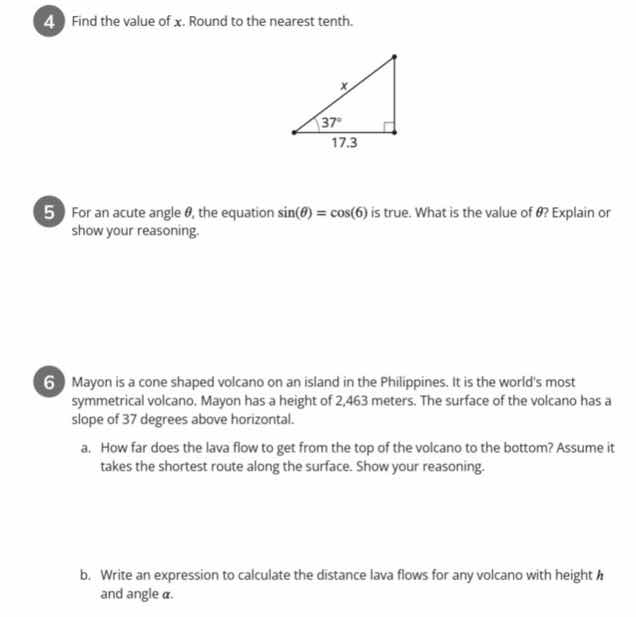
4 find the value of x. round to the nearest tenth.
5 for an acute angle \\( \theta \\), the equation \\( \sin(\theta) = \cos(6) \\) is true. what is the value of \\( \theta \\)? explain or show your reasoning.
6 mayon is a cone shaped volcano on an island in the philippines. it is the world’s most symmetrical volcano. mayon has a height of 2,463 meters. the surface of the volcano has a slope of 37 degrees above horizontal.
a. how far does the lava flow to get from the top of the volcano to the bottom? assume it takes the shortest route along the surface. show your reasoning.
b. write an expression to calculate the distance lava flows for any volcano with height \\( h \\) and angle \\( \alpha \\).
Question 4
Step1: Identify trigonometric ratio
We have a right triangle with adjacent side \( 17.3 \) and angle \( 37^\circ \), and hypotenuse \( x \). The cosine ratio is \( \cos(\theta)=\frac{\text{adjacent}}{\text{hypotenuse}} \), so \( \cos(37^\circ)=\frac{17.3}{x} \).
Step2: Solve for \( x \)
Rearrange the formula: \( x = \frac{17.3}{\cos(37^\circ)} \). Calculate \( \cos(37^\circ)\approx0.8 \) (using calculator approximation). Then \( x=\frac{17.3}{0.8}\approx21.6 \) (rounded to nearest tenth).
We know the co - function identity \( \sin(\theta)=\cos(90^\circ - \theta) \). Given \( \sin(\theta)=\cos(6) \) (assuming the angle is in degrees), so \( \theta = 90^\circ-6^\circ = 84^\circ \)? Wait, maybe the equation is \( \sin(\theta)=\cos(\theta) \). If \( \sin(\theta)=\cos(\theta) \), then \( \tan(\theta) = 1 \), and for acute \( \theta \), \( \theta = 45^\circ \) because \( \tan(45^\circ)=1 \) and \( \sin(45^\circ)=\cos(45^\circ)=\frac{\sqrt{2}}{2} \).
Step1: Identify the triangle
The volcano is a cone, so the cross - section is a right triangle with height \( h = 2463 \) m (opposite side to angle \( 37^\circ \)) and the distance along the surface is the hypotenuse \( d \). We use the sine ratio \( \sin(\alpha)=\frac{\text{opposite}}{\text{hypotenuse}} \), where \( \alpha = 37^\circ \), opposite \( = 2463 \), hypotenuse \( = d \).
Step2: Solve for \( d \)
\( \sin(37^\circ)=\frac{2463}{d} \), so \( d=\frac{2463}{\sin(37^\circ)} \). \( \sin(37^\circ)\approx0.6 \), then \( d=\frac{2463}{0.6}=4105 \) m (approximate, more accurately with calculator \( \sin(37^\circ)\approx0.6018 \), \( d=\frac{2463}{0.6018}\approx4093 \) m, but using \( \sin(37^\circ)\approx0.6 \) for simplicity).

Snap & solve any problem in the app
Get step-by-step solutions on Sovi AI
Photo-based solutions with guided steps
Explore more problems and detailed explanations
\( x\approx21.6 \)