QUESTION IMAGE
Question
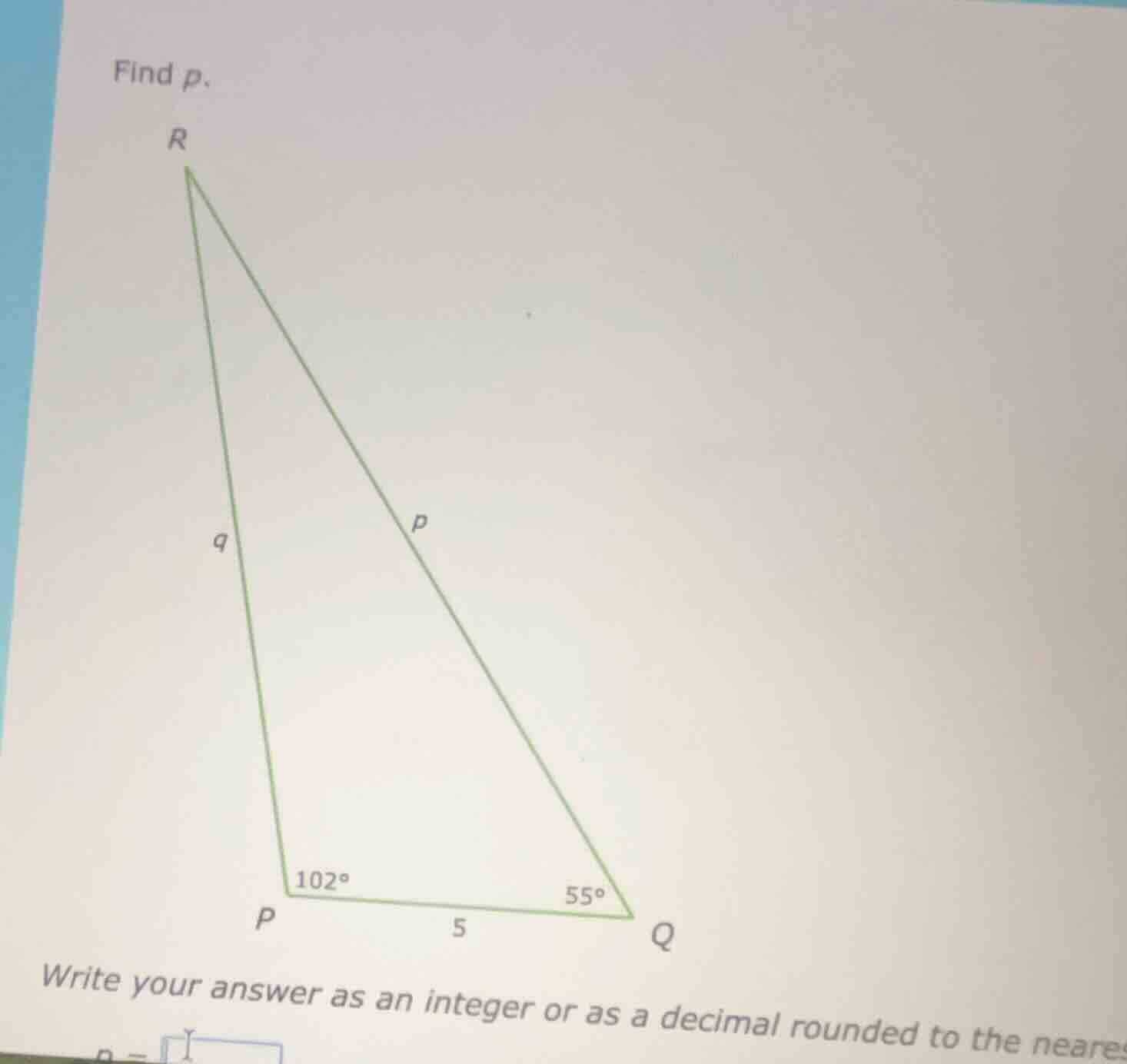
find p.
write your answer as an integer or as a decimal rounded to the neare
Step1: Find angle at R
The sum of angles in a triangle is \(180^\circ\). So, \(\angle R = 180^\circ - 102^\circ - 55^\circ = 23^\circ\).
Step2: Apply the Law of Sines
The Law of Sines states that \(\frac{p}{\sin P}=\frac{PQ}{\sin R}\). Here, \(PQ = 5\), \(\angle P = 102^\circ\), \(\angle R = 23^\circ\). So, \(\frac{p}{\sin 102^\circ}=\frac{5}{\sin 23^\circ}\).
Step3: Solve for p
\(p=\frac{5\times\sin 102^\circ}{\sin 23^\circ}\). Calculate \(\sin 102^\circ\approx0.9781\) and \(\sin 23^\circ\approx0.3907\). Then \(p=\frac{5\times0.9781}{0.3907}\approx\frac{4.8905}{0.3907}\approx12.52\). Rounding to the nearest whole number (or as needed), but let's check the calculation again. Wait, maybe I mixed up the angles. Wait, Law of Sines: \(\frac{a}{\sin A}=\frac{b}{\sin B}=\frac{c}{\sin C}\). So side opposite angle P is \(RQ = p\), side opposite angle Q is \(PR = q\), side opposite angle R is \(PQ = 5\). So angle P is \(102^\circ\), opposite side \(p\); angle Q is \(55^\circ\), opposite side \(q\); angle R is \(23^\circ\), opposite side \(5\). Wait, no, I think I messed up. Wait, angle at P is \(102^\circ\), so side opposite is \(RQ = p\); angle at Q is \(55^\circ\), side opposite is \(PR = q\); angle at R is \(23^\circ\), side opposite is \(PQ = 5\). So Law of Sines: \(\frac{p}{\sin P}=\frac{PQ}{\sin R}\). So \(p = \frac{PQ\times\sin P}{\sin R}=\frac{5\times\sin 102^\circ}{\sin 23^\circ}\). Let's compute \(\sin 102^\circ\approx0.9781\), \(\sin 23^\circ\approx0.3907\). So \(5\times0.9781 = 4.8905\), divided by \(0.3907\) is approximately \(12.52\), which rounds to \(13\) or maybe I made a mistake in angle assignment. Wait, maybe the side \(PQ = 5\) is between P and Q, so angle at P is \(102^\circ\), angle at Q is \(55^\circ\), so angle at R is \(23^\circ\). Then side opposite angle Q (55°) is PR, side opposite angle P (102°) is RQ (p), side opposite angle R (23°) is PQ (5). So Law of Sines: \(\frac{p}{\sin 102^\circ}=\frac{5}{\sin 23^\circ}\). So \(p = \frac{5\sin 102^\circ}{\sin 23^\circ}\). Let's calculate \(\sin 102^\circ\approx0.9781\), \(\sin 23^\circ\approx0.3907\). So \(5\times0.9781 = 4.8905\), \(4.8905\div0.3907\approx12.52\), so approximately \(12.5\) or \(13\). Wait, maybe I had the angle wrong. Wait, maybe the angle at P is \(102^\circ\), angle at Q is \(55^\circ\), so angle at R is \(23^\circ\). Alternatively, maybe I should use angle Q. Wait, no, let's re-express. Let's denote:
- \( \angle P = 102^\circ \)
- \( \angle Q = 55^\circ \)
- \( \angle R = 180 - 102 - 55 = 23^\circ \)
- \( PQ = 5 \) (side opposite \( \angle R \))
- \( RQ = p \) (side opposite \( \angle P \))
So by Law of Sines:
\( \frac{p}{\sin \angle P} = \frac{PQ}{\sin \angle R} \)
So \( p = \frac{PQ \times \sin \angle P}{\sin \angle R} \)
Substitute the values:
\( PQ = 5 \), \( \angle P = 102^\circ \), \( \angle R = 23^\circ \)
\( \sin 102^\circ \approx 0.9781 \)
\( \sin 23^\circ \approx 0.3907 \)
\( p = \frac{5 \times 0.9781}{0.3907} \approx \frac{4.8905}{0.3907} \approx 12.52 \)
So rounding to the nearest tenth, it's \(12.5\), or to the nearest whole number, \(13\). But let's check with another approach. Wait, maybe I mixed up the angles. Wait, if angle at P is \(102^\circ\), angle at Q is \(55^\circ\), then angle at R is \(23^\circ\). So side opposite angle Q (55°) is PR, side opposite angle P (102°) is RQ (p), side opposite angle R (23°) is PQ (5). So yes, Law of Sines is correct. So the calculation gives approximately \(12.5\), which can be rounded to \(13\) or \(12.5\) depending on the requirement. But let's do the calculation more accuratel…

Snap & solve any problem in the app
Get step-by-step solutions on Sovi AI
Photo-based solutions with guided steps
Explore more problems and detailed explanations
\(12.5\) (or \(13\) if rounded to nearest integer)