QUESTION IMAGE
Question
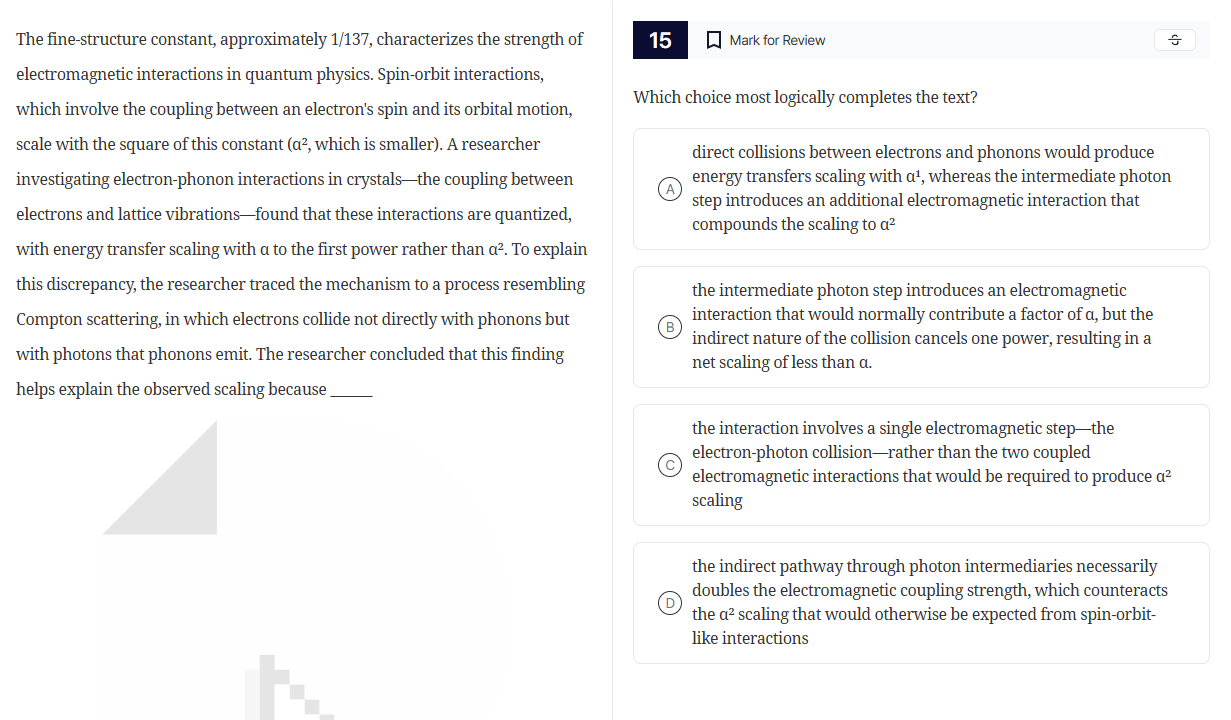
the fine - structure constant, approximately 1/137, characterizes the strength of electromagnetic interactions in quantum physics. spin - orbit interactions, which involve the coupling between an electrons spin and its orbital motion, scale with the square of this constant ($alpha^{2}$, which is smaller). a researcher investigating electron - phonon interactions in crystals—the coupling between electrons and lattice vibrations—found that these interactions are quantized, with energy transfer scaling with $alpha$ to the first power rather than $alpha^{2}$. to explain this discrepancy, the researcher traced the mechanism to a process resembling compton scattering, in which electrons collide not directly with phonons but with photons that phonons emit. the researcher concluded that this finding helps explain the observed scaling because ____
15 □ mark for review
which choice most logically completes the text?
a direct collisions between electrons and phonons would produce energy transfers scaling with $alpha^{1}$, whereas the intermediate photon step introduces an additional electromagnetic interaction that compounds the scaling to $alpha^{2}$
b the intermediate photon step introduces an electromagnetic interaction that would normally contribute a factor of $alpha$, but the indirect nature of the collision cancels one power, resulting in a net scaling of less than $alpha$.
c the interaction involves a single electromagnetic step—the electron - photon collision—rather than the two coupled electromagnetic interactions that would be required to produce $alpha^{2}$ scaling
d the indirect pathway through photon intermediaries necessarily doubles the electromagnetic coupling strength, which counteracts the $alpha^{2}$ scaling that would otherwise be expected from spin - orbit - like interactions
To solve this, we analyze the text and options:
- The problem is about electron - phonon interactions and their energy transfer scaling. The key is to find why the scaling is $\alpha$ instead of $\alpha^{2}$.
- Option A: Talks about direct collisions scaling with $\alpha^{1}$ and an additional step compounding to $\alpha^{2}$, which doesn't explain the $\alpha$ scaling. Eliminate A.
- Option B: Says the net scaling is less than $\alpha$, but the text says the scaling is $\alpha$ (not less). Eliminate B.
- Option C: The interaction here has a single electromagnetic step (electron - photon collision) instead of two steps (which would give $\alpha^{2}$). This explains why the scaling is $\alpha$ (since one step gives $\alpha$ instead of two steps giving $\alpha^{2}$).
- Option D: Says the indirect pathway doubles the coupling strength, which would not lead to $\alpha$ scaling. Eliminate D.

Snap & solve any problem in the app
Get step-by-step solutions on Sovi AI
Photo-based solutions with guided steps
Explore more problems and detailed explanations
C. the interaction involves a single electromagnetic step—the electron - photon collision—rather than the two coupled electromagnetic interactions that would be required to produce $\alpha^{2}$ scaling