QUESTION IMAGE
Question
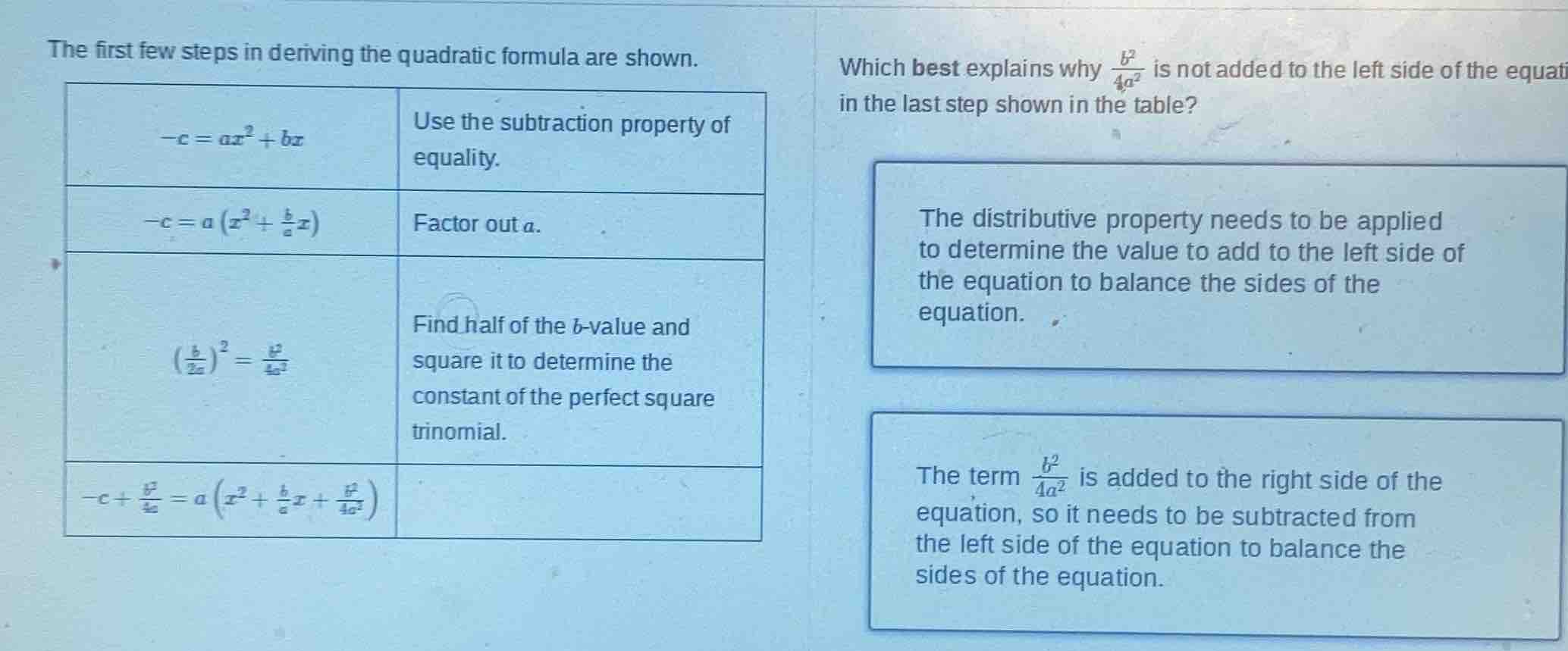
the first few steps in deriving the quadratic formula are shown.
| $-c = ax^2 + bx$ | use the subtraction property of equality. |
| $-c = a\left(x^2 + \frac{b}{a}x\
ight)$ | factor out $a$. |
| $\left(\frac{b}{2a}\
ight)^2 = \frac{b^2}{4a^2}$ | find half of the $b$-value and square it to determine the constant of the perfect square trinomial. |
| $-c + \frac{b^2}{4a} = a\left(x^2 + \frac{b}{a}x + \frac{b^2}{4a^2}\
ight)$ | |
which best explains why $\frac{b^2}{4a^2}$ is not added to the left side of the equati in the last step shown in the table?
- the distributive property needs to be applied to determine the value to add to the left side of the equation to balance the sides of the equation.
- the term $\frac{b^2}{4a^2}$ is added to the right side of the equation, so it needs to be subtracted from the left side of the equation to balance the sides of the equation.
To balance the equation when completing the square, we analyze the left and right sides. The right side has a factored out \( a \), so when we add \( \frac{b^2}{4a^2} \) inside the parentheses on the right, we are actually adding \( a\times\frac{b^2}{4a^2}=\frac{b^2}{4a} \) to the right side (by the distributive property). On the left side, we add \( \frac{b^2}{4a} \) (not \( \frac{b^2}{4a^2} \)) to balance it. The first explanation about the distributive property determining the value to add to the left to balance is correct. The second explanation is wrong because we don't subtract from the left; we add the correct value based on the distributive property's effect on the right side.

Snap & solve any problem in the app
Get step-by-step solutions on Sovi AI
Photo-based solutions with guided steps
Explore more problems and detailed explanations
The first explanation (The distributive property needs to be applied to determine the value to add to the left side of the equation to balance the sides of the equation.)