QUESTION IMAGE
Question
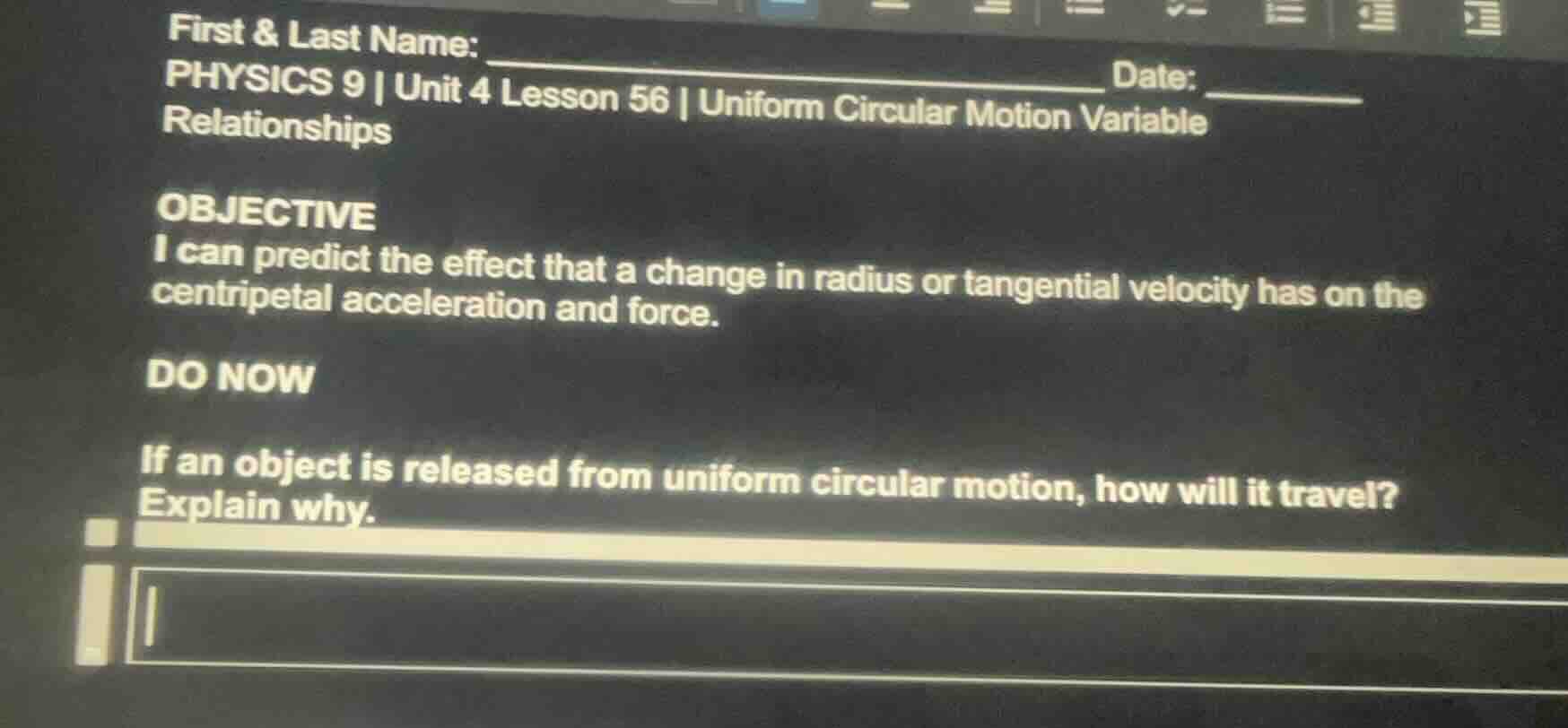
first & last name: date: physics 9 | unit 4 lesson 56 | uniform circular motion variable relationships objective i can predict the effect that a change in radius or tangential velocity has on the centripetal acceleration and force. do now if an object is released from uniform circular motion, how will it travel? explain why.
In uniform circular motion, the object moves in a circle due to a centripetal force (or net force) that keeps it changing direction (toward the center). When released, this centripetal force/constraint is removed. By Newton's First Law (Law of Inertia), an object in motion will continue in motion with a constant velocity (same speed and direction) unless acted upon by a net external force. At the moment of release, the object's velocity is tangential to the circular path (since that's the instantaneous direction of motion in circular motion). So, it will travel in a straight - line path that is tangent to the point of release on the circular path, with the speed it had at the moment of release (assuming no other forces like air resistance act significantly immediately after release).

Snap & solve any problem in the app
Get step-by-step solutions on Sovi AI
Photo-based solutions with guided steps
Explore more problems and detailed explanations
When an object is released from uniform circular motion, it will travel in a straight - line path that is tangent to the circular path at the point of release. This occurs because of Newton's First Law of Motion (Law of Inertia): an object in motion will maintain its state of motion (constant velocity, which includes both speed and direction) unless a net external force acts on it. In uniform circular motion, the centripetal force (net force) acts to change the object's direction (toward the center of the circle) to keep it moving in a circle. When this centripetal force is removed (upon release), the object continues moving with the velocity it had at the instant of release. At any point in uniform circular motion, the object's velocity is tangential to the circular path, so it will move along the tangent line at the point of release.