QUESTION IMAGE
Question
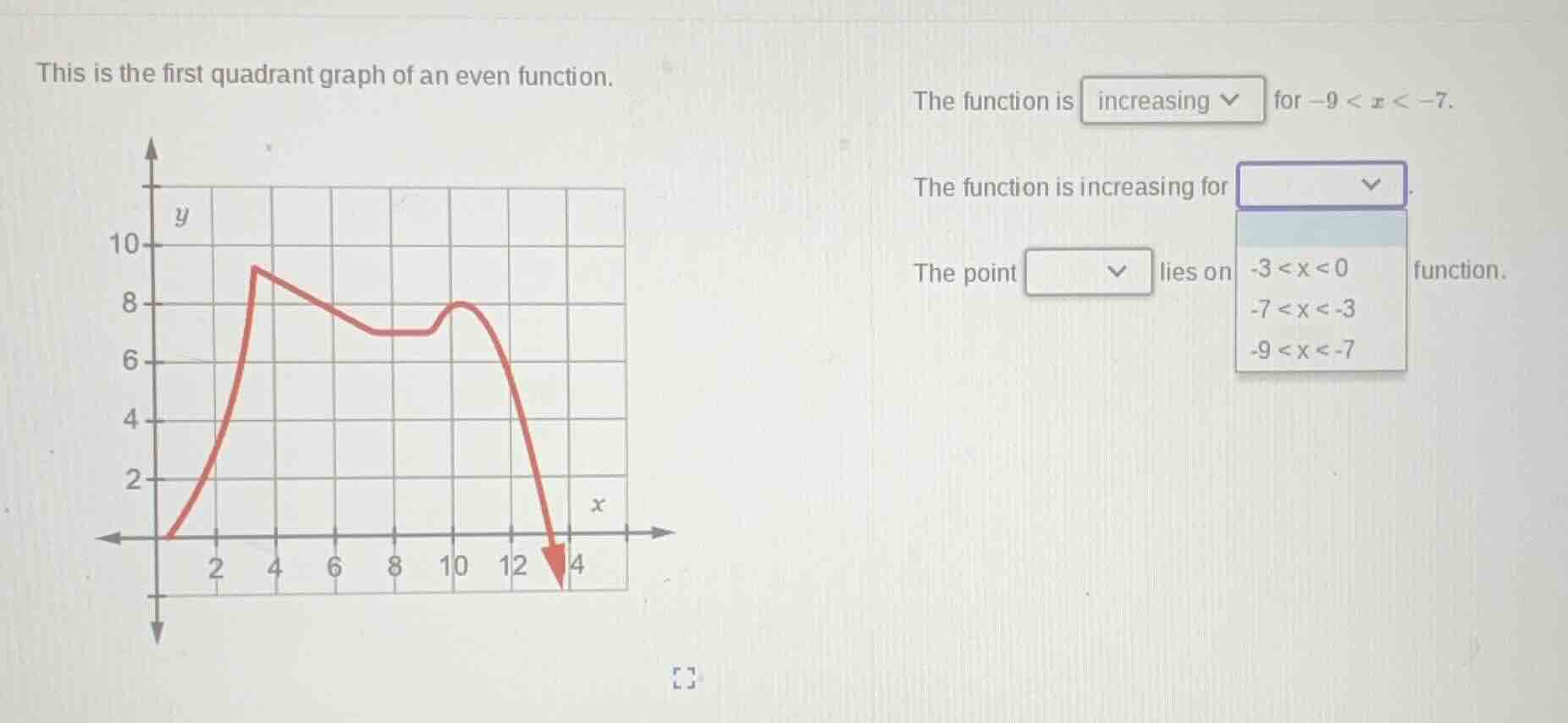
this is the first quadrant graph of an even function. the function is increasing for -9 < x < -7. the function is increasing for dropdown. the point dropdown lies on function. dropdown options: -3 < x < 0, -7 < x < -3, -9 < x < -7
Response
Part 1: Determining where the function is increasing (for the second dropdown)
- Recall the property of an even function: \( f(-x) = f(x) \), which means the graph is symmetric about the \( y \)-axis.
- In the first quadrant (given graph), we analyze the increasing/decreasing intervals. The graph in the first quadrant ( \( x>0 \)): let's see the intervals. For \( x>0 \), when is the function increasing? Looking at the graph, from \( x = 0 \) to \( x = 4 \) (approx), the function is increasing (since as \( x \) increases from 0 to 4, \( y \) increases). By symmetry of even function, the interval for \( x<0 \) that corresponds to \( x>0 \) increasing ( \( 0 < x < 4 \)) will be \( -4 < x < 0 \)? Wait, no, wait the options are \( -3 < x < 0 \), \( -7 < x < -3 \), \( -9 < x < -7 \). Wait, maybe I misread. Wait the first quadrant graph: let's check the \( x \)-axis. The graph starts at (0,0), goes up to (4,9) maybe, then decreases. Wait the options for the second dropdown: the intervals are \( -3 < x < 0 \), \( -7 < x < -3 \), \( -9 < x < -7 \). Wait, the first part says the function is increasing for \( -9 < x < -7 \). Let's think about symmetry. For an even function, the behavior on \( x>0 \) is mirrored on \( x<0 \) (reflected over \( y \)-axis). So if on \( x>0 \), the function is increasing on some interval, then on \( x<0 \), it's increasing on the interval \( -a < x < 0 \) where \( a \) is the positive interval. Wait, looking at the first quadrant graph: from \( x = 0 \) to \( x = 4 \) (maybe), the function is increasing. So the symmetric interval on \( x<0 \) would be \( -4 < x < 0 \). But the options have \( -3 < x < 0 \). Wait maybe the graph in first quadrant: let's check the grid. The \( x \)-axis has marks at 2,4,6,8,10,12,14? Wait the arrow is at 14? Wait the graph in first quadrant: starts at (0,0), goes up to (4,9) (since at x=4, y is 9), then decreases. So for \( x>0 \), increasing on \( 0 < x < 4 \). By even function symmetry, \( f(x) = f(-x) \), so the derivative (if we think about increasing/decreasing) on \( x<0 \): the function is increasing on \( -4 < x < 0 \) (since \( f(-x) \) increasing when \( -x \) is in \( 0 < -x < 4 \) i.e., \( -4 < x < 0 \)). But the options have \( -3 < x < 0 \). Maybe the grid is such that the increasing on \( x>0 \) is up to x=3? Wait the options are \( -3 < x < 0 \), \( -7 < x < -3 \), \( -9 < x < -7 \). Wait the first part: the function is increasing for \( -9 < x < -7 \). Let's see the first quadrant graph: when is the function increasing on \( x>0 \) that would correspond to \( -9 < x < -7 \) on \( x<0 \)? Wait \( -9 < x < -7 \) on \( x<0 \) corresponds to \( 7 < x < 9 \) on \( x>0 \). But on \( x>0 \), from x=0 to x=4, it's increasing; then decreasing, then maybe a small increase? Wait the graph: after x=4, it decreases until x=8, then has a flat part, then a small increase at x=10, then decreases. Wait maybe I made a mistake. Wait the first dropdown was "increasing" for \( -9 < x < -7 \). So for \( -9 < x < -7 \) (x negative), the function is increasing. By symmetry, on \( x>0 \), the corresponding interval is \( 7 < x < 9 \). But on \( x>0 \), is the function increasing on \( 7 < x < 9 \)? Looking at the graph, from x=8 to x=10, there's a flat part then a small increase. Wait maybe the second dropdown: the function is increasing for \( -3 < x < 0 \)? Wait no, let's re-express. For an even function, the graph is symmetric about y-axis. So if on \( x>0 \), the function is increasing on \( 0 < x < 4 \), then on \( x<0 \), it's increasing on \( -4 < x < 0 \). The option \( -3 < x < 0 \) is within \( -4 < x < 0 \), so that's a possible interval. Wait the other op…

Snap & solve any problem in the app
Get step-by-step solutions on Sovi AI
Photo-based solutions with guided steps
Explore more problems and detailed explanations
(for the second dropdown):
\( -3 < x < 0 \)
(For the third dropdown, following the same logic, the interval where the point lies (on the increasing part) is also \( -3 < x < 0 \), assuming the question refers to a point on the increasing segment.)