QUESTION IMAGE
Question
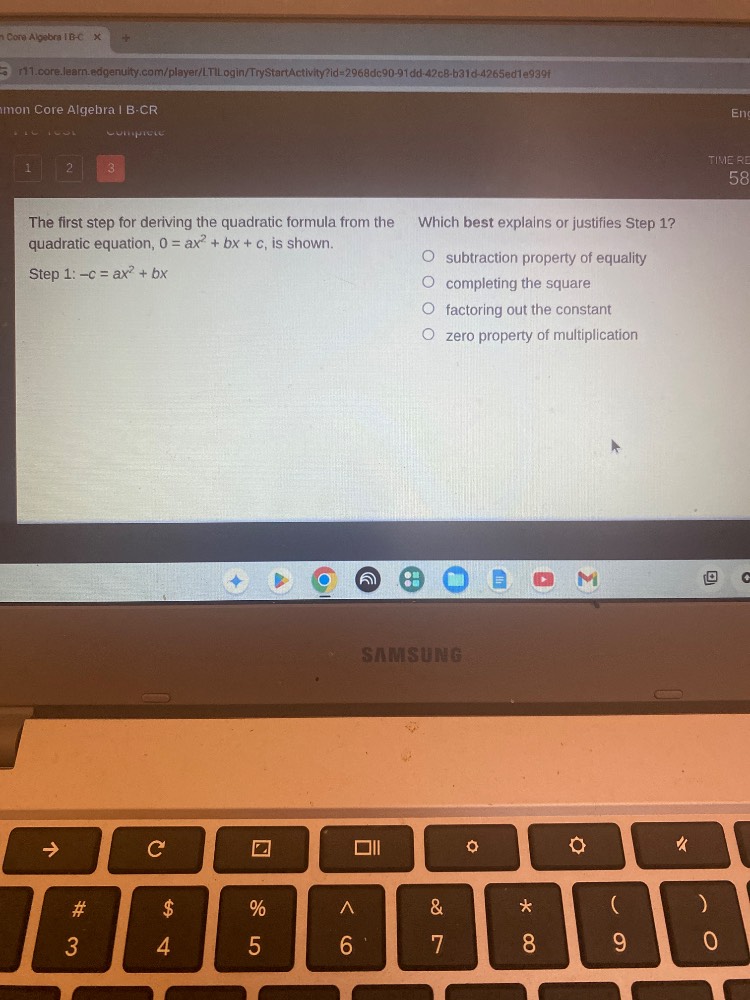
the first step for deriving the quadratic formula from the quadratic equation, $0 = ax^2 + bx + c$, is shown. step 1: $-c = ax^2 + bx$ which best explains or justifies step 1? \bigcirc subtraction property of equality \bigcirc completing the square \bigcirc factoring out the constant \bigcirc zero property of multiplication
Brief Explanations
To determine the justification for Step 1 (\(-c = ax^2 + bx\)) from the quadratic equation \(0 = ax^2 + bx + c\), we analyze each option:
- Subtraction property of equality: This property states that if we subtract the same quantity from both sides of an equation, the equation remains true. Here, we subtract \(c\) from both sides of \(0 = ax^2 + bx + c\): \(0 - c=ax^2 + bx + c - c\), which simplifies to \(-c = ax^2 + bx\). This matches the operation.
- Completing the square: Completing the square involves manipulating the quadratic to form a perfect square trinomial, which is not done in this first step.
- Factoring out the constant: Factoring out a constant would involve extracting a common factor from terms, which is not what is happening here (we are not factoring, but rather isolating terms).
- Zero property of multiplication: This property relates to products being zero (if \(ab = 0\), then \(a = 0\) or \(b = 0\)), which is not relevant to this step.
So the subtraction property of equality justifies Step 1.

Snap & solve any problem in the app
Get step-by-step solutions on Sovi AI
Photo-based solutions with guided steps
Explore more problems and detailed explanations
subtraction property of equality