QUESTION IMAGE
Question
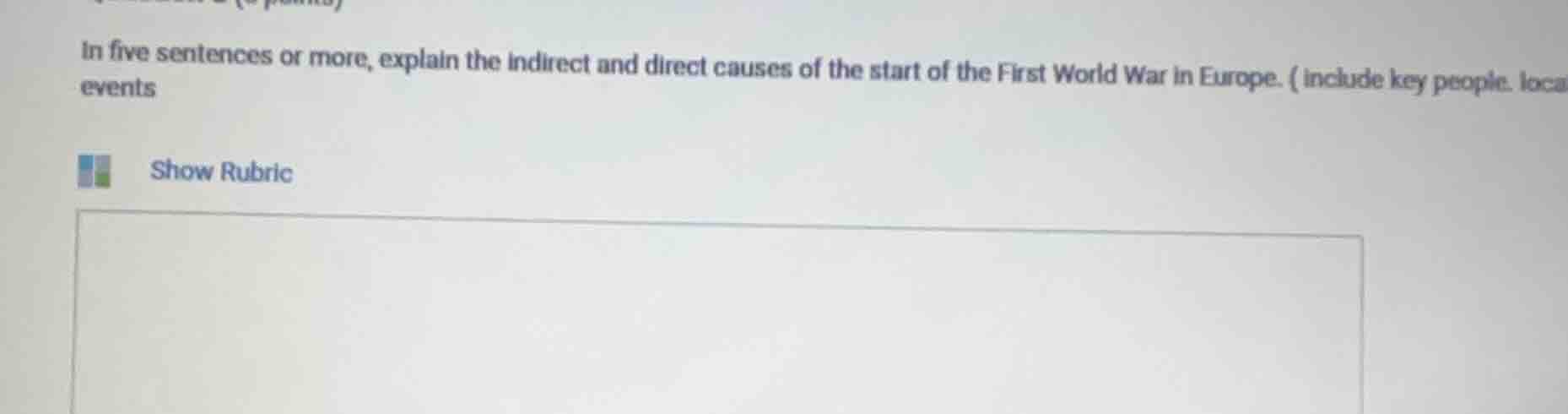
in five sentences or more, explain the indirect and direct causes of the start of the first world war in europe. ( include key people, local events
show rubric
The indirect causes of World War I in Europe laid the long-term groundwork for conflict, starting with the system of entangling alliances that split the continent into two hostile blocs: the Triple Entente (Britain, France, Russia) and the Triple Alliance (Germany, Austria-Hungary, Italy). Imperial rivalry also fueled tension, as major powers competed fiercely for colonies and global influence, with Germany challenging Britain's naval dominance through a large-scale shipbuilding program. Nationalism was another critical indirect cause; ethnic groups in multi-ethnic empires like Austria-Hungary (such as Serbs in Bosnia) demanded self-determination, creating internal instability and cross-border tensions. Militarism amplified these risks, as all major powers expanded their armies, adopted aggressive war plans (like Germany's Schlieffen Plan), and glorified military strength, making armed conflict seem increasingly inevitable.
The direct cause of the war was the assassination of Archduke Franz Ferdinand, heir to the Austro-Hungarian throne, and his wife Sophie in Sarajevo on June 28, 1914, by Gavrilo Princip, a young Serbian nationalist affiliated with the secret group the Black Hand. Austria-Hungary held Serbia responsible for the attack, and with unconditional support from Germany (the "blank check"), issued an ultimatum to Serbia on July 23, 1914, with demands so harsh that full compliance was nearly impossible. When Serbia accepted most terms but rejected a few that violated its sovereignty, Austria-Hungary declared war on Serbia on July 28, 1914. The alliance system then triggered a chain reaction: Russia mobilized its army to support Serbia, Germany declared war on Russia on August 1 and on France on August 3, and when Germany invaded neutral Belgium to execute the Schlieffen Plan, Britain declared war on Germany on August 4, officially launching the global conflict.

Snap & solve any problem in the app
Get step-by-step solutions on Sovi AI
Photo-based solutions with guided steps
Explore more problems and detailed explanations
The indirect causes of World War I in Europe included four key long-term factors:
- Entangling Alliances: The continent was divided into two competing blocs—the Triple Entente (Britain, France, Russia) and the Triple Alliance (Germany, Austria-Hungary, Italy)—ensuring a local conflict would escalate globally.
- Imperial Rivalry: Powers like Germany and Britain clashed over colonial territories and naval supremacy, with Germany's naval buildup threatening Britain's dominance.
- Nationalism: Restive ethnic groups (e.g., Serbs in Austria-Hungary’s Bosnia) pushed for self-rule, destabilizing multi-ethnic empires and stoking cross-border tensions.
- Militarism: All major powers expanded their armies, adopted aggressive war plans (such as Germany’s Schlieffen Plan), and normalized the idea of military conflict as a solution to disputes.
The direct cause was the assassination of Archduke Franz Ferdinand of Austria-Hungary and his wife Sophie on June 28, 1914, in Sarajevo. The killer, Gavrilo Princip, was a Serbian nationalist linked to the secret Black Hand group, which sought to unite Bosnia with Serbia. Backed by Germany’s "blank check" of unconditional support, Austria-Hungary issued an extreme ultimatum to Serbia on July 23, 1914, designed to be rejected. When Serbia accepted most terms but refused clauses violating its sovereignty, Austria-Hungary declared war on Serbia on July 28. The alliance system then triggered a rapid escalation: Russia mobilized to support Serbia, Germany declared war on Russia (August 1) and France (August 3), Germany invaded neutral Belgium to implement the Schlieffen Plan, and Britain declared war on Germany (August 4), officially starting World War I.