QUESTION IMAGE
Question
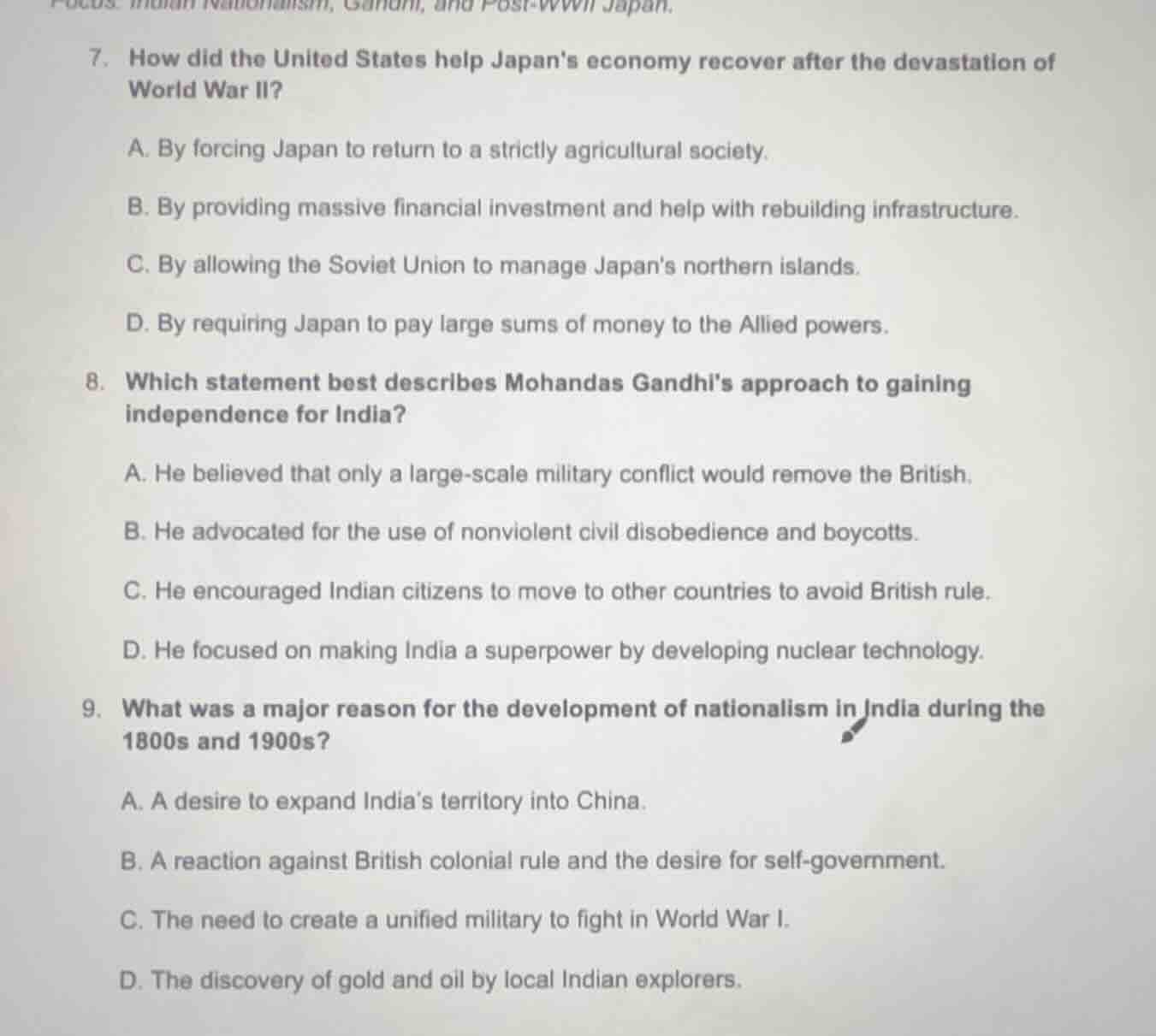
focus: indian nationalism, gandhi, and post - wwii japan.
- how did the united states help japans economy recover after the devastation of world war ii?
a. by forcing japan to return to a strictly agricultural society.
b. by providing massive financial investment and help with rebuilding infrastructure.
c. by allowing the soviet union to manage japans northern islands.
d. by requiring japan to pay large sums of money to the allied powers.
- which statement best describes mohandas gandhis approach to gaining independence for india?
a. he believed that only a large - scale military conflict would remove the british.
b. he advocated for the use of nonviolent civil disobedience and boycotts.
c. he encouraged indian citizens to move to other countries to avoid british rule.
d. he focused on making india a superpower by developing nuclear technology.
- what was a major reason for the development of nationalism in india during the 1800s and 1900s?
a. a desire to expand indias territory into china.
b. a reaction against british colonial rule and the desire for self - government.
c. the need to create a unified military to fight in world war i.
d. the discovery of gold and oil by local indian explorers.
Question 7
- Option A: Forcing Japan to an agricultural society would hinder, not help, economic recovery. Eliminate A.
- Option B: After WWII, the US provided financial aid and helped rebuild Japan's infrastructure (like factories, transportation), which boosted its economy. This is correct.
- Option C: Soviet management of northern islands was a territorial issue, not economic recovery help. Eliminate C.
- Option D: Making Japan pay reparations would hurt its economy, not help recovery. Eliminate D.
- Option A: Gandhi was against violent conflict; he advocated non - violence. Eliminate A.
- Option B: Gandhi's approach was nonviolent civil disobedience (e.g., Salt March) and boycotts (e.g., boycotting British goods) to gain independence. This matches his philosophy.
- Option C: Gandhi encouraged Indians to stay and fight for their rights in India, not emigrate. Eliminate C.
- Option D: Nuclear technology development was not part of Gandhi's time or approach. Eliminate D.
- Option A: India had no desire to expand into China; it was focused on its own independence from Britain. Eliminate A.
- Option B: British colonial rule exploited India's resources and restricted self - governance. The desire for self - rule and reaction against colonial oppression led to nationalism. This is correct.
- Option C: Indian nationalism developed before WWI, and the push for independence was not mainly for WWI military. Eliminate C.
- Option D: There was no major gold or oil discovery by Indian explorers driving nationalism; the main issue was colonial rule. Eliminate D.

Snap & solve any problem in the app
Get step-by-step solutions on Sovi AI
Photo-based solutions with guided steps
Explore more problems and detailed explanations
B. By providing massive financial investment and help with rebuilding infrastructure.