QUESTION IMAGE
Question
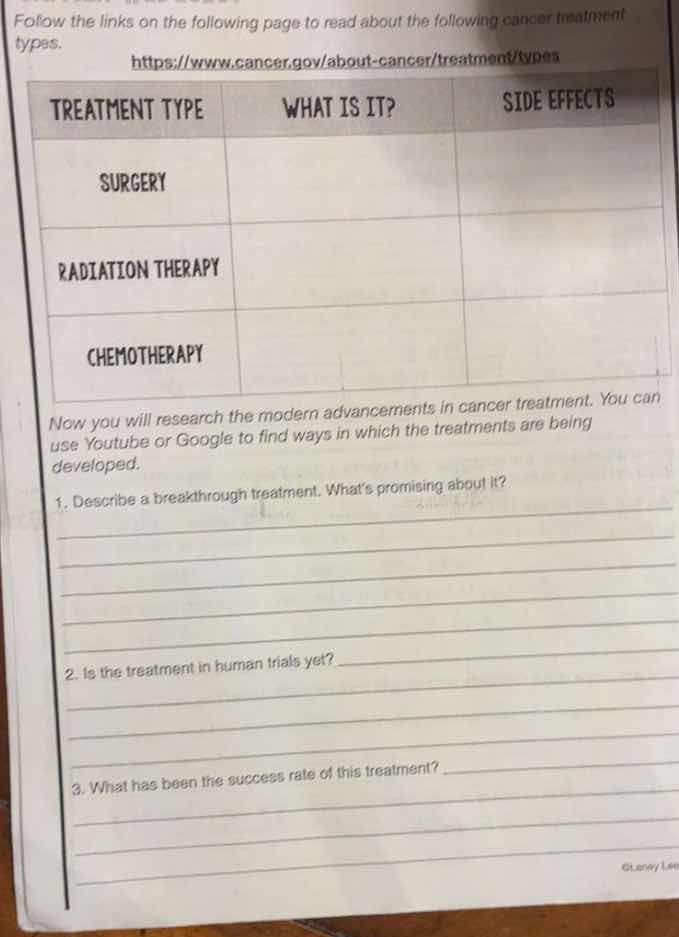
follow the links on the following page to read about the following cancer treatment types.
https://www.cancer.gov/about-cancer/treatment/types
treatment type what is it? side effects
surgery
radiation therapy
chemotherapy
now you will research the modern advancements in cancer treatment. you can use youtube or google to find ways in which the treatments are being developed.
- describe a breakthrough treatment. whats promising about it?
- is the treatment in human trials yet?
- what has been the success rate of this treatment?
©laney lee
Brief Explanations
First, for the table, details are sourced from the provided cancer.gov link. For the breakthrough treatment, CAR T-cell therapy is a leading modern advancement, with data from clinical research summaries.
- Table Completion:
- Surgery: A procedure to remove cancerous tumors/tissue from the body. Side effects include pain, infection risk, scarring, and organ function changes based on the surgery site.
- Radiation Therapy: Uses high-energy beams (like X-rays) to kill cancer cells. Side effects include skin irritation, fatigue, nausea, and damage to nearby healthy tissue.
- Chemotherapy: Uses drugs to kill or slow fast-growing cancer cells throughout the body. Side effects include hair loss, nausea, fatigue, increased infection risk, and nerve damage.
- Breakthrough Treatment: Chimeric Antigen Receptor (CAR) T-cell therapy is a personalized immunotherapy. It modifies a patient's own T-cells in a lab to recognize and attack cancer cells. It is promising because it targets specific cancer cells (reducing healthy cell damage), offers long-term remission for some hard-to-treat cancers, and is a personalized approach tailored to each patient.
- Human Trials Status: CAR T-cell therapy is beyond trials; it has been approved by the FDA for multiple blood cancers (like certain leukemias and lymphomas) since 2017, and ongoing trials are expanding its use to solid tumors.
- Success Rate: For relapsed/refractory B-cell acute lymphoblastic leukemia (ALL) in children and young adults, CAR T-cell therapy has achieved complete remission rates of 70-90% in clinical trials. For relapsed large B-cell lymphoma, complete remission rates are around 40-50%.

Snap & solve any problem in the app
Get step-by-step solutions on Sovi AI
Photo-based solutions with guided steps
Explore more problems and detailed explanations
Completed Table:
| TREATMENT TYPE | WHAT IS IT? | SIDE EFFECTS |
|---|---|---|
| RADIATION THERAPY | High-energy beams to kill cancer cells | Skin irritation, fatigue, nausea, healthy tissue damage near treatment site |
| CHEMOTHERAPY | Systemic drugs to kill fast-growing cancer cells | Hair loss, nausea, fatigue, increased infection risk, nerve damage |
- Breakthrough treatment: CAR T-cell therapy. It is a personalized immunotherapy that engineers a patient's own T-cells to target and destroy their specific cancer cells. It is promising because it delivers targeted, long-lasting remission for some blood cancers that do not respond to other treatments, and avoids widespread damage to healthy cells that comes with chemo/radiation.
- Yes, CAR T-cell therapy is approved for clinical use in humans (for specific blood cancers) and is also in ongoing human trials for expanded use in solid tumors.
- For relapsed/refractory pediatric B-cell ALL: 70-90% complete remission rate. For relapsed large B-cell lymphoma: 40-50% complete remission rate.