QUESTION IMAGE
Question
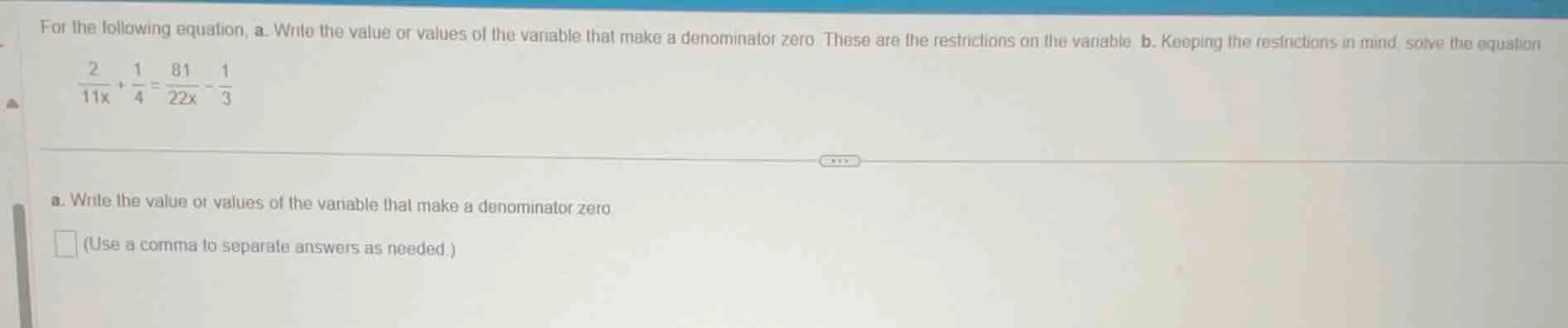
for the following equation, a. write the value or values of the variable that make a denominator zero. these are the restrictions on the variable. b. keeping the restrictions in mind, solve the equation
\\(\frac{2}{11x} + \frac{1}{4} = \frac{81}{22x} - \frac{1}{3}\\)
a. write the value or values of the variable that make a denominator zero.
(use a comma to separate answers as needed.)
Step1: Identify denominators
The denominators in the equation are \(11x\), \(4\), \(22x\), and \(3\). The denominators that contain the variable \(x\) are \(11x\) and \(22x\).
Step2: Find values that make denominators zero
For a denominator \(11x\) to be zero, we set \(11x = 0\), which gives \(x = 0\). For the denominator \(22x\) to be zero, we set \(22x=0\), which also gives \(x = 0\). The denominators \(4\) and \(3\) are constants and never zero. So the value that makes a denominator zero is \(x = 0\).

Snap & solve any problem in the app
Get step-by-step solutions on Sovi AI
Photo-based solutions with guided steps
Explore more problems and detailed explanations
\(0\)