QUESTION IMAGE
Question
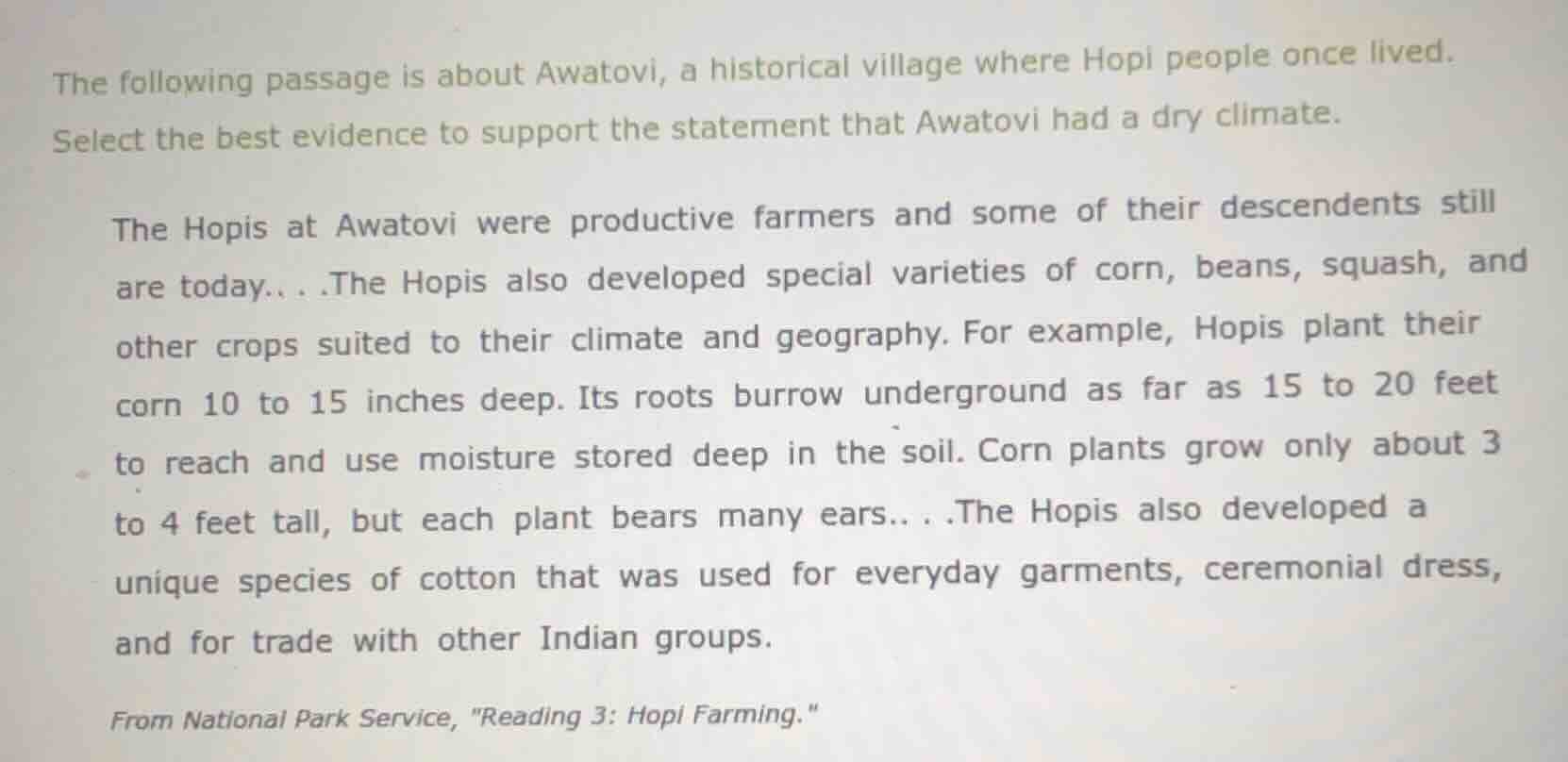
the following passage is about awatovi, a historical village where hopi people once lived. select the best evidence to support the statement that awatovi had a dry climate. the hopis at awatovi were productive farmers and some of their descendents still are today....the hopis also developed special varieties of corn, beans, squash, and other crops suited to their climate and geography. for example, hopis plant their corn 10 to 15 inches deep. its roots burrow underground as far as 15 to 20 feet to reach and use moisture stored deep in the soil. corn plants grow only about 3 to 4 feet tall, but each plant bears many ears....the hopis also developed a unique species of cotton that was used for everyday garments, ceremonial dress, and for trade with other indian groups. from national park service,
eading 3: hopi farming.\
To support the statement that Awatovi had a dry climate, we look for evidence related to how the Hopis' farming practices adapted to limited moisture. The detail about Hopis planting corn 10 to 15 inches deep, with roots burrowing 15 to 20 feet underground to reach stored moisture, shows they needed to access deep - seated moisture, implying surface moisture was scarce, which is characteristic of a dry climate. Other details like crop varieties or cotton development don't directly indicate aridity as clearly as the corn - planting and root - growth information.

Snap & solve any problem in the app
Get step-by-step solutions on Sovi AI
Photo-based solutions with guided steps
Explore more problems and detailed explanations
For example, Hopis plant their corn 10 to 15 inches deep. Its roots burrow underground as far as 15 to 20 feet to reach and use moisture stored deep in the soil.