QUESTION IMAGE
Question
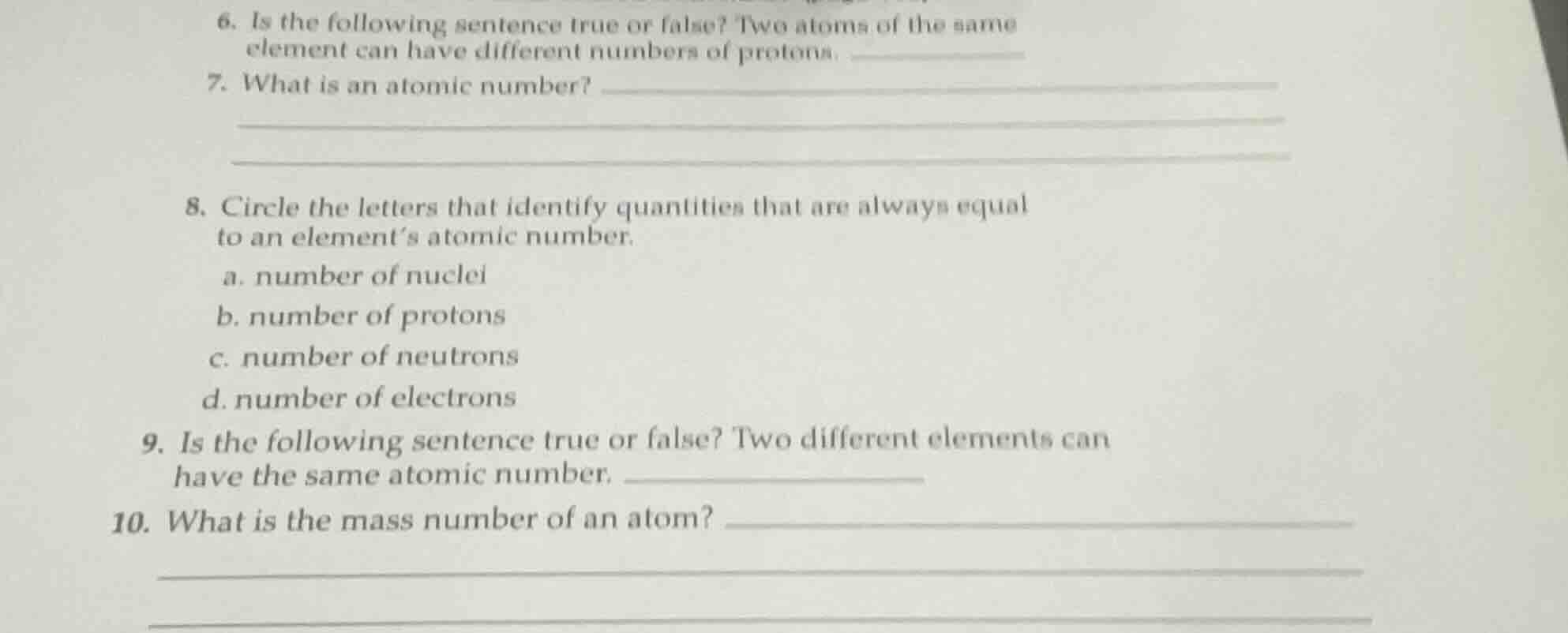
- is the following sentence true or false? two atoms of the same element can have different numbers of protons.
- what is an atomic number?
- circle the letters that identify quantities that are always equal to an element’s atomic number.
a. number of nuclei
b. number of protons
c. number of neutrons
d. number of electrons
- is the following sentence true or false? two different elements can have the same atomic number.
- what is the mass number of an atom?
Response
Question 6
Brief Explanations
The number of protons in an atom defines the element. So, two atoms of the same element must have the same number of protons. Thus, the statement is false.
Brief Explanations
The atomic number of an element is defined as the number of protons present in the nucleus of an atom of that element. It is a unique identifier for each chemical element.
Brief Explanations
- Option a: The number of nuclei is not related to atomic number (each atom has one nucleus, but atomic number is about protons). Eliminate a.
- Option b: By definition, atomic number equals the number of protons. So b is correct.
- Option c: Neutrons can vary (isotopes), so atomic number ≠ number of neutrons. Eliminate c.
- Option d: In a neutral atom, number of electrons = number of protons (atomic number). But if the atom is ionized (charged), electrons differ. However, the question says "always equal". But in the context of basic atomic structure (neutral atoms, which is the default unless stated), and since the other options are clearly wrong, and the question is likely considering the fundamental definition (atomic number = number of protons, and in neutral state electrons equal protons, but the key "always" here is more about the definition: atomic number is number of protons, and electrons in neutral atoms. But strictly, the atomic number is defined as number of protons, and in a neutral atom, electrons equal protons. However, among the options, the number of protons (b) is always equal to atomic number (by definition), and number of electrons (d) is equal in neutral atoms. But the question says "always equal". Wait, the atomic number is defined as the number of protons. So the number of protons is always equal to atomic number. The number of electrons is equal to atomic number only when the atom is neutral (no charge). If the atom is ionized (e.g., a cation or anion), electrons differ. But maybe the question is considering neutral atoms (the standard state). However, the key is: atomic number = number of protons (always). Number of electrons = atomic number (only in neutral atoms). But the options: b (number of protons) is always equal. d (number of electrons) – is it always? No, if the atom is charged. But maybe the question is in the context of neutral atoms (the usual case). But let's check the options again. The question says "quantities that are always equal to an element’s atomic number". So:
- a: No.
- b: Yes (by definition, atomic number = number of protons).
- c: No (neutrons can vary).
- d: In a neutral atom, yes, but if ionized, no. But maybe the question is considering the fundamental definition and neutral atoms. However, the primary definition is atomic number = number of protons. So b is always correct, and d is correct for neutral atoms. But the question says "always equal". Wait, maybe the question is from a basic chemistry context where atoms are considered neutral (so electrons = protons = atomic number). But strictly, the atomic number is the number of protons. So the correct options are b (and d for neutral atoms, but since the question is about "always", and the definition is atomic number = number of protons, and in neutral atoms electrons equal protons. But among the options, the number of protons (b) is always equal to atomic number. The number of electrons (d) is equal to atomic number only when the atom is neutral. But maybe the question is intended to have b and d? Wait, no. Wait, the atomic number is defined as the number of protons. So the number of protons is always equal to atomic number. The number of electrons: in a neutral atom, yes, but in an ion, no. But maybe the question is in a basic level where they consider atoms as neutral (so electrons = protons). But the key is, the number of protons (b) is always equal to atomic number. So we circle b (and maybe d? But let's check standard textbooks: Atomic number (Z) = number of protons (p⁺). In a neutral atom, number of electrons (e⁻) = p⁺ = Z.…

Snap & solve any problem in the app
Get step-by-step solutions on Sovi AI
Photo-based solutions with guided steps
Explore more problems and detailed explanations
False