QUESTION IMAGE
Question
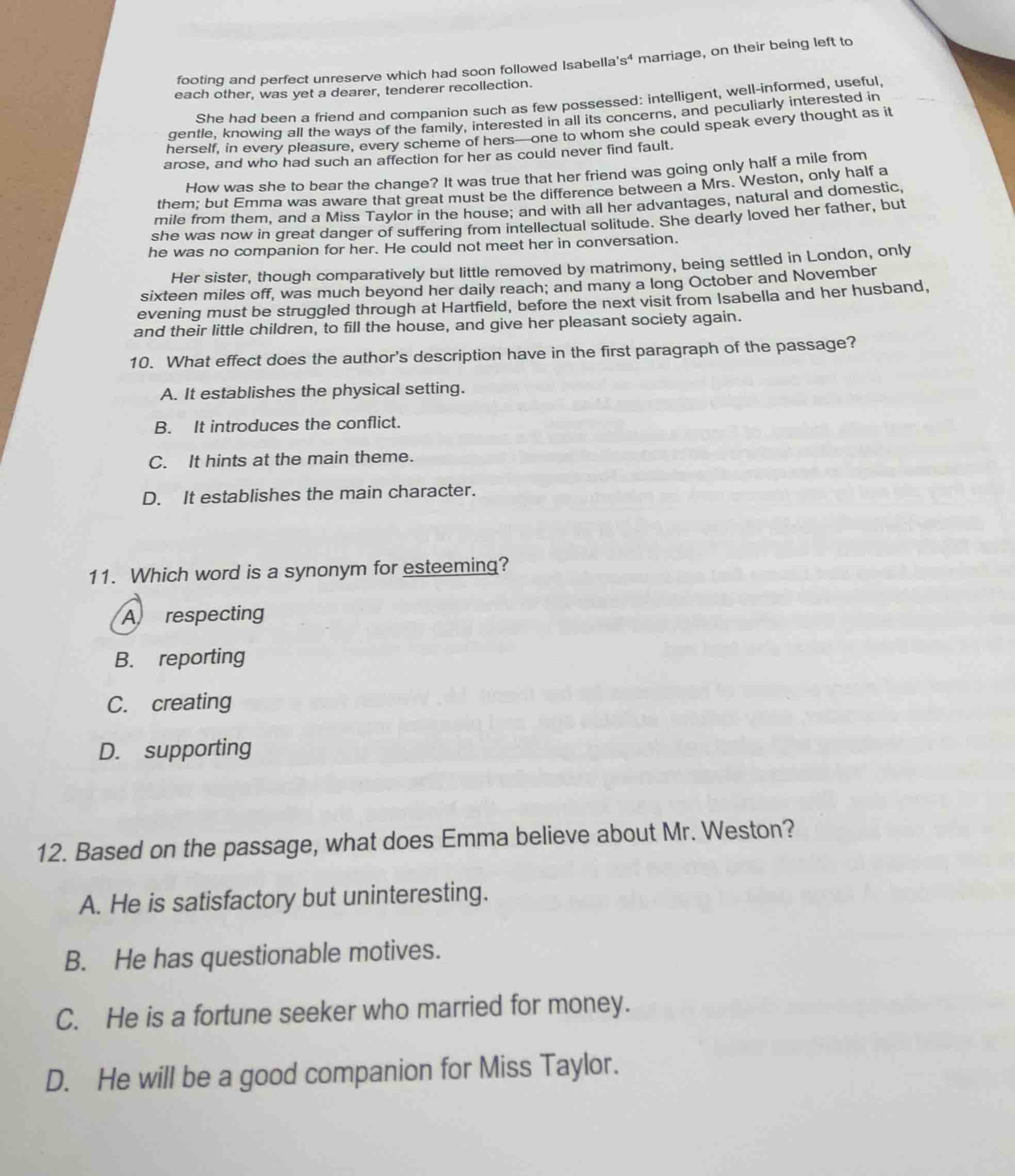
footing and perfect unreserve which had soon followed isabellas⁴ marriage, on their being left to each other, was yet a dearer, tenderer recollection. she had been a friend and companion such as few possessed: intelligent, well - informed, useful, gentle, knowing all the ways of the family, interested in all its concerns, and peculiarly interested in herself, in every pleasure, every scheme of hers—one to whom she could speak every thought as it arose, and who had such an affection for her as could never find fault. how was she to bear the change? it was true that her friend was going only half a mile from them; but emma was aware that great must be the difference between a mrs. weston, only half a mile from them, and a miss taylor in the house; and with all her advantages, natural and domestic, she was now in great danger of suffering from intellectual solitude. she dearly loved her father, but he was no companion for her. he could not meet her in conversation. her sister, though comparatively but little removed by matrimony, being settled in london, only sixteen miles off, was much beyond her daily reach; and many a long october and november evening must be struggled through at hartfield, before the next visit from isabella and her husband, and their little children, to fill the house, and give her pleasant society again. 10. what effect does the author’s description have in the first paragraph of the passage? a. it establishes the physical setting. b. it introduces the conflict. c. it hints at the main theme. d. it establishes the main character. 11. which word is a synonym for esteeming? a respecting b. reporting c. creating d. supporting 12. based on the passage, what does emma believe about mr. weston? a. he is satisfactory but uninteresting. b. he has questionable motives. c. he is a fortune seeker who married for money. d. he will be a good companion for miss taylor.
Question 10
To solve this, we analyze each option:
- Option A: The first paragraph focuses on the relationship and character, not physical setting. Eliminate A.
- Option B: The conflict (Emma's loss of companion) is introduced later. The first paragraph describes the friend, not the conflict. Eliminate B.
- Option C: The main theme (friendship, change) is hinted by describing the close friendship, which sets up the later conflict of change. This fits.
- Option D: The first paragraph describes a friend (Miss Taylor), not the main character (Emma) directly. Eliminate D.
"Esteeming" means having respect or admiration.
- Option A: "Respecting" has a similar meaning (holding in respect).
- Option B: "Reporting" is about giving information, not related.
- Option C: "Creating" is about making, not related.
- Option D: "Supporting" is about helping, not the same as esteeming.
From the passage, Emma's friend (Miss Taylor) marries Mr. Weston. The passage implies that while the marriage is a change, there's no negative view of Mr. Weston's motives (eliminate B, C). The passage shows Miss Taylor was a good companion, and the marriage is presented as a change but not as Mr. Weston being uninteresting in a negative way. However, re - evaluating: Wait, the relevant part is about Emma's feelings about the change. The option D says he will be a good companion for Miss Taylor. Since Miss Taylor was a good companion to Emma, and the marriage is presented as a positive change in terms of Miss Taylor's new role (Mrs. Weston), it implies Emma believes Mr. Weston will be a good companion.
- Option A: The passage doesn't suggest he is uninteresting. Eliminate A.
- Option B: No indication of questionable motives. Eliminate B.
- Option C: No evidence of marrying for money. Eliminate C.
- Option D: The context of the marriage and Miss Taylor's positive traits imply Emma believes Mr. Weston will be a good companion.

Snap & solve any problem in the app
Get step-by-step solutions on Sovi AI
Photo-based solutions with guided steps
Explore more problems and detailed explanations
C. It hints at the main theme.