QUESTION IMAGE
Question
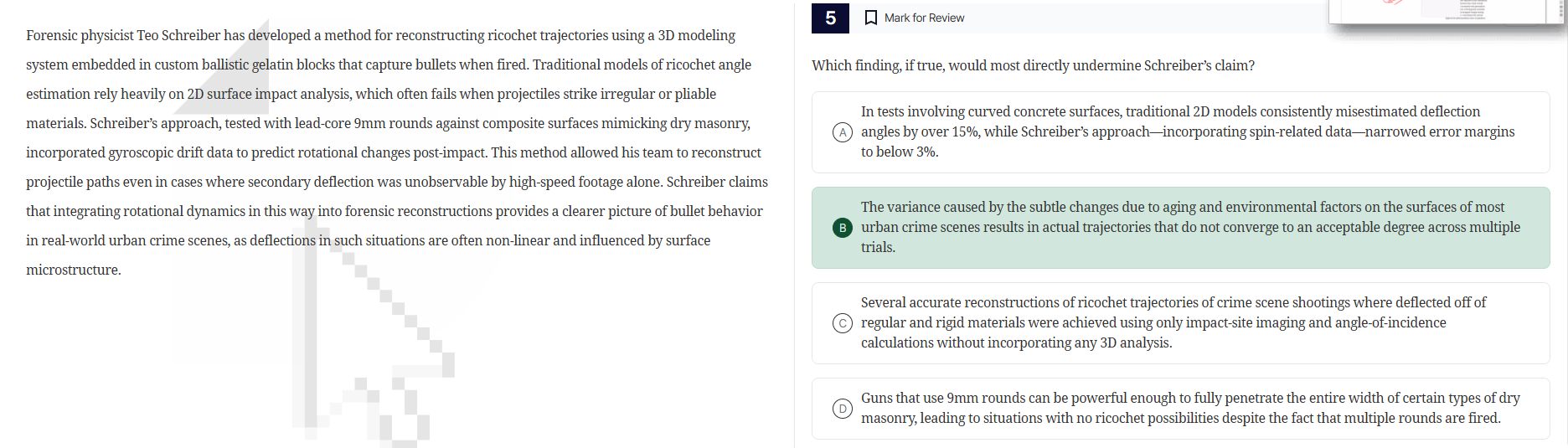
forensic physicist teo schreiber has developed a method for reconstructing ricochet trajectories using a 3d modeling system embedded in custom ballistic gelatin blocks that capture bullets when fired. traditional models of ricochet angle estimation rely heavily on 2d surface impact analysis, which often fails when projectiles strike irregular or pliable materials. schreibers approach, tested with lead - core 9mm rounds against composite surfaces mimicking dry masonry, incorporated gyroscopic drift data to predict rotational changes post - impact. this method allowed his team to reconstruct projectile paths even in cases where secondary deflection was unobservable by high - speed footage alone. schreiber claims that integrating rotational dynamics in this way into forensic reconstructions provides a clearer picture of bullet behavior in real - world urban crime scenes, as deflections in such situations are often non - linear and influenced by surface microstructure.
5 mark for review
which finding, if true, would most directly undermine schreibers claim?
a in tests involving curved concrete surfaces, traditional 2d models consistently misestimated deflection angles by over 15%, while schreibers approach—incorporating spin - related data—narrowed error margins to below 3%.
b the variance caused by the subtle changes due to aging and environmental factors on the surfaces of most urban crime scenes results in actual trajectories that do not converge to an acceptable degree across multiple trials.
c several accurate reconstructions of ricochet trajectories of crime scene shootings where deflected off of regular and rigid materials were achieved using only impact - site imaging and angle - of - incidence calculations without incorporating any 3d analysis.
d guns that use 9mm rounds can be powerful enough to fully penetrate the entire width of certain types of dry masonry, leading to situations with no ricochet possibilities despite the fact that multiple rounds are fired.
Schreiber claims his method (incorporating rotational dynamics) provides a clearer picture of bullet behavior in real - world urban crime scenes, as deflections there are non - linear and influenced by surface microstructure. To undermine this, we need a finding that shows his method can't achieve consistent results in such real - world scenarios.
- Option A: This option shows that Schreiber's approach is better than traditional 2D models in tests with curved concrete surfaces. It actually supports his claim, so it's incorrect.
- Option B: It states that due to aging and environmental factors on surfaces of most urban crime scenes, the actual trajectories don't converge across multiple trials. If the trajectories can't be made to converge, then Schreiber's method (which aims to provide a clearer picture of bullet behavior in these scenes) would be ineffective. This directly undermines his claim.
- Option C: This option is about cases with regular and rigid materials, while Schreiber's claim is about real - world urban crime scenes with non - linear deflections and surface microstructure influence. So it's not relevant to undermining his claim.
- Option D: This is about situations with no ricochet possibilities, but Schreiber's method is for reconstructing ricochet trajectories. So it doesn't undermine his claim.

Snap & solve any problem in the app
Get step-by-step solutions on Sovi AI
Photo-based solutions with guided steps
Explore more problems and detailed explanations
B. The variance caused by the subtle changes due to aging and environmental factors on the surfaces of most urban crime scenes results in actual trajectories that do not converge to an acceptable degree across multiple trials.