QUESTION IMAGE
Question
formative assessment
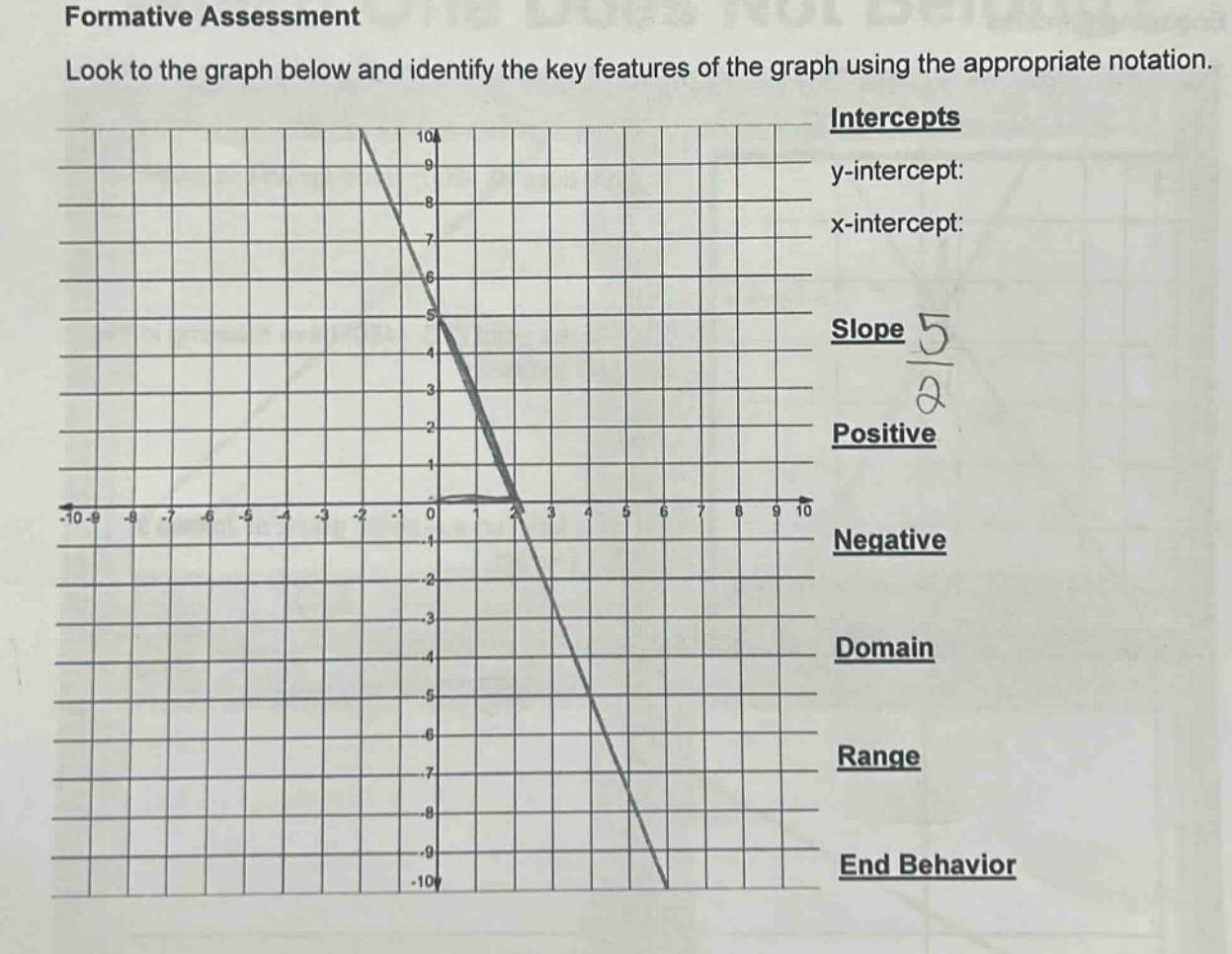
look to the graph below and identify the key features of the graph using the appropriate notation.
intercepts
y - intercept:
x - intercept:
slope
positive
negative
domain
range
end behavior
Step1: Identify y - intercept
The y - intercept is the point where the graph crosses the y - axis (x = 0). From the graph, when x = 0, y = 5. So the y - intercept is (0, 5).
Step2: Identify x - intercept
The x - intercept is the point where the graph crosses the x - axis (y = 0). From the graph, when y = 0, x = 2. So the x - intercept is (2, 0).
Step3: Calculate the slope
The slope \(m\) between two points \((x_1,y_1)\) and \((x_2,y_2)\) is given by \(m=\frac{y_2 - y_1}{x_2 - x_1}\). Using the points (0, 5) and (2, 0), we have \(m=\frac{0 - 5}{2 - 0}=\frac{- 5}{2}\). Since the slope is negative, we mark the 'Negative' option.
Step4: Determine the domain
The domain of a linear graph (a straight line) that extends infinitely in both horizontal directions (assuming it's a non - vertical line) is all real numbers. In interval notation, the domain is \((-\infty,\infty)\) or in set notation \(\{x|x\in\mathbb{R}\}\).
Step5: Determine the range
The range of a linear graph (a straight line) that extends infinitely in both vertical directions (assuming it's a non - horizontal line) is all real numbers. In interval notation, the range is \((-\infty,\infty)\) or in set notation \(\{y|y\in\mathbb{R}\}\).
Step6: Analyze end behavior
For a linear function \(y = mx + b\) with \(m=-\frac{5}{2}<0\), as \(x
ightarrow\infty\), \(y
ightarrow-\infty\) and as \(x
ightarrow-\infty\), \(y
ightarrow\infty\).

Snap & solve any problem in the app
Get step-by-step solutions on Sovi AI
Photo-based solutions with guided steps
Explore more problems and detailed explanations
- y - intercept: \((0, 5)\)
- x - intercept: \((2, 0)\)
- Slope: \(-\frac{5}{2}\) (mark 'Negative')
- Domain: \((-\infty,\infty)\) (or all real numbers)
- Range: \((-\infty,\infty)\) (or all real numbers)
- End Behavior: As \(x
ightarrow\infty\), \(y
ightarrow-\infty\); as \(x
ightarrow-\infty\), \(y
ightarrow\infty\)