QUESTION IMAGE
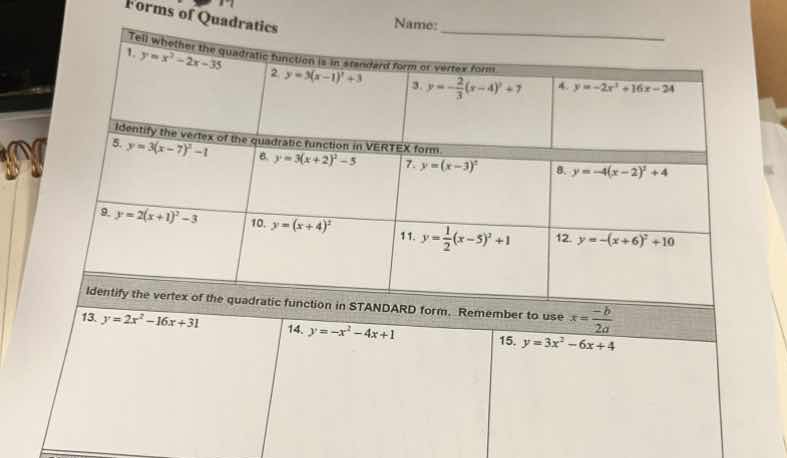
Question
forms of quadratics
name: _______
tell whether the quadratic function is in standard form or vertex form.
- $y = x^2 - 2x - 35$
- $y = 3(x - 1)^2 + 3$
- $y = -\frac{2}{3}(x - 4)^2 + 7$
- $y = -2x^2 + 16x - 24$
identify the vertex of the quadratic function in vertex form.
- $y = 3(x - 7)^2 - 1$
- $y = 3(x + 2)^2 - 5$
- $y = (x - 3)^2$
- $y = -4(x - 2)^2 + 4$
- $y = 2(x + 1)^2 - 3$
- $y = (x + 4)^2$
- $y = \frac{1}{2}(x - 5)^2 + 1$
- $y = -(x + 6)^2 + 10$
identify the vertex of the quadratic function in standard form. remember to use $x = \frac{-b}{2a}$
- $y = 2x^2 - 16x + 31$
- $y = -x^2 - 4x + 1$
- $y = 3x^2 - 6x + 4$
---
Part 1: Classify quadratic forms
Step1: Recall standard/vertex form rules
Standard form: $y=ax^2+bx+c$; Vertex form: $y=a(x-h)^2+k$
Step2: Classify each function
- $y=x^2-2x-35$ matches $y=ax^2+bx+c$ → Standard form
- $y=3(x-7)^2+3$ matches $y=a(x-h)^2+k$ → Vertex form
- $y=-\frac{2}{3}(x-4)^2+7$ matches $y=a(x-h)^2+k$ → Vertex form
- $y=-2x^2+16x-24$ matches $y=ax^2+bx+c$ → Standard form
---
Part 2: Vertex from vertex form
Step1: Use vertex form vertex rule
For $y=a(x-h)^2+k$, vertex is $(h,k)$
Step2: Calculate each vertex
- $y=3(x-7)^2-1$: $h=7, k=-1$ → $(7, -1)$
- $y=3(x+2)^2-5 = 3(x-(-2))^2-5$: $h=-2, k=-5$ → $(-2, -5)$
- $y=(x-3)^2 = (x-3)^2+0$: $h=3, k=0$ → $(3, 0)$
- $y=-4(x-2)^2+4$: $h=2, k=4$ → $(2, 4)$
- $y=2(x+1)^2-3 = 2(x-(-1))^2-3$: $h=-1, k=-3$ → $(-1, -3)$
- $y=(x+4)^2 = (x-(-4))^2+0$: $h=-4, k=0$ → $(-4, 0)$
- $y=\frac{1}{2}(x-5)^2+1$: $h=5, k=1$ → $(5, 1)$
- $y=-(x+6)^2+10 = -(x-(-6))^2+10$: $h=-6, k=10$ → $(-6, 10)$
---
Part 3: Vertex from standard form
Step1: Find x-coordinate of vertex
Use $x=-\frac{b}{2a}$ for $y=ax^2+bx+c$
Step2: Find y-coordinate via substitution
Substitute $x$ into the original function to find $y$
Step3: Solve each function
- $y=2x^2-16x+31$:
- $a=2, b=-16$
- $x=-\frac{-16}{2(2)} = \frac{16}{4}=4$
- $y=2(4)^2-16(4)+31=32-64+31=-1$ → $(4, -1)$
- $y=-x^2-4x+1$:
- $a=-1, b=-4$
- $x=-\frac{-4}{2(-1)} = \frac{4}{-2}=-2$
- $y=-(-2)^2-4(-2)+1=-4+8+1=5$ → $(-2, 5)$
- $y=3x^2-6x+4$:
- $a=3, b=-6$
- $x=-\frac{-6}{2(3)} = \frac{6}{6}=1$
- $y=3(1)^2-6(1)+4=3-6+4=1$ → $(1, 1)$
---

Snap & solve any problem in the app
Get step-by-step solutions on Sovi AI
Photo-based solutions with guided steps
Explore more problems and detailed explanations
Part 1: Form Classification
- Standard form
- Vertex form
- Vertex form
- Standard form
Part 2: Vertex from Vertex Form
- $(7, -1)$
- $(-2, -5)$
- $(3, 0)$
- $(2, 4)$
- $(-1, -3)$
- $(-4, 0)$
- $(5, 1)$
- $(-6, 10)$
Part 3: Vertex from Standard Form
- $(4, -1)$
- $(-2, 5)$
- $(1, 1)$