QUESTION IMAGE
Question
fractions
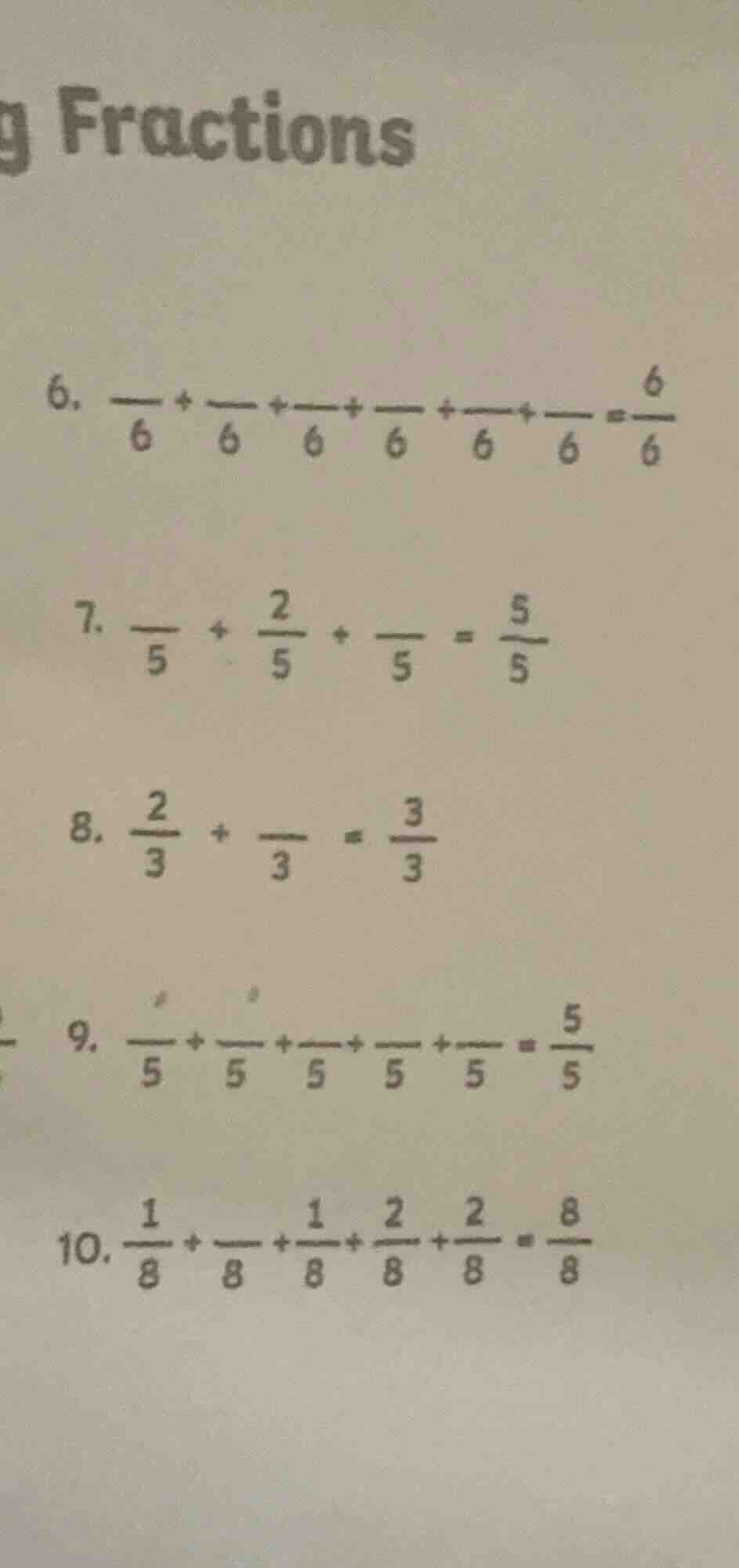
- (\frac{}{6} + \frac{}{6} + \frac{}{6} + \frac{}{6} + \frac{}{6} + \frac{}{6} = \frac{6}{6})
- (\frac{}{5} + \frac{2}{5} + \frac{}{5} = \frac{5}{5})
- (\frac{2}{3} + \frac{}{3} = \frac{3}{3})
- (\frac{}{5} + \frac{}{5} + \frac{}{5} + \frac{}{5} + \frac{}{5} = \frac{5}{5})
- (\frac{1}{8} + \frac{}{8} + \frac{1}{8} + \frac{2}{8} + \frac{2}{8} = \frac{8}{8})
To solve these fraction addition problems, we use the rule for adding fractions with the same denominator: add the numerators and keep the denominator the same. Let's solve each one:
Problem 6:
We have six fractions with denominator 6, and the sum is $\frac{6}{6}$. Let the numerator of each fraction be $x$. Then:
$$\underbrace{\frac{x}{6} + \frac{x}{6} + \frac{x}{6} + \frac{x}{6} + \frac{x}{6} + \frac{x}{6}}_{6 \text{ terms}} = \frac{6x}{6}$$
We know the sum is $\frac{6}{6}$, so:
$$\frac{6x}{6} = \frac{6}{6} \implies 6x = 6 \implies x = 1$$
Thus, each numerator is 1: $\boldsymbol{\frac{1}{6} + \frac{1}{6} + \frac{1}{6} + \frac{1}{6} + \frac{1}{6} + \frac{1}{6} = \frac{6}{6}}$
Problem 7:
We have $\frac{x}{5} + \frac{2}{5} + \frac{y}{5} = \frac{5}{5}$. Add the numerators:
$$x + 2 + y = 5$$
We need two numbers $x$ and $y$ (likely positive integers, as it’s a basic fraction problem) that add to $5 - 2 = 3$. The simplest is $x = 1$ and $y = 2$ (or vice versa). Let’s check:
$$\frac{1}{5} + \frac{2}{5} + \frac{2}{5} = \frac{1 + 2 + 2}{5} = \frac{5}{5}$$
Wait, no—wait, the sum of numerators must be 5. So $x + 2 + y = 5 \implies x + y = 3$. The most intuitive (for a basic problem) is $x = 1$ and $y = 2$ (or $x = 2$, $y = 1$). Let’s use $x = 1$, $y = 2$:
$$\frac{1}{5} + \frac{2}{5} + \frac{2}{5} = \frac{5}{5}$$
Wait, no—wait, $1 + 2 + 2 = 5$? No, $1 + 2 + 2 = 5$? Wait, $1 + 2 + 2 = 5$? Yes! Wait, no, $1 + 2 + 2 = 5$? Wait, $1 + 2 = 3$, plus $2$ is $5$. Yes. Alternatively, $x = 2$, $y = 1$:
$$\frac{2}{5} + \frac{2}{5} + \frac{1}{5} = \frac{5}{5}$$
Either way, the missing numerators are $1$ and $2$ (or $2$ and $1$). For simplicity, let’s use $x = 1$, $y = 2$:
$$\boldsymbol{\frac{1}{5} + \frac{2}{5} + \frac{2}{5} = \frac{5}{5}}$$
Problem 8:
We have $\frac{2}{3} + \frac{x}{3} = \frac{3}{3}$. Add the numerators:
$$2 + x = 3 \implies x = 1$$
Thus, the missing numerator is 1:
$$\boldsymbol{\frac{2}{3} + \frac{1}{3} = \frac{3}{3}}$$
Problem 9:
We have five fractions with denominator 5, and the sum is $\frac{5}{5}$. Let the numerator of each fraction be $x$. Then:
$$\underbrace{\frac{x}{5} + \frac{x}{5} + \frac{x}{5} + \frac{x}{5} + \frac{x}{5}}_{5 \text{ terms}} = \frac{5x}{5}$$
We know the sum is $\frac{5}{5}$, so:
$$\frac{5x}{5} = \frac{5}{5} \implies 5x = 5 \implies x = 1$$
Thus, each numerator is 1:
$$\boldsymbol{\frac{1}{5} + \frac{1}{5} + \frac{1}{5} + \frac{1}{5} + \frac{1}{5} = \frac{5}{5}}$$
Problem 10:
We have $\frac{1}{8} + \frac{x}{8} + \frac{1}{8} + \frac{2}{8} + \frac{2}{8} = \frac{8}{8}$. Add the numerators:
$$1 + x + 1 + 2 + 2 = 8$$
Simplify:
$$6 + x = 8 \implies x = 2$$
Thus, the missing numerator is 2:
$$\boldsymbol{\frac{1}{8} + \frac{2}{8} + \frac{1}{8} + \frac{2}{8} + \frac{2}{8} = \frac{8}{8}}$$
Final Answers:
- $\boldsymbol{\frac{1}{6} + \frac{1}{6} + \frac{1}{6} + \frac{1}{6} + \frac{1}{6} + \frac{1}{6} = \frac{6}{6}}$
- $\boldsymbol{\frac{1}{5} + \frac{2}{5} + \frac{2}{5} = \frac{5}{5}}$ (or $\frac{2}{5} + \frac{2}{5} + \frac{1}{5} = \frac{5}{5}$)
- $\boldsymbol{\frac{2}{3} + \frac{1}{3} = \frac{3}{3}}$
- $\boldsymbol{\frac{1}{5} + \frac{1}{5} + \frac{1}{5} + \frac{1}{5} + \frac{1}{5} = \frac{5}{5}}$
- $\boldsymbol{\frac{1}{8} + \frac{2}{8} + \frac{1}{8} + \frac{2}{8} + \frac{2}{8} = \frac{8}{8}}$

Snap & solve any problem in the app
Get step-by-step solutions on Sovi AI
Photo-based solutions with guided steps
Explore more problems and detailed explanations
To solve these fraction addition problems, we use the rule for adding fractions with the same denominator: add the numerators and keep the denominator the same. Let's solve each one:
Problem 6:
We have six fractions with denominator 6, and the sum is $\frac{6}{6}$. Let the numerator of each fraction be $x$. Then:
$$\underbrace{\frac{x}{6} + \frac{x}{6} + \frac{x}{6} + \frac{x}{6} + \frac{x}{6} + \frac{x}{6}}_{6 \text{ terms}} = \frac{6x}{6}$$
We know the sum is $\frac{6}{6}$, so:
$$\frac{6x}{6} = \frac{6}{6} \implies 6x = 6 \implies x = 1$$
Thus, each numerator is 1: $\boldsymbol{\frac{1}{6} + \frac{1}{6} + \frac{1}{6} + \frac{1}{6} + \frac{1}{6} + \frac{1}{6} = \frac{6}{6}}$
Problem 7:
We have $\frac{x}{5} + \frac{2}{5} + \frac{y}{5} = \frac{5}{5}$. Add the numerators:
$$x + 2 + y = 5$$
We need two numbers $x$ and $y$ (likely positive integers, as it’s a basic fraction problem) that add to $5 - 2 = 3$. The simplest is $x = 1$ and $y = 2$ (or vice versa). Let’s check:
$$\frac{1}{5} + \frac{2}{5} + \frac{2}{5} = \frac{1 + 2 + 2}{5} = \frac{5}{5}$$
Wait, no—wait, the sum of numerators must be 5. So $x + 2 + y = 5 \implies x + y = 3$. The most intuitive (for a basic problem) is $x = 1$ and $y = 2$ (or $x = 2$, $y = 1$). Let’s use $x = 1$, $y = 2$:
$$\frac{1}{5} + \frac{2}{5} + \frac{2}{5} = \frac{5}{5}$$
Wait, no—wait, $1 + 2 + 2 = 5$? No, $1 + 2 + 2 = 5$? Wait, $1 + 2 + 2 = 5$? Yes! Wait, no, $1 + 2 + 2 = 5$? Wait, $1 + 2 = 3$, plus $2$ is $5$. Yes. Alternatively, $x = 2$, $y = 1$:
$$\frac{2}{5} + \frac{2}{5} + \frac{1}{5} = \frac{5}{5}$$
Either way, the missing numerators are $1$ and $2$ (or $2$ and $1$). For simplicity, let’s use $x = 1$, $y = 2$:
$$\boldsymbol{\frac{1}{5} + \frac{2}{5} + \frac{2}{5} = \frac{5}{5}}$$
Problem 8:
We have $\frac{2}{3} + \frac{x}{3} = \frac{3}{3}$. Add the numerators:
$$2 + x = 3 \implies x = 1$$
Thus, the missing numerator is 1:
$$\boldsymbol{\frac{2}{3} + \frac{1}{3} = \frac{3}{3}}$$
Problem 9:
We have five fractions with denominator 5, and the sum is $\frac{5}{5}$. Let the numerator of each fraction be $x$. Then:
$$\underbrace{\frac{x}{5} + \frac{x}{5} + \frac{x}{5} + \frac{x}{5} + \frac{x}{5}}_{5 \text{ terms}} = \frac{5x}{5}$$
We know the sum is $\frac{5}{5}$, so:
$$\frac{5x}{5} = \frac{5}{5} \implies 5x = 5 \implies x = 1$$
Thus, each numerator is 1:
$$\boldsymbol{\frac{1}{5} + \frac{1}{5} + \frac{1}{5} + \frac{1}{5} + \frac{1}{5} = \frac{5}{5}}$$
Problem 10:
We have $\frac{1}{8} + \frac{x}{8} + \frac{1}{8} + \frac{2}{8} + \frac{2}{8} = \frac{8}{8}$. Add the numerators:
$$1 + x + 1 + 2 + 2 = 8$$
Simplify:
$$6 + x = 8 \implies x = 2$$
Thus, the missing numerator is 2:
$$\boldsymbol{\frac{1}{8} + \frac{2}{8} + \frac{1}{8} + \frac{2}{8} + \frac{2}{8} = \frac{8}{8}}$$
Final Answers:
- $\boldsymbol{\frac{1}{6} + \frac{1}{6} + \frac{1}{6} + \frac{1}{6} + \frac{1}{6} + \frac{1}{6} = \frac{6}{6}}$
- $\boldsymbol{\frac{1}{5} + \frac{2}{5} + \frac{2}{5} = \frac{5}{5}}$ (or $\frac{2}{5} + \frac{2}{5} + \frac{1}{5} = \frac{5}{5}$)
- $\boldsymbol{\frac{2}{3} + \frac{1}{3} = \frac{3}{3}}$
- $\boldsymbol{\frac{1}{5} + \frac{1}{5} + \frac{1}{5} + \frac{1}{5} + \frac{1}{5} = \frac{5}{5}}$
- $\boldsymbol{\frac{1}{8} + \frac{2}{8} + \frac{1}{8} + \frac{2}{8} + \frac{2}{8} = \frac{8}{8}}$