QUESTION IMAGE
Question
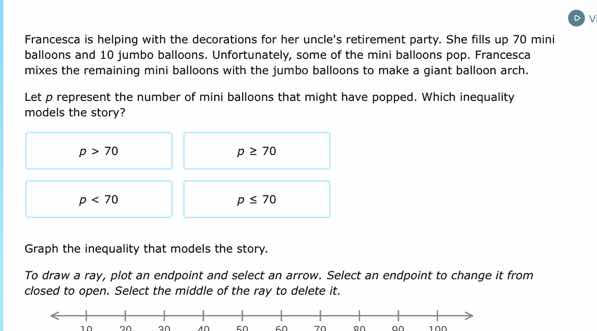
francesca is helping with the decorations for her uncles retirement party. she fills up 70 mini balloons and 10 jumbo balloons. unfortunately, some of the mini balloons pop. francesca mixes the remaining mini balloons with the jumbo balloons to make a giant balloon arch. let p represent the number of mini balloons that might have popped. which inequality models the story? \\( p > 70 \\) \\( p \geq 70 \\) \\( p < 70 \\) \\( p \leq 70 \\) graph the inequality that models the story. to draw a ray, plot an endpoint and select an arrow. select an endpoint to change it from closed to open. select the middle of the ray to delete it. \\(\longleftarrow\hspace{10pt}10\hspace{10pt}20\hspace{10pt}30\hspace{10pt}40\hspace{10pt}50\hspace{10pt}60\hspace{10pt}70\hspace{10pt}80\hspace{10pt}90\hspace{10pt}100\longrightarrow\\)
Part 1: Finding the Inequality
Step 1: Analyze the number of mini balloons
Francesca starts with 70 mini balloons. The number of popped mini balloons, \( p \), can't be more than the total number of mini balloons she had initially (because you can't pop more balloons than you have). Also, the number of popped balloons can't be negative, but since we are comparing with 70, we consider that \( p \) (number of popped) must be less than or equal to 70? Wait, no—wait, actually, the number of remaining mini balloons is \( 70 - p \), and we know that the number of popped balloons can't exceed the initial number of mini balloons (because you can't pop more than you have). But also, the number of popped balloons has to be a non - negative number, but in terms of the inequality related to 70: since \( p \) is the number of popped mini balloons, and you can't pop more than 70 (because there are only 70 mini balloons), so \( p \leq 70 \)? Wait, no, wait. Wait, if \( p \) is the number of popped, then the number of remaining is \( 70 - p \), and \( 70 - p \) has to be a non - negative number (because you can't have a negative number of remaining balloons). So \( 70 - p\geq0 \), which implies \( p\leq70 \). But also, the number of popped balloons can't be negative, so \( p\geq0 \). But the question is about which inequality models the story. The total number of mini balloons is 70, so the number of popped balloons \( p \) must be less than or equal to 70 (because you can't pop more than you have). Wait, but let's think again: initially, there are 70 mini balloons. The number of popped balloons \( p \): the maximum number of balloons that can pop is 70 (if all pop). So \( p \) can be at most 70, so \( p\leq70 \). But wait, if \( p > 70 \), that would mean more balloons popped than she had, which is impossible. If \( p\geq70 \), that includes \( p = 70,71,72,...\), but 71 is more than 70, which is impossible. If \( p < 70 \), that means less than 70 popped, but she could have popped all 70 (so \( p = 70 \) is allowed). So the correct inequality is \( p\leq70 \).
Step 1: Determine the endpoint
For the inequality \( p\leq70 \), the endpoint is at 70. Since the inequality is "less than or equal to", the endpoint is closed (filled circle) because 70 is included in the solution set.
Step 2: Determine the direction of the arrow
We need to shade the values of \( p \) that are less than or equal to 70. So we draw a closed circle at 70 on the number line and draw an arrow pointing to the left (towards the smaller numbers) to represent all numbers less than or equal to 70.

Snap & solve any problem in the app
Get step-by-step solutions on Sovi AI
Photo-based solutions with guided steps
Explore more problems and detailed explanations
\( p\leq70 \)