QUESTION IMAGE
Question
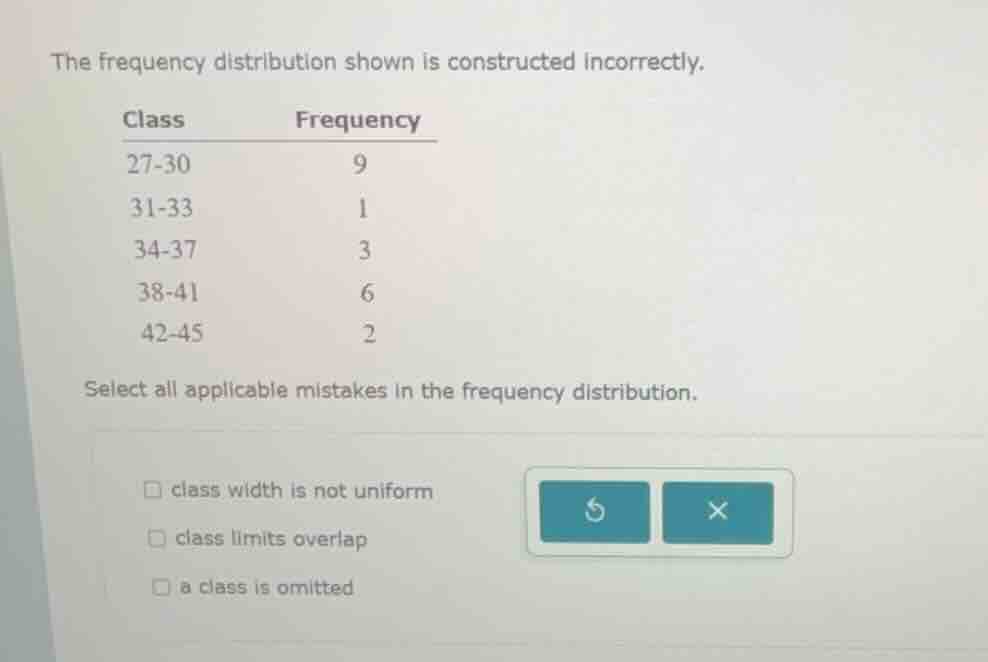
the frequency distribution shown is constructed incorrectly.
class frequency
27-30 9
31-33 1
34-37 3
38-41 6
42-45 2
select all applicable mistakes in the frequency distribution.
□ class width is not uniform
□ class limits overlap
□ a class is omitted
- Check class width: Calculate the width of each class (upper - lower limit + 1 for discrete, or upper - lower for continuous). For 27 - 30: \(30 - 27=3\); 31 - 33: \(33 - 31 = 2\); 34 - 37: \(37 - 34 = 3\); 38 - 41: \(41 - 38 = 3\); 42 - 45: \(45 - 42 = 3\). Wait, no, maybe it's continuous. Wait, 27 - 30: width is \(30 - 27=3\)? Wait, no, 27 to 30: if it's inclusive, the width is \(30 - 27 + 1=4\)? Wait, no, maybe the classes are supposed to have uniform width. Let's calculate the difference between the lower limits: 31 - 27 = 4? No, 27 - 30 (width 3), 31 - 33 (width 2), so class width is not uniform. Also, check for omitted class: Between 30 and 31, there's a gap. The first class ends at 30, next starts at 31, so no overlap, but a class is omitted? Wait, no, the class width: 27 - 30 (width 3), 31 - 33 (width 2), so class width is not uniform. Also, is there an omitted class? Let's see the lower limits: 27, 31, 34, 38, 42. The difference between 27 and 31 is 4, but the first class width is 3 (27 - 30), then next starts at 31. So between 30 and 31, there's a value (30.5, if continuous) that's not in any class? Wait, no, maybe the classes are discrete. Wait, the main mistakes:
- Class width not uniform: The width of 27 - 30 is \(30 - 27 = 3\) (if we take upper - lower), 31 - 33 is \(33 - 31 = 2\), so widths are 3, 2, 3, 3, 3 – not uniform.
- A class is omitted: Between 30 and 31, there's a gap. The first class is 27 - 30, next is 31 - 33. So values like 30 (if the first class is inclusive, 30 is included) and 31 (next class). Wait, no, if the classes are exclusive, 27 - 30 would include up to 29.99, and 31 - 33 starts at 31. Then there's a gap between 30 and 31 (e.g., 30.5) which is not in any class, so a class (30 - 30? No, maybe 30 - 33? No, the class width should be uniform. Wait, maybe the intended class width is 4? Let's see: 27 - 30 (width 3), 31 - 34 (width 3), but the second class is 31 - 33 (width 2). So class width is not uniform, and a class is omitted (between 30 and 31, or the class 30 - 33? No, the second class is 31 - 33, so the class 30 - 33 is not there, but the first is 27 - 30, so the gap is 30 - 31, so a class is omitted. Also, class width is not uniform.
Wait, the options are: class width not uniform, class limits overlap, a class is omitted.
- Class limits overlap: Do any classes overlap? 27 - 30 and 31 - 33: 30 < 31, so no overlap. So class limits do not overlap.
- Class width not uniform: As calculated, widths are 3, 2, 3, 3, 3 – not uniform.
- A class is omitted: Between 30 and 31, there's a gap. The first class ends at 30, next starts at 31. So values between 30 and 31 (if continuous) or 30 (if discrete, but 30 is in first class, 31 in next) – wait, maybe the class width should be 4. Let's check the difference between lower limits: 31 - 27 = 4, 34 - 31 = 3, which is inconsistent. So the class width is not uniform, and a class is omitted (because the jump from 30 to 31 is not covered by a class, implying a class is missing between 30 and 31, or the class width is wrong).
So the applicable mistakes are "class width is not uniform" and "a class is omitted". Wait, but let's re - check:
- Class width not uniform:
- Class 27 - 30: \(30 - 27=3\)
- Class 31 - 33: \(33 - 31 = 2\)
- Class 34 - 37: \(37 - 34 = 3\)
- Class 38 - 41: \(41 - 38 = 3\)
- Class 42 - 45: \(45 - 42 = 3\)
Since the widths (3, 2, 3, 3, 3) are not all the same, the class width is not uniform.
- A class is omitted:
The first class ends at 30, and the next class starts at 31. There is no class that inc…

Snap & solve any problem in the app
Get step-by-step solutions on Sovi AI
Photo-based solutions with guided steps
Explore more problems and detailed explanations
- class width is not uniform
- a class is omitted