QUESTION IMAGE
Question
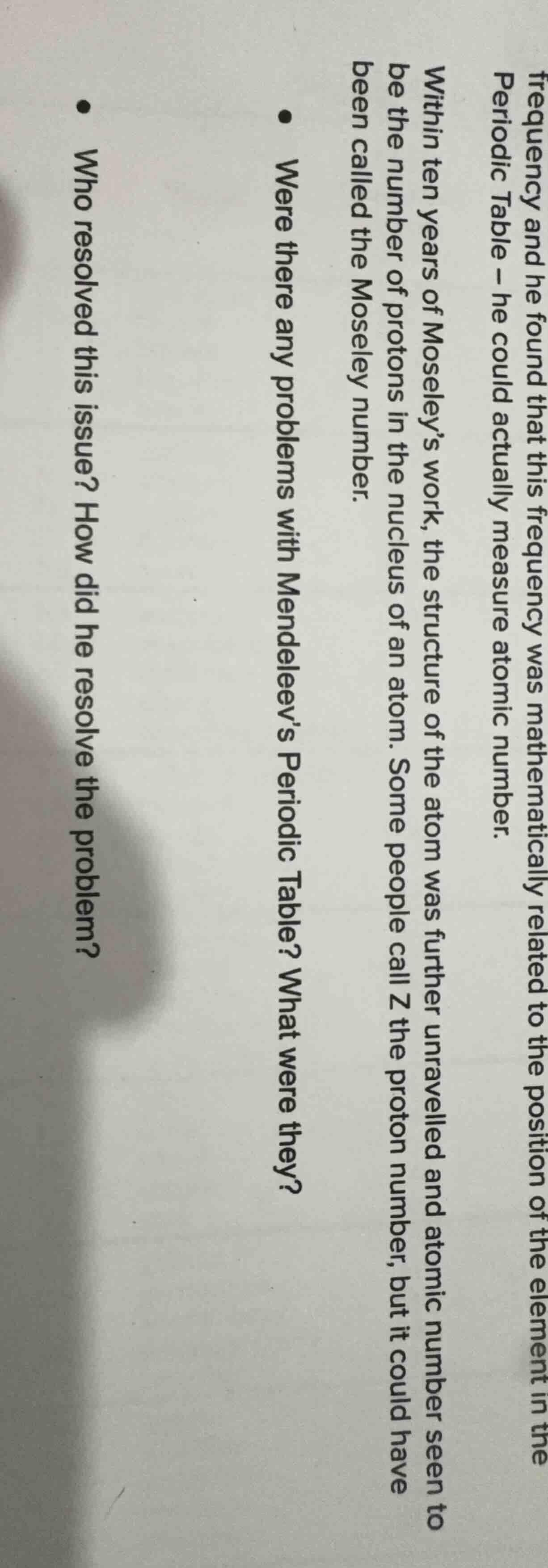
frequency and he found that this frequency was mathematically related to the position of the element in the periodic table – he could actually measure atomic number.
within ten years of moseley’s work, the structure of the atom was further unravelled and atomic number seen to be the number of protons in the nucleus of an atom. some people call z the proton number, but it could have been called the moseley number.
- were there any problems with mendeleev’s periodic table? what were they?
- who resolved this issue? how did he resolve the problem?
Sub - question 1: Were there any problems with Mendeleev’s Periodic Table? What were they?
Mendeleev's Periodic Table had several problems. One major issue was that it was based on atomic mass for arranging elements, but there were exceptions. For example, iodine (atomic mass ~127) was placed after tellurium (atomic mass ~128), even though iodine's chemical properties were more similar to bromine and chlorine, while tellurium's properties were more like selenium and sulfur. Also, the table had gaps for undiscovered elements, but the prediction of some elements' properties was not always accurate. Another problem was that it couldn't account for the existence of isotopes, as isotopes of an element have different atomic masses but same chemical properties, so their placement was unclear.
Henry Moseley resolved the issues with Mendeleev's Periodic Table. Moseley conducted experiments where he bombarded different elements with electrons and studied the X - rays emitted. He found that the frequency of the emitted X - rays was mathematically related to the atomic number (the number of protons in the nucleus of an atom). He then proposed that elements should be arranged in the periodic table based on their atomic number (Moseley's number, also called the proton number or Z) rather than atomic mass. This new arrangement based on atomic number fixed the problem of reversed elements (like tellurium and iodine) because when arranged by atomic number, iodine (atomic number 53) comes after tellurium (atomic number 52), which also aligns with their chemical properties. It also provided a clear basis for the placement of elements, including isotopes (since isotopes of an element have the same atomic number).

Snap & solve any problem in the app
Get step-by-step solutions on Sovi AI
Photo-based solutions with guided steps
Explore more problems and detailed explanations
Yes, there were problems with Mendeleev’s Periodic Table.
- Atomic Mass - based Arrangement Exceptions: Elements were arranged by atomic mass, but some elements (e.g., tellurium and iodine) had their order reversed because chemical properties took precedence. Tellurium (atomic mass ~128) was placed before iodine (atomic mass ~127) even though iodine's chemical properties aligned more with halogens, while tellurium's aligned with chalcogens.
- Isotope Placement Issue: The table couldn't account for isotopes. Isotopes of an element have different atomic masses but identical chemical properties, so their placement in a table based on atomic mass was ambiguous.
- Inaccurate Element Property Predictions: While Mendeleev predicted properties of undiscovered elements, some predictions were not entirely accurate. Also, the existence of noble gases was not accounted for initially, and they had to be added as a new group later.