QUESTION IMAGE
Question
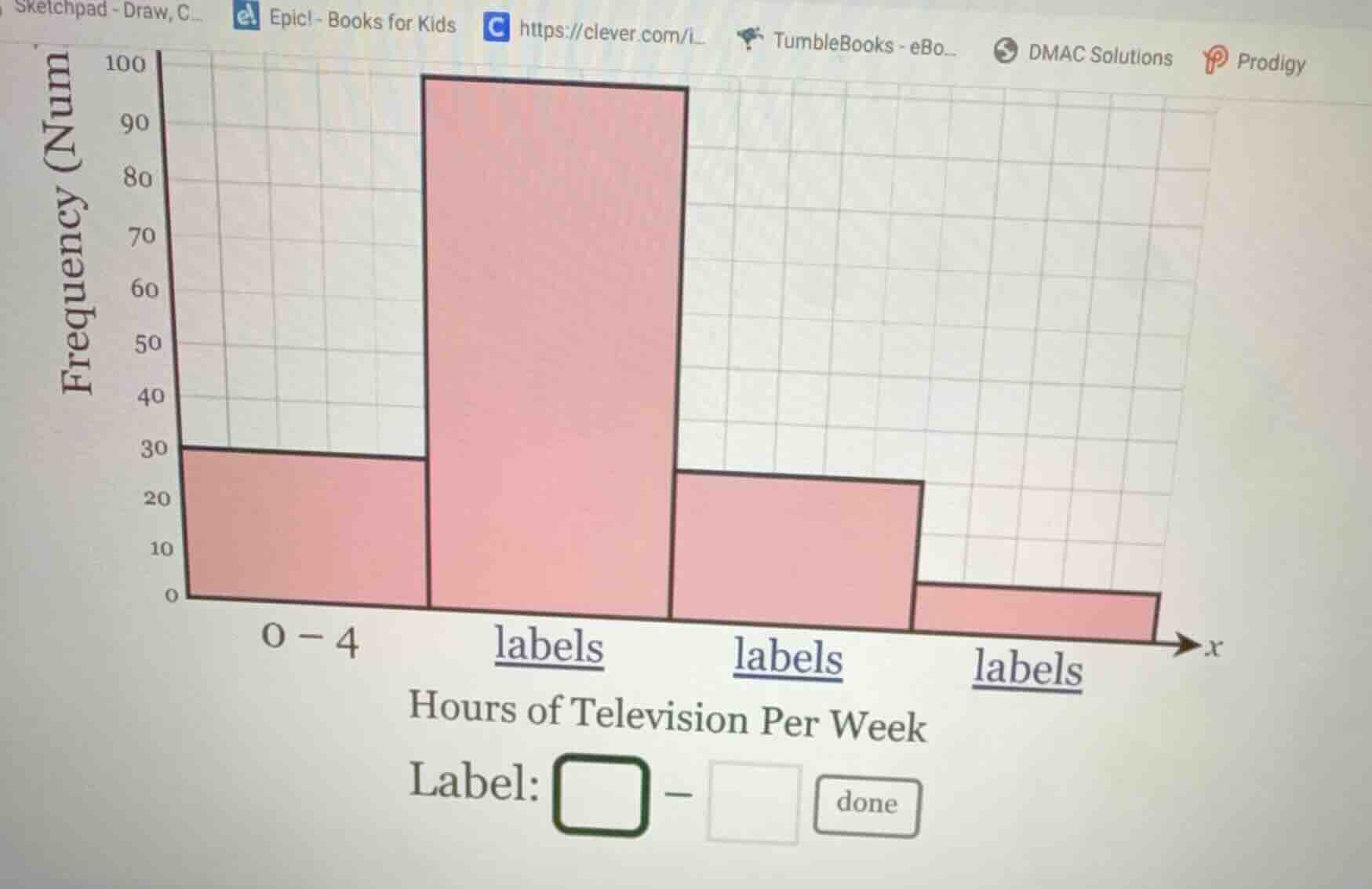
frequency (num) 0 to 100 by 10, x axis: hours of television per week with categories 0 - 4, labels, labels, labels. bar graph with bars: 0 - 4 (height ~30), next (height ~95), next (height ~25), last (height ~5). label: blank - blank done
To label the intervals for the "Hours of Television Per Week" histogram, we analyze the first interval \(0 - 4\). The width of this interval is \(4 - 0 = 4\) (since \(4 - 0 = 4\)). So the subsequent intervals should also have a width of 4.
Step 1: Determine the interval width
The first interval is \(0 - 4\), so the width is \(4 - 0 = 4\).
Step 2: Find the second interval
The first interval ends at 4, so the second interval starts at 4 and ends at \(4 + 4 = 8\). Thus, the second interval is \(4 - 8\).
Step 3: Find the third interval
The second interval ends at 8, so the third interval starts at 8 and ends at \(8 + 4 = 12\). Thus, the third interval is \(8 - 12\).
Step 4: Find the fourth interval
The third interval ends at 12, so the fourth interval starts at 12 and ends at \(12 + 4 = 16\). Thus, the fourth interval is \(12 - 16\).
If we assume the second interval (the tallest bar) is to be labeled, the label would be \(4 - 8\) (since the first is \(0 - 4\), next is \(4 - 8\), then \(8 - 12\), then \(12 - 16\)).

Snap & solve any problem in the app
Get step-by-step solutions on Sovi AI
Photo-based solutions with guided steps
Explore more problems and detailed explanations
For the second interval (tallest bar), the label is \(4 - 8\) (followed by \(8 - 12\) for the third, \(12 - 16\) for the fourth). If labeling the second interval, the answer is \(4 - 8\).