QUESTION IMAGE
Question
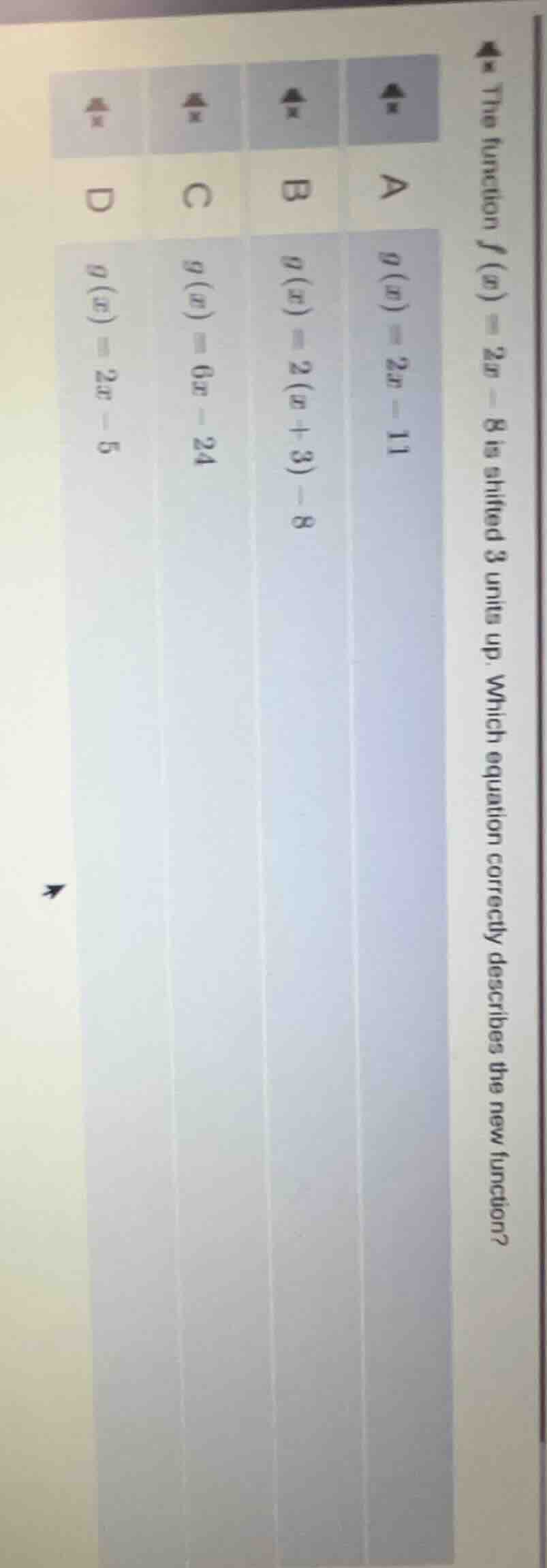
the function ( f(x) = 2x - 8 ) is shifted 3 units up. which equation correctly describes the new function?
a ( g(x) = 2x - 11 )
b ( g(x) = 2(x + 3) - 8 )
c ( g(x) = 6x - 24 )
d ( g(x) = 2x - 5 )
Step1: Recall vertical shift rule
For a function \( y = f(x) \), shifting it up by \( k \) units gives \( y = f(x)+k \). Here, \( f(x)=2x - 8 \) and \( k = 3 \).
Step2: Apply the shift
So the new function \( g(x)=f(x)+3=(2x - 8)+3 \).
Step3: Simplify the expression
Simplify \( (2x - 8)+3 \): \( 2x-8 + 3=2x-5 \)? Wait, no, wait. Wait, original function is \( f(x)=2x - 8 \), shift up 3 units: \( g(x)=2x-8 + 3=2x - 5 \)? Wait, no, wait the options: Wait, option D is \( 2x - 5 \), but wait, let me check again. Wait, maybe I misread the original function. Wait, the original function is \( f(x)=2x - 8 \)? Wait, no, the image says "The function \( f(x)=2x - 8 \) is shifted 3 units up. Which equation correctly describes the new function?" Wait, no, wait the first line: "The function \( f(x)=2x - 8 \) is shifted 3 units up. Which equation correctly describes the new function?" Wait, no, maybe the original function is \( f(x)=2x - 11 \)? No, wait the options: Option D is \( 2x - 5 \), but let's recalculate. \( f(x)=2x - 8 \), shift up 3: \( 2x-8 + 3=2x - 5 \). But wait, maybe the original function was \( f(x)=2x - 8 \)? Wait, but let's check the options. Wait, the options are:
A. \( g(x)=2x - 11 \)
B. \( g(x)=2(x + 3)-8 \)
C. \( g(x)=6x - 24 \)
D. \( g(x)=2x - 5 \)
Wait, so according to the vertical shift, \( g(x)=f(x)+3=(2x - 8)+3=2x - 5 \), which is option D. Wait, but maybe I made a mistake. Wait, no, vertical shift up 3: add 3 to the function. So \( f(x)=2x - 8 \), \( g(x)=2x - 8+3=2x - 5 \). So the correct answer is D.

Snap & solve any problem in the app
Get step-by-step solutions on Sovi AI
Photo-based solutions with guided steps
Explore more problems and detailed explanations
D. \( g(x) = 2x - 5 \)