QUESTION IMAGE
Question
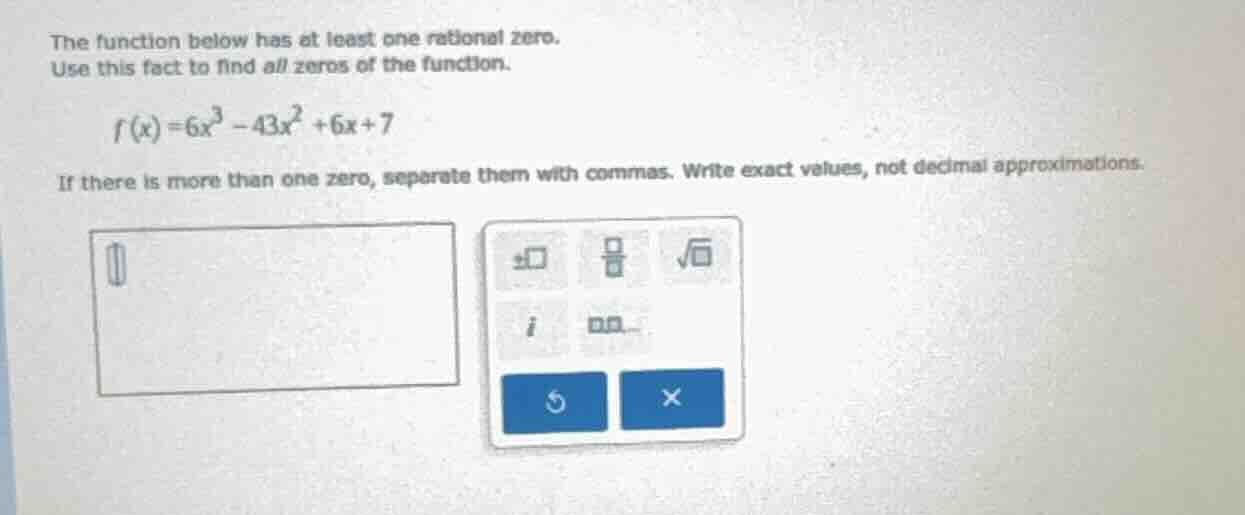
the function below has at least one rational zero. use this fact to find all zeros of the function. \\( f(x)=6x^3 - 43x^2 + 6x + 7 \\) if there is more than one zero, separate them with commas. write exact values, not decimal approximations.
Step 1: Apply Rational Root Theorem
The Rational Root Theorem states that possible rational roots of a polynomial \(a_nx^n + a_{n - 1}x^{n - 1}+\cdots+a_1x + a_0\) are of the form \(\frac{p}{q}\), where \(p\) is a factor of the constant term \(a_0\) and \(q\) is a factor of the leading coefficient \(a_n\). For \(f(x)=6x^3 - 43x^2+6x + 7\), the constant term \(a_0 = 7\) (factors: \(\pm1,\pm7\)) and the leading coefficient \(a_3=6\) (factors: \(\pm1,\pm2,\pm3,\pm6\)). So possible rational roots are \(\pm1,\pm7,\pm\frac{1}{2},\pm\frac{7}{2},\pm\frac{1}{3},\pm\frac{7}{3},\pm\frac{1}{6},\pm\frac{7}{6}\).
We test \(x = 7\): \(f(7)=6(7)^3-43(7)^2 + 6(7)+7=6(343)-43(49)+42 + 7=2058-2107 + 42+7=0\). So \(x = 7\) is a root, and \((x - 7)\) is a factor.
Step 2: Perform Polynomial Division or Use Synthetic Division
We use synthetic division with root \(7\) for the polynomial \(6x^3-43x^2 + 6x+7\).
The coefficients are \(6,-43,6,7\).
Bring down the \(6\). Multiply \(6\times7 = 42\). Add to \(-43\): \(-43 + 42=-1\).
Multiply \(-1\times7=-7\). Add to \(6\): \(6-7=-1\).
Multiply \(-1\times7=-7\). Add to \(7\): \(7-7 = 0\).
So the quotient polynomial is \(6x^2-x - 1\).
Step 3: Factor the Quadratic Polynomial
Factor \(6x^2-x - 1\). We need two numbers \(a\) and \(b\) such that \(a\times b=6\times(-1)=-6\) and \(a + b=-1\). The numbers are \(-3\) and \(2\).
Rewrite the middle term: \(6x^2-3x + 2x-1=3x(2x - 1)+1(2x - 1)=(3x + 1)(2x - 1)\).
Step 4: Find the Zeros of the Quadratic
Set \((3x + 1)(2x - 1)=0\).
For \(3x+1 = 0\), \(x=-\frac{1}{3}\).
For \(2x - 1=0\), \(x=\frac{1}{2}\).

Snap & solve any problem in the app
Get step-by-step solutions on Sovi AI
Photo-based solutions with guided steps
Explore more problems and detailed explanations
\(7,-\frac{1}{3},\frac{1}{2}\)