QUESTION IMAGE
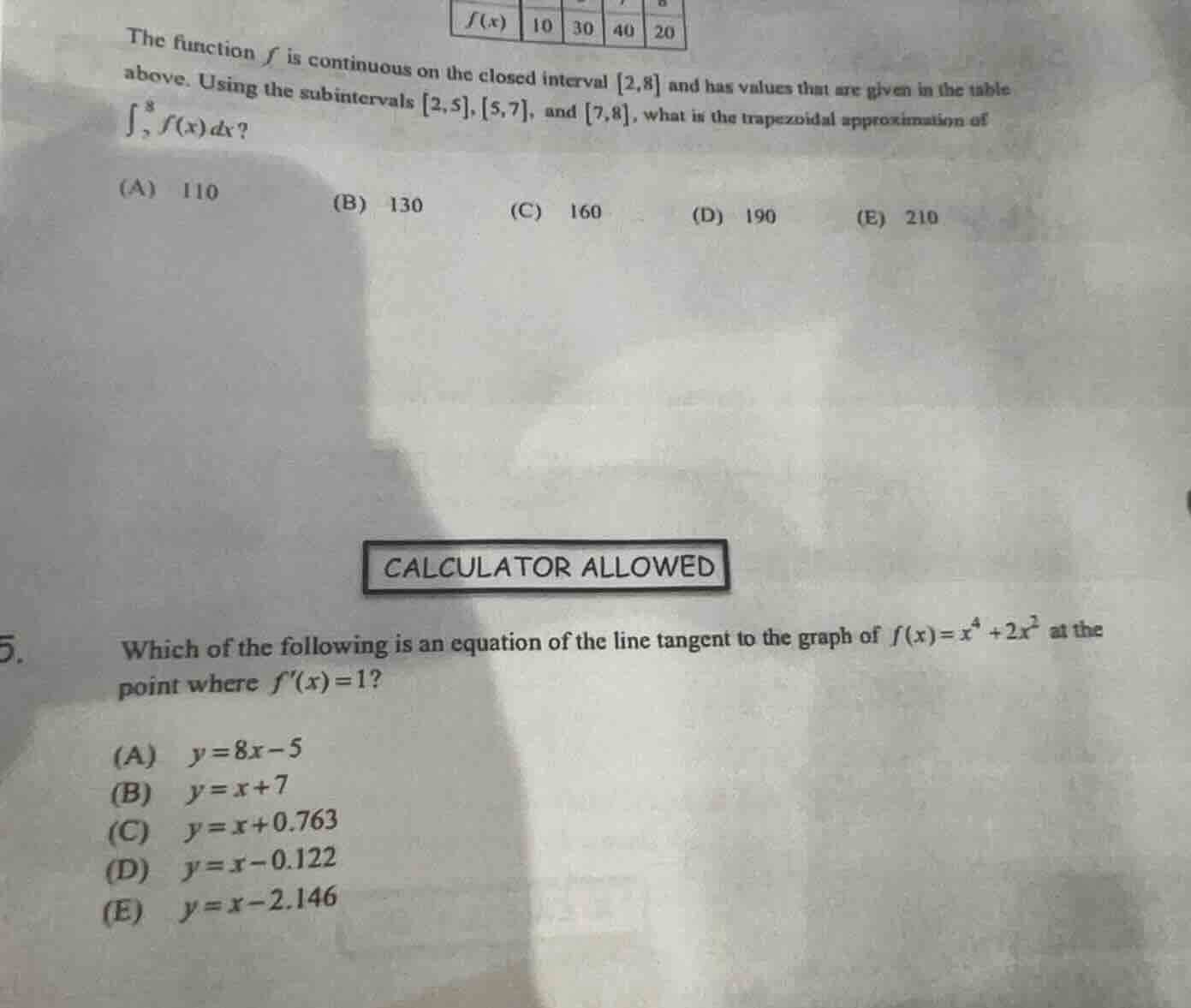
Question
the function ( f ) is continuous on the closed interval (2,8) and has values that are given in the table above. using the subintervals (2,5), (5,7), and (7,8), what is the trapezoidal approximation of ( int_{2}^{8} f(x) dx )?
(a) 110
(b) 130
(c) 160
(d) 190
(e) 210
calculator allowed
- which of the following is an equation of the line tangent to the graph of ( f(x) = x^4 + 2x^2 ) at the point where ( f(x) = 1 )?
(a) ( y = 8x - 5 )
(b) ( y = x + 7 )
(c) ( y = x + 0.763 )
(d) ( y = x - 0.122 )
(e) ( y = x - 2.146 )
First Problem (Trapezoidal Approximation)
Step 1: Recall Trapezoidal Rule Formula
The trapezoidal rule for a function \( f(x) \) on subintervals \([x_0, x_1], [x_1, x_2], \dots, [x_{n - 1}, x_n]\) is \( \int_{x_0}^{x_n} f(x)dx\approx\frac{1}{2}\sum_{i = 1}^{n}(x_i - x_{i - 1})(f(x_{i - 1})+f(x_i)) \).
Given subintervals \([2,5]\), \([5,7]\), \([7,8]\). Let \( x_0 = 2\), \( x_1 = 5\), \( x_2 = 7\), \( x_3 = 8\). From the table (assuming \( f(2)=10\), \( f(5)=30\), \( f(7)=40\), \( f(8)=20\)) (since the table has \( f(x) \) values 10, 30, 40, 20 corresponding to x values 2,5,7,8 probably).
Step 2: Calculate for each subinterval
- For \([2,5]\): \( \Delta x_1=5 - 2 = 3\), \( f(x_0)=10\), \( f(x_1)=30\). The area of trapezoid is \( \frac{1}{2}(3)(10 + 30)=\frac{3}{2}\times40 = 60\).
- For \([5,7]\): \( \Delta x_2=7 - 5 = 2\), \( f(x_1)=30\), \( f(x_2)=40\). The area is \( \frac{1}{2}(2)(30 + 40)=1\times70 = 70\).
- For \([7,8]\): \( \Delta x_3=8 - 7 = 1\), \( f(x_2)=40\), \( f(x_3)=20\). The area is \( \frac{1}{2}(1)(40 + 20)=\frac{1}{2}\times60 = 30\).
Step 3: Sum the areas
Total approximation \(=60 + 70+30 = 160\).
Step 1: Find the derivative of \( f(x) \)
Given \( f(x)=x^4 + 2x^2 \), then \( f'(x)=4x^3+4x \) (using power rule: \( \frac{d}{dx}x^n=nx^{n - 1} \)).
Step 2: Solve \( f'(x)=1 \)
We need to solve \( 4x^3+4x = 1 \), i.e., \( 4x^3+4x - 1 = 0 \). By inspection or using a calculator (since calculator is allowed), we find the real root. Let's approximate:
Try \( x = 0.2 \): \( 4(0.008)+4(0.2)-1=0.032 + 0.8 - 1=-0.168 \)
Try \( x = 0.3 \): \( 4(0.027)+4(0.3)-1=0.108 + 1.2 - 1 = 0.308 \)
Using linear approximation between \( x = 0.2 \) and \( x = 0.3 \):
The root is between \( 0.2 \) and \( 0.3 \). Let \( f(x)=4x^3 + 4x - 1 \), \( f(0.2)=-0.168 \), \( f(0.3)=0.308 \), \( f'(x)=12x^2 + 4 \), \( f'(0.2)=12(0.04)+4=0.48 + 4 = 4.48 \)
Using Newton - Raphson: \( x_{n+1}=x_n-\frac{f(x_n)}{f'(x_n)} \)
Start with \( x_0 = 0.2 \):
\( x_1=0.2-\frac{-0.168}{4.48}\approx0.2 + 0.0375 = 0.2375 \)
\( f(0.2375)=4(0.2375)^3+4(0.2375)-1\approx4(0.0134)+0.95 - 1\approx0.0536 + 0.95 - 1 = 0.0036 \)
So \( x\approx0.2375 \) (close to the root).
Step 3: Find \( f(x) \) at this \( x \)
\( f(x)=x^4 + 2x^2 \), at \( x\approx0.2375 \):
\( x^4\approx(0.2375)^4\approx0.0032 \), \( 2x^2\approx2(0.0564)=0.1128 \), so \( f(x)\approx0.0032 + 0.1128 = 0.116 \)
Step 4: Equation of Tangent Line
The tangent line at \( x = a \) is \( y - f(a)=f'(a)(x - a) \). Here \( f'(a)=1 \), so \( y - f(a)=1\times(x - a) \), i.e., \( y=x+(f(a)-a) \)
\( f(a)-a\approx0.116 - 0.2375=-0.1215\approx - 0.122 \)
So the equation is \( y=x - 0.122 \)

Snap & solve any problem in the app
Get step-by-step solutions on Sovi AI
Photo-based solutions with guided steps
Explore more problems and detailed explanations
C. 160