QUESTION IMAGE
Question
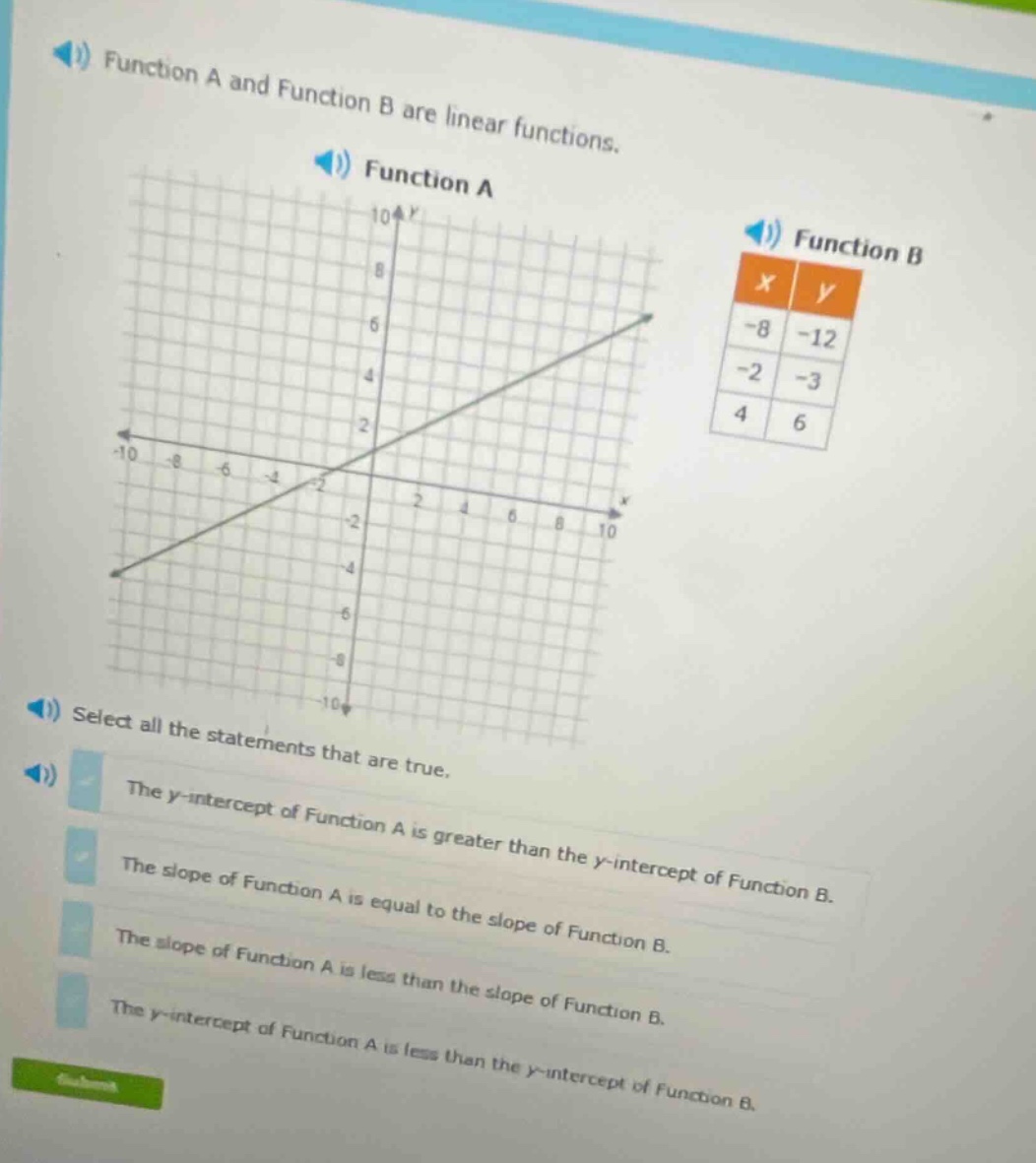
function a and function b are linear functions.
function a
(graph of function a: a line on a coordinate grid with x from -10 to 10 and y from -10 to 10, passing through some points)
function b
| x | y |
| -8 | -12 |
| -2 | -3 |
| 4 | 6 |
select all the statements that are true.
- the y - intercept of function a is greater than the y - intercept of function b.
- the slope of function a is equal to the slope of function b.
- the slope of function a is less than the slope of function b.
- the y - intercept of function a is less than the y - intercept of function b.
Step1: Find y-intercept of Function A
From the graph, Function A crosses the y-axis at (0, 1), so y-intercept \( b_A = 1 \).
Step2: Find equation of Function B (to get y-intercept and slope)
Use two points \((x_1, y_1)=(-8, -12)\) and \((x_2, y_2)=(-2, -3)\) to find slope \( m_B \):
\( m_B = \frac{y_2 - y_1}{x_2 - x_1} = \frac{-3 - (-12)}{-2 - (-8)} = \frac{9}{6} = \frac{3}{2} \).
Use point-slope form \( y - y_1 = m(x - x_1) \) with \((-2, -3)\):
\( y - (-3) = \frac{3}{2}(x - (-2)) \)
\( y + 3 = \frac{3}{2}(x + 2) \)
\( y = \frac{3}{2}x + 3 - 3 \)
\( y = \frac{3}{2}x \). So y-intercept \( b_B = 0 \).
Step3: Find slope of Function A
From the graph, use points (0, 1) and (2, 2) (approximate, or see rise/run). Slope \( m_A = \frac{2 - 1}{2 - 0} = \frac{1}{2} \)? Wait, no—wait, let's check again. Wait, the graph: when x=0, y=1; when x=2, y=2? Wait, no, maybe better to use ( -2, 0) and (0, 1). So \( m_A = \frac{1 - 0}{0 - (-2)} = \frac{1}{2} \)? Wait, no, wait the line: from (-2, 0) to (0, 1), rise 1, run 2, so slope \( \frac{1}{2} \)? Wait, no, wait the graph: let's check another point. Wait, maybe I made a mistake. Wait, the graph of Function A: when x=0, y=1; when x=2, y=2? Wait, no, the line goes through (0,1) and (2,2)? Wait, no, maybe the slope is \( \frac{1}{2} \)? Wait, no, wait the table for Function B has slope \( \frac{3}{2} \). Wait, but let's re-examine Function A's graph. Wait, the line passes through (0,1) and (2,2)? No, wait, when x=0, y=1; when x=2, y=2? Then slope is \( \frac{2 - 1}{2 - 0} = \frac{1}{2} \). But wait, Function B's slope is \( \frac{3}{2} \). Wait, no, maybe I messed up Function A's points. Wait, the graph: the line crosses the x-axis at (-2, 0) and y-axis at (0, 1). So slope \( m_A = \frac{1 - 0}{0 - (-2)} = \frac{1}{2} \). Wait, but let's check again. Wait, the problem: Function A is linear. Let's take two clear points: (0, 1) and (2, 2) – slope \( \frac{1}{2} \). Function B's slope is \( \frac{3}{2} \). Wait, but wait, maybe I made a mistake in Function A's slope. Wait, no, let's re-express:
Wait, Function A: from the graph, when x= -2, y=0; x=0, y=1; x=2, y=2. So slope is \( \frac{1 - 0}{0 - (-2)} = \frac{1}{2} \). Function B's slope is \( \frac{3}{2} \). Y-intercept of A is 1, B is 0.
Now check the statements:
- "The y-intercept of Function A is greater than the y-intercept of Function B." \( b_A = 1 \), \( b_B = 0 \). 1 > 0: True.
- "The slope of Function A is equal to the slope of Function B." \( m_A = \frac{1}{2} \), \( m_B = \frac{3}{2} \). Not equal: False.
- "The slope of Function A is less than the slope of Function B." \( \frac{1}{2} < \frac{3}{2} \): True? Wait, wait, no—wait, did I calculate Function A's slope wrong? Wait, maybe I misread the graph. Wait, let's look again. The graph of Function A: when x=0, y=1; when x=2, y=2? No, maybe the line is steeper? Wait, no, the table for Function B: when x=4, y=6. So Function B at x=4, y=6: \( y = \frac{3}{2}(4) = 6 \), correct. So Function B is \( y = \frac{3}{2}x \). Now Function A: let's take x=0, y=1; x=2, y=2? No, that would be slope 1/2. But maybe the graph is different. Wait, maybe I made a mistake. Wait, the graph: the line goes through (0,1) and (2, 2)? No, maybe (0,1) and (4, 3)? Then slope is (3-1)/(4-0)=2/4=1/2. Wait, but Function B's slope is 3/2. So \( m_A = 1/2 \), \( m_B = 3/2 \). So \( m_A < m_B \): True. Wait, but the statement "The slope of Function A is less than the slope of Function B" is true? Wait, but let's check the y-intercepts: \( b_A = 1 \), \( b_B = 0 \), so "The y-intercept of Function A is greater…

Snap & solve any problem in the app
Get step-by-step solutions on Sovi AI
Photo-based solutions with guided steps
Explore more problems and detailed explanations
The true statements are:
- The y-intercept of Function A is greater than the y-intercept of Function B.
- The slope of Function A is less than the slope of Function B.
(If selecting options, mark these two. But since the options are checkboxes, the correct ones are the first and third (assuming the options are ordered as: 1. y-intercept A > B; 2. slope A = B; 3. slope A < B; 4. y-intercept A < B). So the correct options are the first and third.)