QUESTION IMAGE
Question
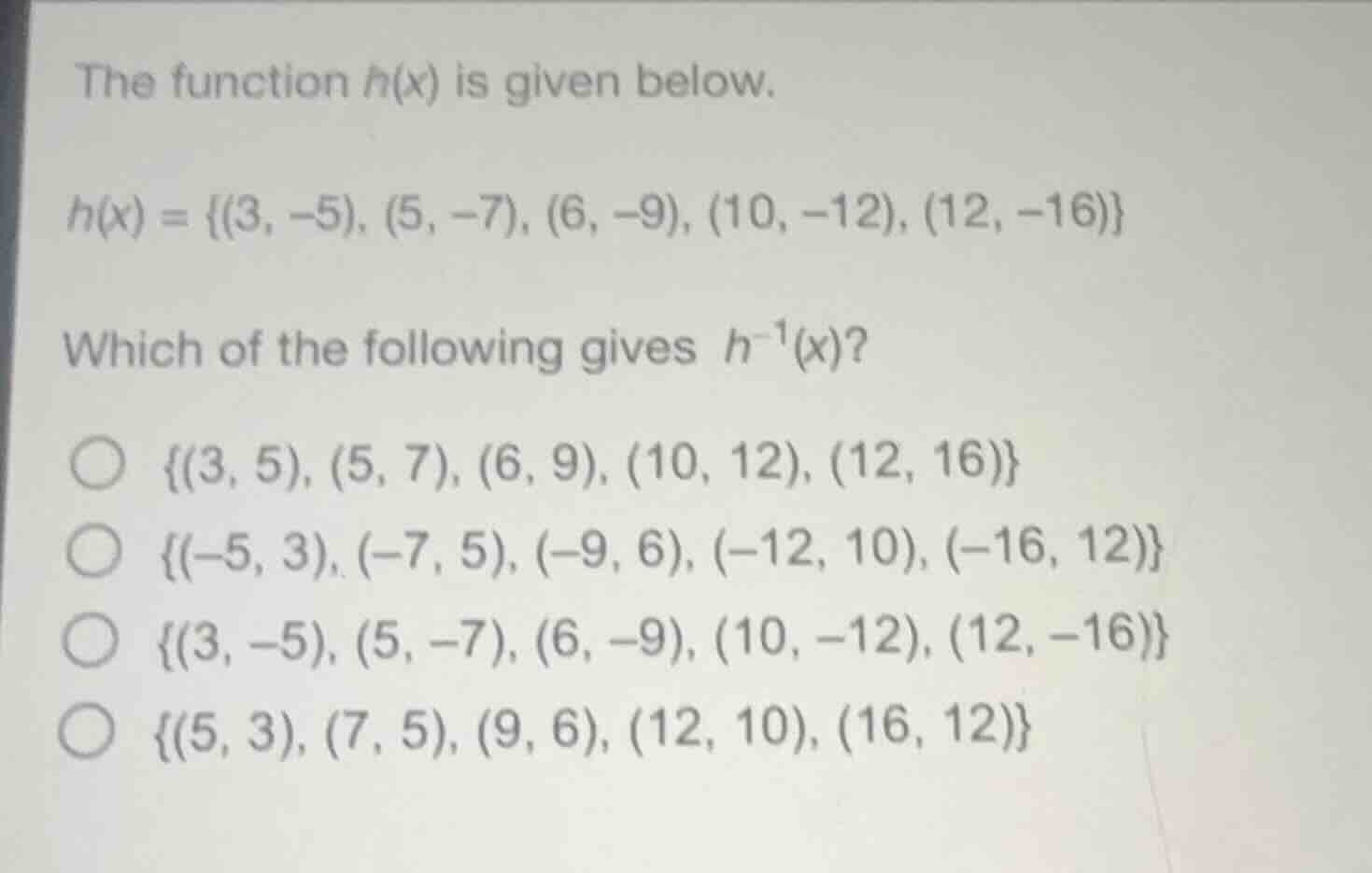
the function $h(x)$ is given below.
$h(x) = \\{(3, -5), (5, -7), (6, -9), (10, -12), (12, -16)\\}$
which of the following gives $h^{-1}(x)$?
$\bigcirc$ $\\{(3, 5), (5, 7), (6, 9), (10, 12), (12, 16)\\}$
$\bigcirc$ $\\{(-5, 3), (-7, 5), (-9, 6), (-12, 10), (-16, 12)\\}$
$\bigcirc$ $\\{(3, -5), (5, -7), (6, -9), (10, -12), (12, -16)\\}$
$\bigcirc$ $\\{(5, 3), (7, 5), (9, 6), (12, 10), (16, 12)\\}$
Step1: Recall inverse function rule
For a function defined as ordered pairs \((x, y)\), its inverse \(h^{-1}(x)\) swaps the \(x\) and \(y\) values of each pair.
Step2: Swap coordinates for each pair
Take each pair in \(h(x)\):
- \((3, -5)\) becomes \((-5, 3)\)
- \((5, -7)\) becomes \((-7, 5)\)
- \((6, -9)\) becomes \((-9, 6)\)
- \((10, -12)\) becomes \((-12, 10)\)
- \((12, -16)\) becomes \((-16, 12)\)

Snap & solve any problem in the app
Get step-by-step solutions on Sovi AI
Photo-based solutions with guided steps
Explore more problems and detailed explanations
$\{(-5, 3), (-7, 5), (-9, 6), (-12, 10), (-16, 12)\}$