QUESTION IMAGE
Question
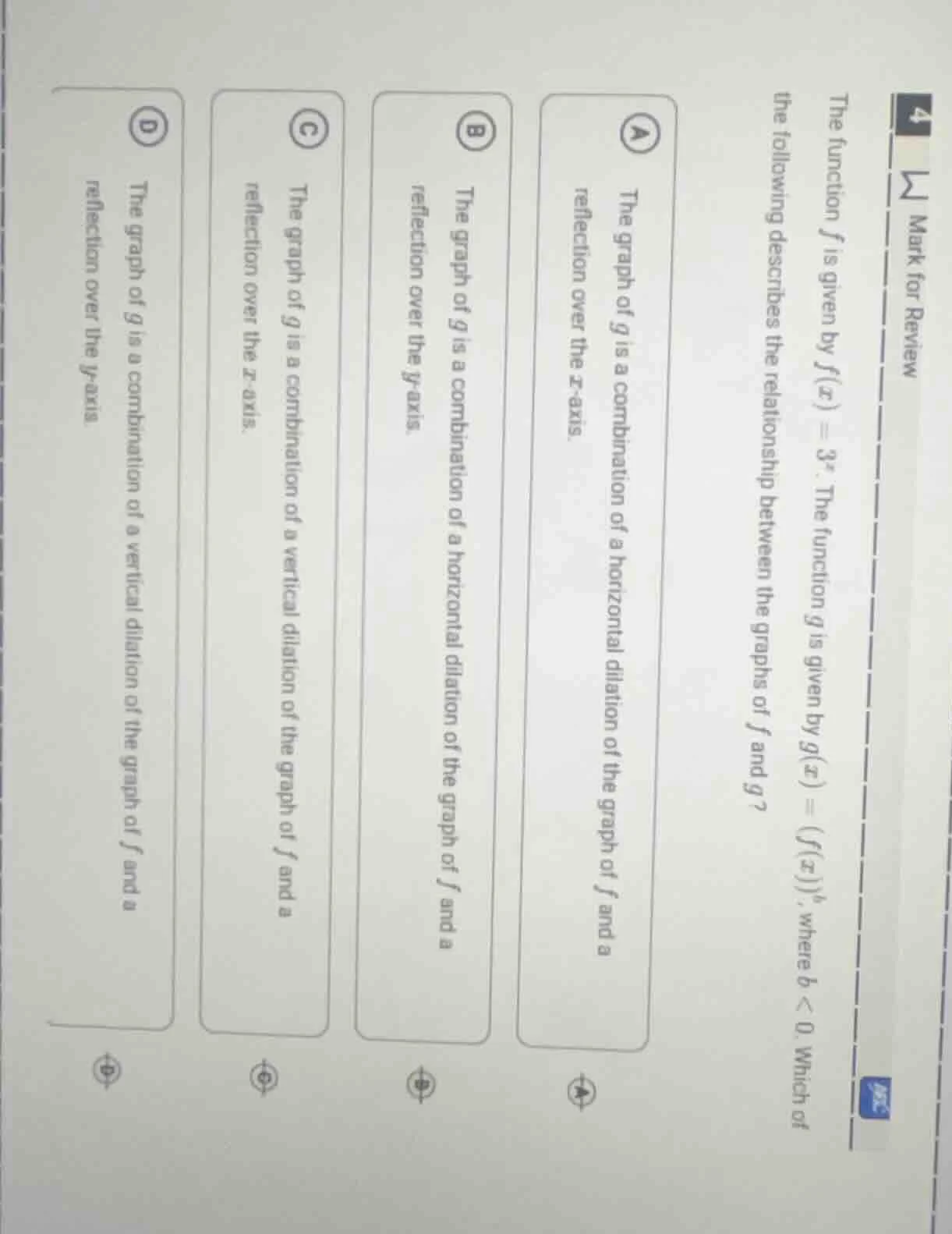
the function ( f ) is given by ( f(x) = 3^x ). the function ( g ) is given by ( g(x) = (f(x))^b ), where ( b < 0 ). which of the following describes the relationship between the graphs of ( f ) and ( g )?
a the graph of ( g ) is a combination of a horizontal dilation of the graph of ( f ) and a reflection over the ( x )-axis.
b the graph of ( g ) is a combination of a horizontal dilation of the graph of ( f ) and a reflection over the ( y )-axis.
c the graph of ( g ) is a combination of a vertical dilation of the graph of ( f ) and a reflection over the ( x )-axis.
d the graph of ( g ) is a combination of a vertical dilation of the graph of ( f ) and a reflection over the ( y )-axis.
First, recall the function transformation rules. For a function \( y = f(x) \), if we have \( y=(f(x))^b \), when \( b < 0 \), we can rewrite it as \( y=\frac{1}{(f(x))^{|b|}} \), which is a vertical dilation (since it's a reciprocal transformation, which is a type of vertical scaling) and a reflection? Wait, no, let's think again. Wait, the original function is \( f(x) = 3^x \), and \( g(x)=(f(x))^b=(3^x)^b = 3^{bx} \)? Wait, no, maybe I misread. Wait, if \( g(x)=(f(x))^b \), and \( f(x)=3^x \), then \( g(x)=(3^x)^b = 3^{bx} \). But if \( b < 0 \), let's say \( b=-k \) where \( k>0 \), then \( g(x)=3^{-kx}=(\frac{1}{3^{kx}})=(3^{kx})^{-1} \), but also, \( 3^{bx}=3^{-kx}=(\frac{1}{3})^{-kx} \)? Wait, no, maybe the problem is about \( g(x)=(f(x))^b \) as a transformation of \( f(x) \). Wait, when we have \( y = (f(x))^b \), if \( b < 0 \), this is equivalent to \( y=\frac{1}{(f(x))^{|b|}} \), which is a vertical dilation (since we're taking the reciprocal, which scales the y - values) and a reflection? Wait, no, reflection over the x - axis is \( y=-f(x) \), but here we have \( y=(f(x))^b \) with \( b < 0 \). Wait, maybe the problem has a typo, or maybe I misinterpret. Wait, another approach: Let's consider the options. Option C says "The graph of g is a combination of a vertical dilation of the graph of f and a reflection over the x - axis." Wait, if \( b < 0 \), let's let \( b=-m \), \( m>0 \). Then \( g(x)=(f(x))^{-m}=\frac{1}{(f(x))^m} \). But a vertical dilation by a factor of \( \frac{1}{(f(x))^m} \) is not exactly, but maybe if we consider \( f(x)=3^x \), then \( g(x)=(3^x)^b = 3^{bx} \). If \( b < 0 \), say \( b = - 2 \), then \( g(x)=3^{-2x}=(\frac{1}{3^{2x}})=(\frac{1}{9})^x \), which is a horizontal dilation? No, wait, \( 3^{bx}=3^{-2x}=(3^{-2})^x=(\frac{1}{9})^x \), which is a vertical dilation? No, that's a horizontal dilation? Wait, no, the transformation from \( f(x)=3^x \) to \( g(x)=3^{bx} \) is a horizontal dilation by a factor of \( \frac{1}{|b|} \) when \( b
eq0 \). But the options are about vertical dilation and reflection. Wait, maybe the problem was supposed to be \( g(x)=b\cdot f(x) \) with \( b < 0 \), but it's written as \( g(x)=(f(x))^b \). Assuming that there's a typo and it's \( g(x)=b\cdot f(x) \) with \( b < 0 \), then \( g(x)=b\cdot 3^x \), where \( b < 0 \). Then, \( b=-|b| \), so \( g(x)=-|b|\cdot 3^x \), which is a vertical dilation (by a factor of \( |b| \)) and a reflection over the x - axis (since we have the negative sign). But the options: Option C says "The graph of g is a combination of a vertical dilation of the graph of f and a reflection over the x - axis." That makes sense because if \( b < 0 \), \( g(x)=b\cdot f(x) \) (assuming the problem meant \( g(x)=b\cdot f(x) \) instead of \( (f(x))^b \)) would be a vertical dilation (by \( |b| \)) and a reflection over the x - axis (because of the negative sign). So among the options, Option C is the most likely. Wait, but let's check the options again. Option C: "The graph of g is a combination of a vertical dilation of the graph of f and a reflection over the x - axis." If \( b < 0 \), then writing \( g(x)=(f(x))^b \) as \( g(x)=b\cdot f(x) \) (maybe a typo, exponent vs. coefficient), then with \( b < 0 \), it's a vertical dilation (by \( |b| \)) and a reflection over the x - axis (since \( b \) is negative, multiplying by a negative number reflects over the x - axis and dilates vertically). So the correct option is C.

Snap & solve any problem in the app
Get step-by-step solutions on Sovi AI
Photo-based solutions with guided steps
Explore more problems and detailed explanations
C. The graph of g is a combination of a vertical dilation of the graph of f and a reflection over the x - axis.