QUESTION IMAGE
Question
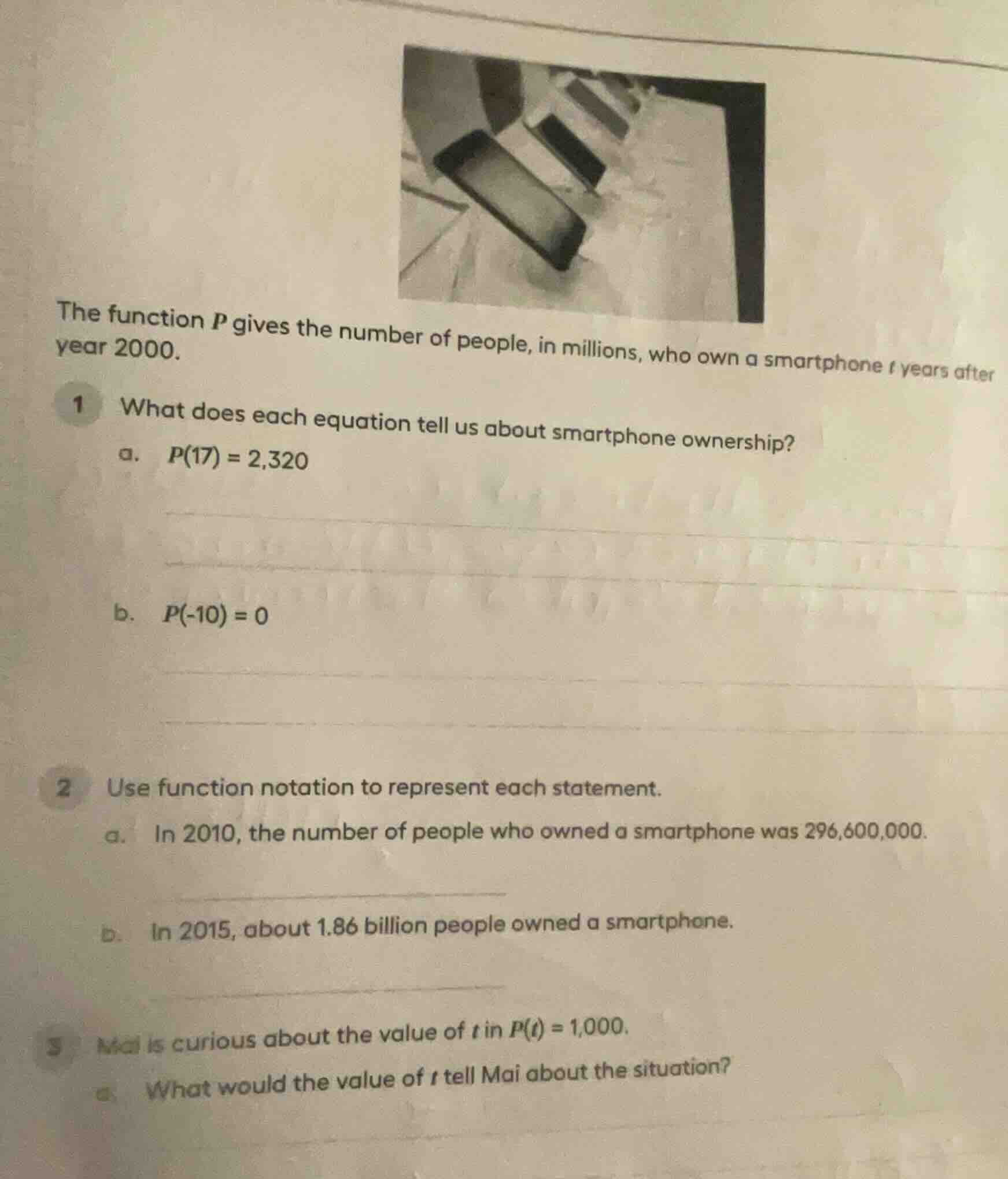
the function p gives the number of people, in millions, who own a smartphone t years after year 2000.
1 what does each equation tell us about smartphone ownership?
a. p(17) = 2,320
b. p(-10) = 0
2 use function notation to represent each statement.
a. in 2010, the number of people who owned a smartphone was 296,600,000.
b. in 2015, about 1.86 billion people owned a smartphone.
3 mai is curious about the value of t in p(t) = 1,000.
a. what would the value of t tell mai about the situation?
Problem 1a
Step1: Understand the function definition
The function \( P(t) \) gives the number of people (in millions) who own a smartphone \( t \) years after 2000. So \( t = 17 \) means 17 years after 2000.
Step2: Calculate the year
2000 + 17 = 2017. And \( P(17)=2320 \) means the number of people (in millions) who own a smartphone in 2017 is 2320 million.
Step1: Understand the function definition
\( P(t) \) is the number of people (in millions) who own a smartphone \( t \) years after 2000. Here \( t=- 10 \).
Step2: Calculate the year
2000-10 = 1990. And \( P(-10) = 0 \) means the number of people who own a smartphone in 1990 is 0 (in millions).
Step1: Calculate \( t \)
2010 - 2000=10, so \( t = 10 \). The number of people is 296600000, which is 296.6 million (since 296600000\(\div\)1000000 = 296.6).
Step2: Write the function notation
Using the function \( P(t) \), we have \( P(10)=296.6 \) (because \( P(t) \) is in millions).

Snap & solve any problem in the app
Get step-by-step solutions on Sovi AI
Photo-based solutions with guided steps
Explore more problems and detailed explanations
In 2017 (17 years after 2000), 2320 million people owned a smartphone.