QUESTION IMAGE
Question
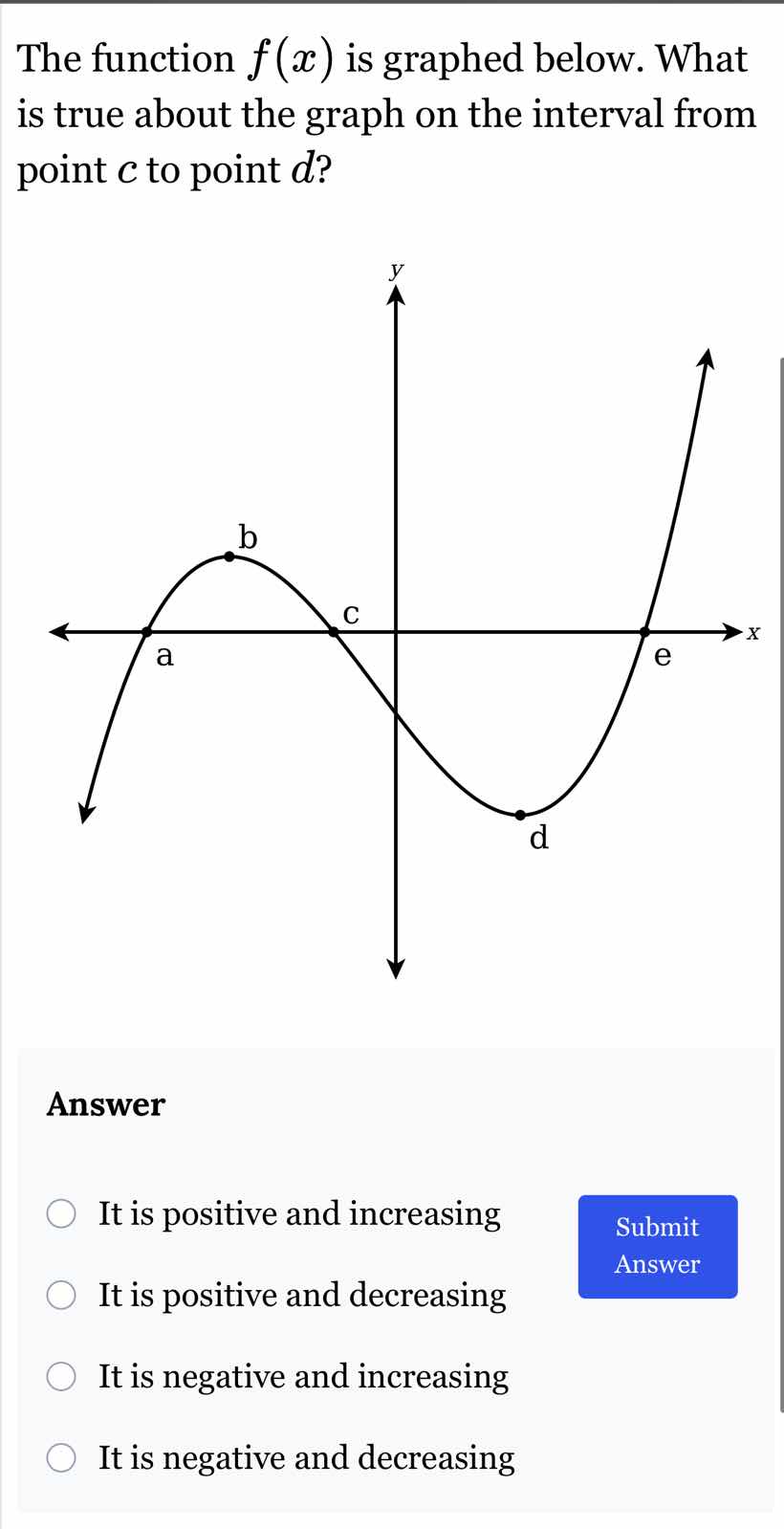
the function $f(x)$ is graphed below. what is true about the graph on the interval from point $c$ to point $d$?
graph of a function with points a, b, c, d, e.
answer
- it is positive and increasing
- it is positive and decreasing
- it is negative and increasing
- it is negative and decreasing
Step1: Analyze the sign of the function (positive/negative)
On the interval from point \( c \) to point \( d \), the graph of the function \( f(x) \) is below the \( x \)-axis. When a graph is below the \( x \)-axis, the function values (\( y \)-values) are negative. So, the function is negative on this interval.
Step2: Analyze the trend of the function (increasing/decreasing)
To determine if the function is increasing or decreasing, we look at the direction of the graph as \( x \) increases from \( c \) to \( d \). As \( x \) increases (moving from left to right on the interval from \( c \) to \( d \)), the \( y \)-values of the function are getting smaller (the graph is going downwards) initially? Wait, no. Wait, from \( c \) to \( d \), let's check the slope. Wait, actually, from \( c \) to \( d \), as \( x \) increases, the \( y \)-values are decreasing? Wait, no, wait. Wait, point \( c \) is on the \( x \)-axis (since it's an intersection point with the \( x \)-axis), and point \( d \) is the minimum point. Wait, when moving from \( c \) to \( d \), the \( x \)-values are increasing (since \( c \) is to the left of \( d \) on the \( x \)-axis? Wait, no, looking at the graph: point \( c \) is on the \( x \)-axis, to the left of the \( y \)-axis? Wait, no, the graph: the left part has a peak at \( b \), crosses the \( x \)-axis at \( a \) and \( c \), then goes down to cross the \( y \)-axis, then goes to the minimum at \( d \), then up to cross the \( x \)-axis at \( e \). So, from \( c \) (which is on the \( x \)-axis, to the left of the \( y \)-axis? Wait, no, the \( x \)-axis: \( a \) is left, \( c \) is between \( a \) and the \( y \)-axis, then the graph goes down to cross the \( y \)-axis (so at \( x = 0 \), \( y \) is negative), then continues down to \( d \) (the minimum), then up to \( e \). So, from \( c \) to \( d \): as \( x \) increases (moving from \( c \) to \( d \), which is to the right and down), the \( y \)-values are decreasing? Wait, no, wait: when \( x \) increases (moving right), the \( y \)-values go from \( 0 \) (at \( c \)) down to the minimum at \( d \). So, as \( x \) increases, \( y \) decreases? Wait, no, that would be decreasing. Wait, but wait, the options: let's re-examine. Wait, the options are:
- It is positive and increasing
- It is positive and decreasing
- It is negative and increasing
- It is negative and decreasing
Wait, maybe I made a mistake. Wait, from \( c \) to \( d \): the \( y \)-values are negative (since below \( x \)-axis). Now, is the function increasing or decreasing? Let's take two points: at \( c \), \( y = 0 \); at \( d \), \( y \) is the minimum (so lower than 0). Wait, as \( x \) increases from \( c \) to \( d \), \( y \) decreases from 0 to the minimum. Wait, but that would be decreasing. But wait, the graph from \( c \) to \( d \): is it decreasing? Wait, the slope: the derivative (if we think in terms of calculus) would be negative? Wait, no, maybe I messed up the direction. Wait, let's look at the graph again. The left part: from \( a \) to \( b \), it's increasing (goes up to \( b \)), then from \( b \) to \( c \), it's decreasing (goes down to \( c \) on the \( x \)-axis). Then from \( c \) to \( d \): it goes down below the \( x \)-axis, crosses the \( y \)-axis (where \( x = 0 \), \( y \) is negative), then continues down to \( d \) (the minimum). So, from \( c \) to \( d \), as \( x \) increases (moving right), the \( y \)-values are decreasing (since it's going down to the minimum). Wait, but that would be negative and decreasing? But wait, the options…

Snap & solve any problem in the app
Get step-by-step solutions on Sovi AI
Photo-based solutions with guided steps
Explore more problems and detailed explanations
It is negative and decreasing (the fourth option: "It is negative and decreasing")