QUESTION IMAGE
Question
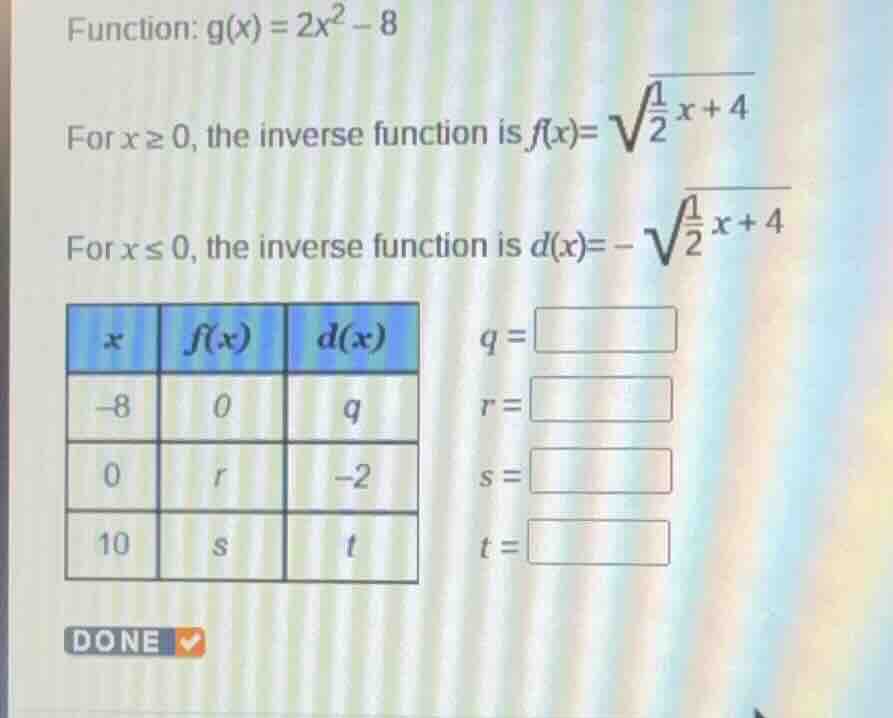
function: $g(x) = 2x^2 - 8$
for $x \geq 0$, the inverse function is $f(x)= \sqrt{\frac{1}{2}x + 4}$
for $x \leq 0$, the inverse function is $d(x)= - \sqrt{\frac{1}{2}x + 4}$
\
$q=\square$
$r=\square$
$s=\square$
$t=\square$
Step1: Find q (x = -8, use d(x))
We use the inverse function \( d(x)=-\sqrt{\frac{1}{2}x + 4} \) for \( x\leq0 \). Substitute \( x=-8 \):
\( d(-8)=-\sqrt{\frac{1}{2}(-8)+4}=-\sqrt{-4 + 4}=-\sqrt{0}=0 \)? Wait, no, wait. Wait, the table has for x=-8, f(x)=0, d(x)=q. Wait, maybe I made a mistake. Wait, the original function is \( g(x)=2x^2 - 8 \). Let's check the inverse. Wait, maybe we should use the inverse function formula. Wait, the inverse function for \( x\leq0 \) is \( d(x)=-\sqrt{\frac{1}{2}x + 4} \). Wait, when x=-8, substitute into d(x):
\( d(-8)=-\sqrt{\frac{1}{2}(-8)+4}=-\sqrt{-4 + 4}=-\sqrt{0}=0 \)? But the table for x=-8, f(x)=0, d(x)=q. Wait, maybe I messed up. Wait, the original function is \( g(x)=2x^2 - 8 \). Let's find the inverse. Let \( y = 2x^2 - 8 \), then \( 2x^2 = y + 8 \), \( x^2=\frac{y + 8}{2} \), so \( x=\pm\sqrt{\frac{y + 8}{2}} \). So for the inverse, when we consider the domain of the original function: if the original function \( g(x)=2x^2 - 8 \), the range is \( y\geq - 8 \). The inverse function for \( x\geq0 \) (original function's domain where x≥0) is \( f(y)=\sqrt{\frac{y + 8}{2}} \)? Wait, the problem says "For \( x\geq0 \), the inverse function is \( f(x)=\sqrt{\frac{1}{2}x + 4} \)". Wait, let's check: if \( y = 2x^2 - 8 \), then solving for x: \( x^2=\frac{y + 8}{2} \), so \( x=\sqrt{\frac{y + 8}{2}} \) when x≥0, so the inverse function (switch x and y) is \( f(x)=\sqrt{\frac{x + 8}{2}}=\sqrt{\frac{1}{2}x + 4} \), which matches. Similarly, for x≤0, the inverse function is \( d(x)=-\sqrt{\frac{1}{2}x + 4} \). So the input to the inverse function is the output of the original function. So when we have x (the input to the inverse function) as -8, 0, 10, those are the outputs of the original function g(x). So we need to find f(x) and d(x) which are the inputs to the original function g(x) such that g(f(x))=x and g(d(x))=x.
Wait, maybe the table is structured as: the first column is the input to the inverse function (i.e., the output of the original function g(x)), and f(x) and d(x) are the inputs to g(x) (i.e., the x-values of the original function) such that g(f(x))=x and g(d(x))=x.
So for the first row: x (input to inverse) = -8. So we need to find d(-8), which is the value of d(x) when the input x (to d) is -8. So d(x) is defined as \( d(x)=-\sqrt{\frac{1}{2}x + 4} \) for x≤0 (wait, no, the inverse function's domain: the original function g(x) has range y≥-8, so the inverse function's domain is x≥-8. The inverse function f(x) is for the original function's domain x≥0, so the inverse function f(x) has domain x≥-8 (since g(x)≥-8) and range x≥0. The inverse function d(x) is for the original function's domain x≤0, so the inverse function d(x) has domain x≥-8 and range x≤0.
So for x=-8 (input to d(x)):
\( d(-8)=-\sqrt{\frac{1}{2}(-8)+4}=-\sqrt{-4 + 4}=-\sqrt{0}=0 \)? But the table for x=-8, f(x)=0, d(x)=q. Wait, that would mean q=0? But let's check the second row: x=0 (input to inverse), f(x)=r, d(x)=-2. Let's check f(0): \( f(0)=\sqrt{\frac{1}{2}(0)+4}=\sqrt{4}=2 \), so r=2. And d(0)=-\sqrt{\frac{1}{2}(0)+4}=-\sqrt{4}=-2, which matches the table (d(x)=-2 when x=0). So that works. So for the first row, x=-8, d(-8)=-\sqrt{\frac{1}{2}(-8)+4}=-\sqrt{-4 + 4}=-\sqrt{0}=0, so q=0? Wait, but f(-8)=\sqrt{\frac{1}{2}(-8)+4}=\sqrt{-4 + 4}=\sqrt{0}=0, which matches the table (f(x)=0 when x=-8). So d(-8)=0? Wait, but the original function g(x)=2x^2 - 8. Let's check g(0)=2(0)^2 - 8=-8, which matches: g(0)=-8, so the inverse function at x=-8 should give 0 (since g(0)=-8). And since 0≥0, we use f(x), and for…

Snap & solve any problem in the app
Get step-by-step solutions on Sovi AI
Photo-based solutions with guided steps
Explore more problems and detailed explanations
q = 0
r = 2
s = 3
t = -3