QUESTION IMAGE
Question
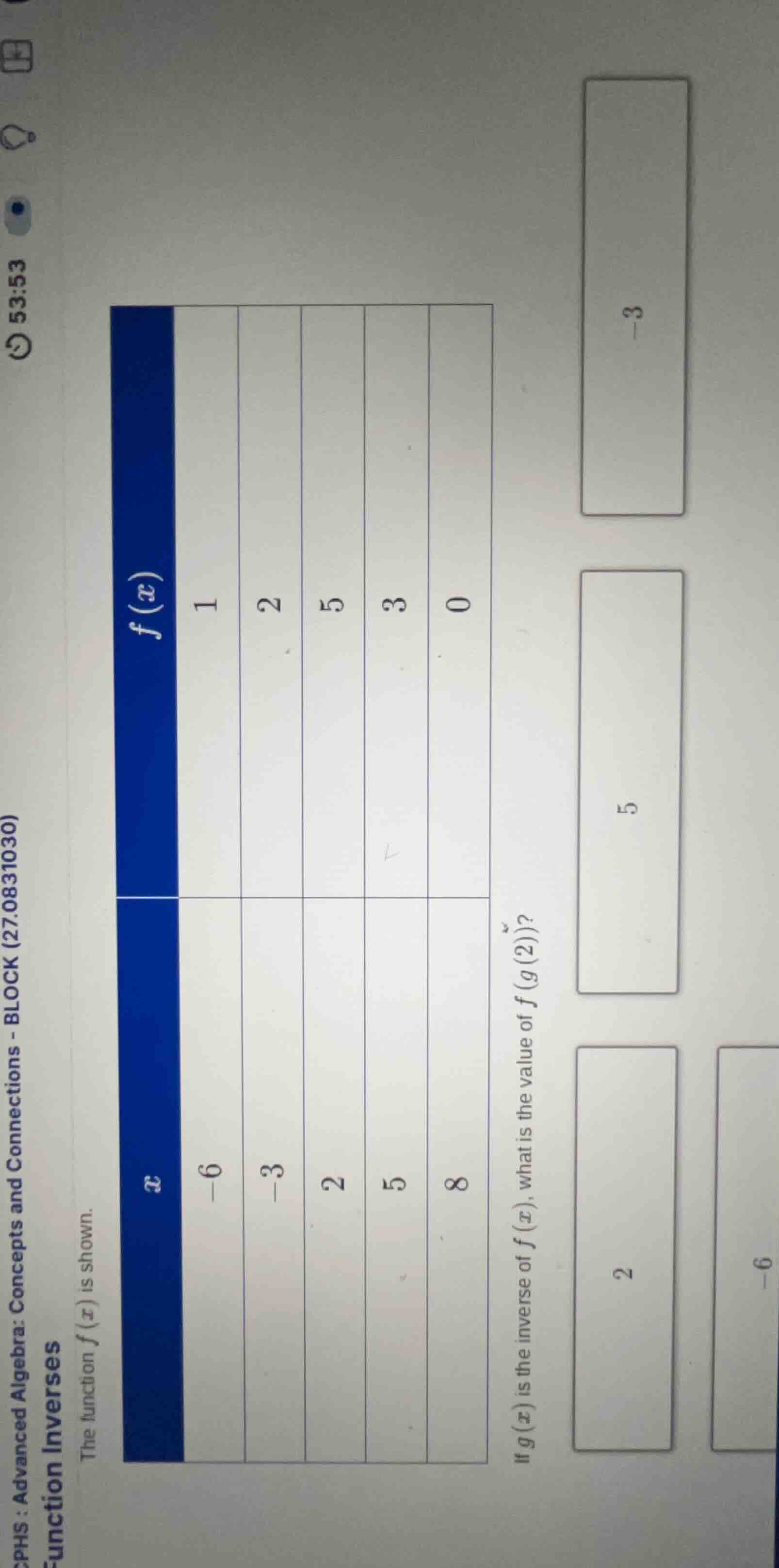
the function ( f(x) ) is shown.
| ( x ) | ( -6 ) | ( -3 ) | ( 2 ) | ( 5 ) | ( 8 ) |
| ( f(x) ) | ( 1 ) | ( 2 ) | ( 5 ) | ( 3 ) | ( 0 ) |
if ( g(x) ) is the inverse of ( f(x) ), what is the value of ( f(g(2)) )?
options: ( 2 ), ( 5 ), ( -3 ), ( -6 )
Step1: Recall inverse function property
If \( g(x) \) is the inverse of \( f(x) \), then \( f(g(x)) = x \) and \( g(f(x)) = x \). Also, to find \( g(2) \), we need to find the \( x \) such that \( f(x)=2 \) (since \( g \) is inverse of \( f \), \( g(y)=x \) when \( f(x)=y \)).
From the table, when \( f(x) = 2 \), \( x=-3 \). So \( g(2)=-3 \) (because \( g \) is inverse of \( f \), so \( g(f(-3))=-3 \) implies \( f(-3)=2 \) so \( g(2)=-3 \)).
Step2: Find \( f(g(2)) \)
Now we need to find \( f(g(2)) \). We already found \( g(2)=-3 \), so we need to find \( f(-3) \).
From the table, when \( x = -3 \), \( f(-3)=2 \)? Wait, no, wait the table: let's recheck the table. The table has \( x \) values: -6, -3, 2, 5, 8 and corresponding \( f(x) \) values: 1, 2, 5, 3, 0. Wait, so when \( x=-3 \), \( f(x)=2 \). So \( g(2) \) is the \( x \) where \( f(x)=2 \), which is \( x=-3 \), so \( g(2)=-3 \). Then \( f(g(2)) = f(-3) \). From the table, \( f(-3)=2 \)? Wait no, wait the table:
Wait the table is:
| \( x \) | -6 | -3 | 2 | 5 | 8 |
|---|
So \( f(-3)=2 \), \( f(2)=5 \), \( f(5)=3 \), \( f(8)=0 \), \( f(-6)=1 \).
So \( g(x) \) is inverse of \( f(x) \), so \( g(y)=x \) when \( f(x)=y \). So:
- \( g(1)=-6 \) (since \( f(-6)=1 \))
- \( g(2)=-3 \) (since \( f(-3)=2 \))
- \( g(5)=2 \) (since \( f(2)=5 \))
- \( g(3)=5 \) (since \( f(5)=3 \))
- \( g(0)=8 \) (since \( f(8)=0 \))
Now, we need to find \( f(g(2)) \). First, \( g(2)=-3 \) (from above, since \( f(-3)=2 \), so inverse function \( g(2)=-3 \)). Then \( f(g(2)) = f(-3) \). From the table, when \( x=-3 \), \( f(x)=2 \)? Wait no, wait the table: \( x=-3 \), \( f(x)=2 \). So \( f(-3)=2 \). Wait, but let's check again. Wait the table:
\( x=-6 \), \( f(x)=1 \)
\( x=-3 \), \( f(x)=2 \)
\( x=2 \), \( f(x)=5 \)
\( x=5 \), \( f(x)=3 \)
\( x=8 \), \( f(x)=0 \)
So \( g(2) \) is the \( x \) such that \( f(x)=2 \), which is \( x=-3 \), so \( g(2)=-3 \). Then \( f(g(2)) = f(-3) \). From the table, \( f(-3)=2 \)? Wait, no, \( x=-3 \), \( f(x)=2 \), so \( f(-3)=2 \). Therefore, \( f(g(2))=2 \)? Wait, no, that can't be. Wait, maybe I made a mistake. Wait, the inverse function property: \( f(g(x))=x \) and \( g(f(x))=x \). So if \( g \) is the inverse of \( f \), then \( f(g(y))=y \) for all \( y \) in the range of \( f \). Wait, that's the property of inverse functions: \( f(g(y))=y \) and \( g(f(x))=x \).
So since \( g \) is the inverse of \( f \), then \( f(g(y))=y \) for any \( y \) in the domain of \( g \) (which is the range of \( f \)). So \( g(2) \) is the \( x \) with \( f(x)=2 \), so \( f(g(2))=f(x)=2 \)? Wait, no, the property is \( f(g(y))=y \). So if \( y=2 \), then \( f(g(2))=2 \). Wait, that's the property of inverse functions. So regardless of the table, if \( g \) is the inverse of \( f \), then \( f(g(y))=y \). So since \( y=2 \), \( f(g(2))=2 \). Wait, but let's check with the table. \( g(2) \) is -3, so \( f(-3)=2 \), so \( f(g(2))=f(-3)=2 \). Yes, that matches the inverse function property. So \( f(g(2))=2 \).

Snap & solve any problem in the app
Get step-by-step solutions on Sovi AI
Photo-based solutions with guided steps
Explore more problems and detailed explanations
2