QUESTION IMAGE
Question
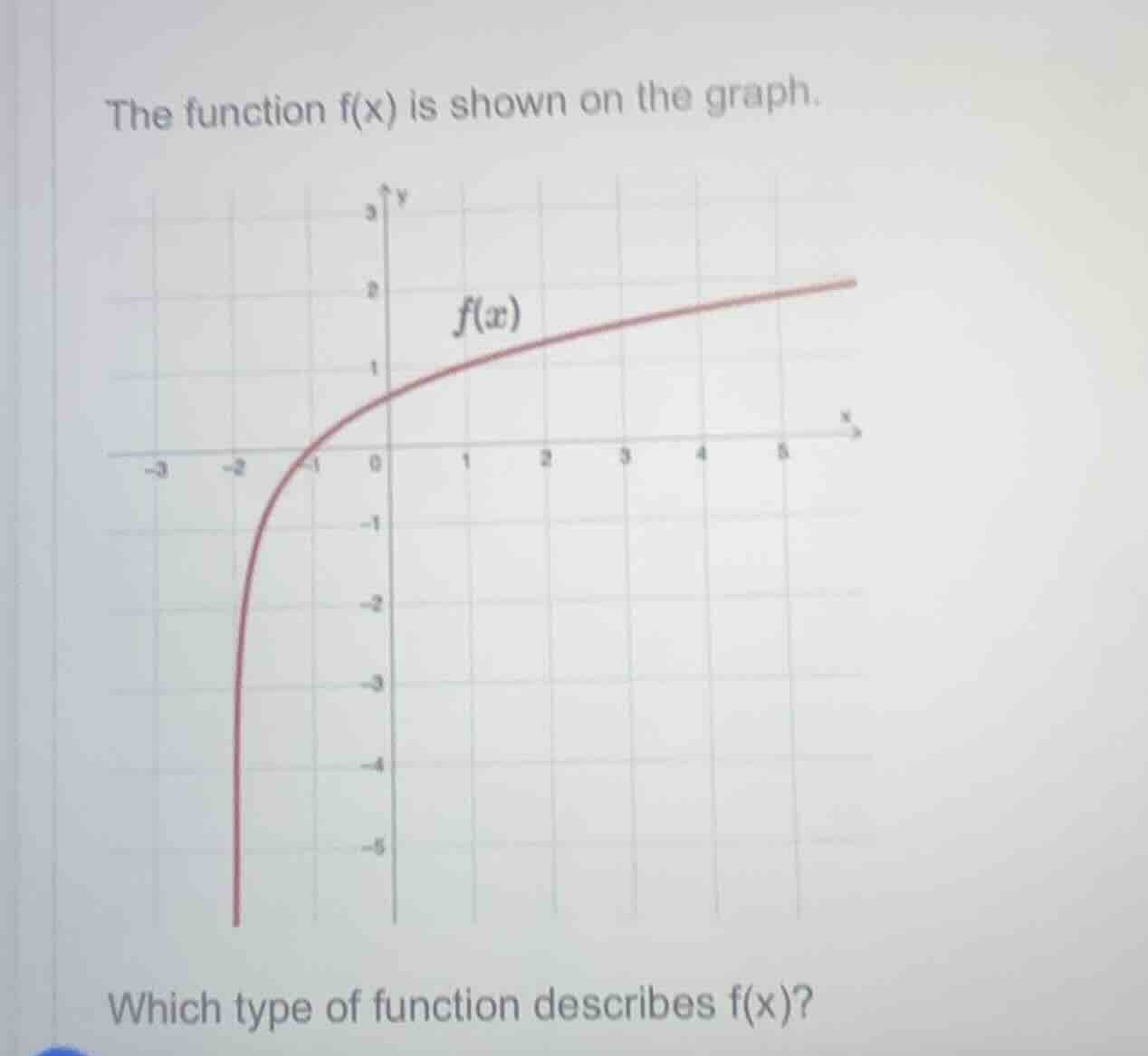
the function f(x) is shown on the graph.
which type of function describes f(x)?
The graph of \( f(x) \) has a curve that resembles the shape of a logarithmic or exponential function? Wait, no, actually, the left - hand side has a vertical asymptote (the vertical line it approaches) and the curve is increasing but with a decreasing rate (concave down for the increasing part). This is characteristic of a logarithmic function? Wait, no, actually, the shape is more like a logarithmic function? Wait, no, let's think again. The function has a vertical asymptote (at \( x=-2 \) maybe? Looking at the graph, as \( x \) approaches - 2 from the right, the function goes down to negative infinity, and as \( x \) increases, it increases but slows down. This is the shape of a logarithmic function? Wait, no, actually, the function \( y = \ln(x + 2) \) would have a vertical asymptote at \( x=-2 \), and as \( x \) increases, \( \ln(x + 2) \) increases but the rate of increase slows down (since the derivative \( \frac{1}{x + 2} \) decreases as \( x \) increases). Alternatively, it could be a logarithmic function. But more precisely, the shape is that of a logarithmic function (or an inverse of an exponential function). The key features: vertical asymptote, increasing function with decreasing slope (concave down for the increasing part). So the function is a logarithmic function (or a logarithmic - type function, like a natural log or common log function shifted horizontally).

Snap & solve any problem in the app
Get step-by-step solutions on Sovi AI
Photo-based solutions with guided steps
Explore more problems and detailed explanations
The function \( f(x) \) is a logarithmic function (or a function of the form \( y=\log_b(x + c) \) with a vertical asymptote, increasing and concave down for the increasing part).