QUESTION IMAGE
Question
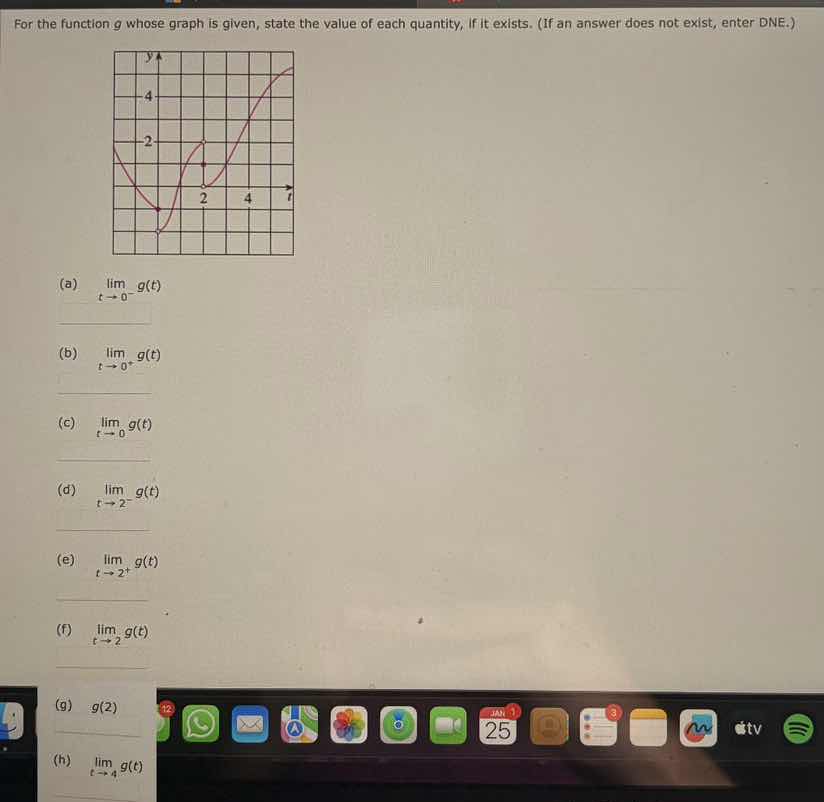
for the function g whose graph is given, state the value of each quantity, if it exists. (if an answer does not exist, enter dne.)
(a) \\( \lim_{t \to 0^-} g(t) \\)
(b) \\( \lim_{t \to 0^+} g(t) \\)
(c) \\( \lim_{t \to 0} g(t) \\)
(d) \\( \lim_{t \to 2^-} g(t) \\)
(e) \\( \lim_{t \to 2^+} g(t) \\)
(f) \\( \lim_{t \to 2} g(t) \\)
(g) \\( g(2) \\)
(h) \\( \lim_{t \to 4} g(t) \\)
To solve these limit and function value problems, we analyze the graph of \( g(t) \) by examining the left - hand and right - hand behavior as \( t \) approaches a given value, and the actual function value at a point.
Part (a): \( \lim_{t
ightarrow0^{-}}g(t) \)
- Step 1: Understand the left - hand limit
The left - hand limit as \( t
ightarrow0^{-} \) means we look at the values of \( g(t) \) as \( t \) approaches \( 0 \) from the left (values of \( t \) less than \( 0 \)). From the graph, as \( t \) approaches \( 0 \) from the left, the \( y \) - values of the function approach \( - 1 \) (we assume the point on the left - hand curve near \( t = 0 \) has a \( y \) - value of \( - 1 \) based on the grid and the shape of the graph). So, \( \lim_{t
ightarrow0^{-}}g(t)=- 1 \)
Part (b): \( \lim_{t
ightarrow0^{+}}g(t) \)
- Step 1: Understand the right - hand limit
The right - hand limit as \( t
ightarrow0^{+} \) means we look at the values of \( g(t) \) as \( t \) approaches \( 0 \) from the right (values of \( t \) greater than \( 0 \)). From the graph, as \( t \) approaches \( 0 \) from the right, the \( y \) - values of the function approach \( - 1 \) (the right - hand curve near \( t = 0 \) also has a \( y \) - value approaching \( - 1 \)). So, \( \lim_{t
ightarrow0^{+}}g(t)=- 1 \)
Part (c): \( \lim_{t
ightarrow0}g(t) \)
- Step 1: Recall the condition for the existence of a two - sided limit
A two - sided limit \( \lim_{t
ightarrow a}g(t) \) exists if and only if \( \lim_{t
ightarrow a^{-}}g(t)=\lim_{t
ightarrow a^{+}}g(t) \). We found that \( \lim_{t
ightarrow0^{-}}g(t)=-1 \) and \( \lim_{t
ightarrow0^{+}}g(t)=-1 \). Since the left - hand limit and the right - hand limit are equal, \( \lim_{t
ightarrow0}g(t)=-1 \)
Part (d): \( \lim_{t
ightarrow2^{-}}g(t) \)
- **Step 1: Analyze the left - hand limit as \( t
ightarrow2^{-} \)**
The left - hand limit as \( t
ightarrow2^{-} \) means we look at the values of \( g(t) \) as \( t \) approaches \( 2 \) from the left (values of \( t \) less than \( 2 \)). From the graph, as \( t \) approaches \( 2 \) from the left, the \( y \) - values of the function approach \( 2 \) (the left - hand curve near \( t = 2 \) has a \( y \) - value approaching \( 2 \)). So, \( \lim_{t
ightarrow2^{-}}g(t)=2 \)
Part (e): \( \lim_{t
ightarrow2^{+}}g(t) \)
- **Step 1: Analyze the right - hand limit as \( t
ightarrow2^{+} \)**
The right - hand limit as \( t
ightarrow2^{+} \) means we look at the values of \( g(t) \) as \( t \) approaches \( 2 \) from the right (values of \( t \) greater than \( 2 \)). From the graph, as \( t \) approaches \( 2 \) from the right, the \( y \) - values of the function approach \( 1 \) (the right - hand curve near \( t = 2 \) has a \( y \) - value approaching \( 1 \)). So, \( \lim_{t
ightarrow2^{+}}g(t)=1 \)
Part (f): \( \lim_{t
ightarrow2}g(t) \)
- Step 1: Recall the condition for the existence of a two - sided limit
For the two - sided limit \( \lim_{t
ightarrow2}g(t) \) to exist, \( \lim_{t
ightarrow2^{-}}g(t) \) must equal \( \lim_{t
ightarrow2^{+}}g(t) \). We found that \( \lim_{t
ightarrow2^{-}}g(t) = 2 \) and \( \lim_{t
ightarrow2^{+}}g(t)=1 \). Since \( 2
eq1 \), the two - sided limit \( \lim_{t
ightarrow2}g(t) \) does not exist. So, \( \lim_{t
ightarrow2}g(t)=\text{DNE} \)
Part (g): \( g(2) \)
- Step 1: Find the function value at \( t = 2 \)
To find \( g(2) \), we look at the actual point on the graph of \( g(t) \) when \( t = 2 \). From the graph, the filled - in dot (the actual function value) at \( t = 2 \) has a \( y \) -…

Snap & solve any problem in the app
Get step-by-step solutions on Sovi AI
Photo-based solutions with guided steps
Explore more problems and detailed explanations
To solve these limit and function value problems, we analyze the graph of \( g(t) \) by examining the left - hand and right - hand behavior as \( t \) approaches a given value, and the actual function value at a point.
Part (a): \( \lim_{t
ightarrow0^{-}}g(t) \)
- Step 1: Understand the left - hand limit
The left - hand limit as \( t
ightarrow0^{-} \) means we look at the values of \( g(t) \) as \( t \) approaches \( 0 \) from the left (values of \( t \) less than \( 0 \)). From the graph, as \( t \) approaches \( 0 \) from the left, the \( y \) - values of the function approach \( - 1 \) (we assume the point on the left - hand curve near \( t = 0 \) has a \( y \) - value of \( - 1 \) based on the grid and the shape of the graph). So, \( \lim_{t
ightarrow0^{-}}g(t)=- 1 \)
Part (b): \( \lim_{t
ightarrow0^{+}}g(t) \)
- Step 1: Understand the right - hand limit
The right - hand limit as \( t
ightarrow0^{+} \) means we look at the values of \( g(t) \) as \( t \) approaches \( 0 \) from the right (values of \( t \) greater than \( 0 \)). From the graph, as \( t \) approaches \( 0 \) from the right, the \( y \) - values of the function approach \( - 1 \) (the right - hand curve near \( t = 0 \) also has a \( y \) - value approaching \( - 1 \)). So, \( \lim_{t
ightarrow0^{+}}g(t)=- 1 \)
Part (c): \( \lim_{t
ightarrow0}g(t) \)
- Step 1: Recall the condition for the existence of a two - sided limit
A two - sided limit \( \lim_{t
ightarrow a}g(t) \) exists if and only if \( \lim_{t
ightarrow a^{-}}g(t)=\lim_{t
ightarrow a^{+}}g(t) \). We found that \( \lim_{t
ightarrow0^{-}}g(t)=-1 \) and \( \lim_{t
ightarrow0^{+}}g(t)=-1 \). Since the left - hand limit and the right - hand limit are equal, \( \lim_{t
ightarrow0}g(t)=-1 \)
Part (d): \( \lim_{t
ightarrow2^{-}}g(t) \)
- **Step 1: Analyze the left - hand limit as \( t
ightarrow2^{-} \)**
The left - hand limit as \( t
ightarrow2^{-} \) means we look at the values of \( g(t) \) as \( t \) approaches \( 2 \) from the left (values of \( t \) less than \( 2 \)). From the graph, as \( t \) approaches \( 2 \) from the left, the \( y \) - values of the function approach \( 2 \) (the left - hand curve near \( t = 2 \) has a \( y \) - value approaching \( 2 \)). So, \( \lim_{t
ightarrow2^{-}}g(t)=2 \)
Part (e): \( \lim_{t
ightarrow2^{+}}g(t) \)
- **Step 1: Analyze the right - hand limit as \( t
ightarrow2^{+} \)**
The right - hand limit as \( t
ightarrow2^{+} \) means we look at the values of \( g(t) \) as \( t \) approaches \( 2 \) from the right (values of \( t \) greater than \( 2 \)). From the graph, as \( t \) approaches \( 2 \) from the right, the \( y \) - values of the function approach \( 1 \) (the right - hand curve near \( t = 2 \) has a \( y \) - value approaching \( 1 \)). So, \( \lim_{t
ightarrow2^{+}}g(t)=1 \)
Part (f): \( \lim_{t
ightarrow2}g(t) \)
- Step 1: Recall the condition for the existence of a two - sided limit
For the two - sided limit \( \lim_{t
ightarrow2}g(t) \) to exist, \( \lim_{t
ightarrow2^{-}}g(t) \) must equal \( \lim_{t
ightarrow2^{+}}g(t) \). We found that \( \lim_{t
ightarrow2^{-}}g(t) = 2 \) and \( \lim_{t
ightarrow2^{+}}g(t)=1 \). Since \( 2
eq1 \), the two - sided limit \( \lim_{t
ightarrow2}g(t) \) does not exist. So, \( \lim_{t
ightarrow2}g(t)=\text{DNE} \)
Part (g): \( g(2) \)
- Step 1: Find the function value at \( t = 2 \)
To find \( g(2) \), we look at the actual point on the graph of \( g(t) \) when \( t = 2 \). From the graph, the filled - in dot (the actual function value) at \( t = 2 \) has a \( y \) - value of \( 1 \). So, \( g(2)=1 \)
Final Answers:
(a) \( \boldsymbol{-1} \)
(b) \( \boldsymbol{-1} \)
(c) \( \boldsymbol{-1} \)
(d) \( \boldsymbol{2} \)
(e) \( \boldsymbol{1} \)
(f) \( \boldsymbol{\text{DNE}} \)
(g) \( \boldsymbol{1} \)