QUESTION IMAGE
Question
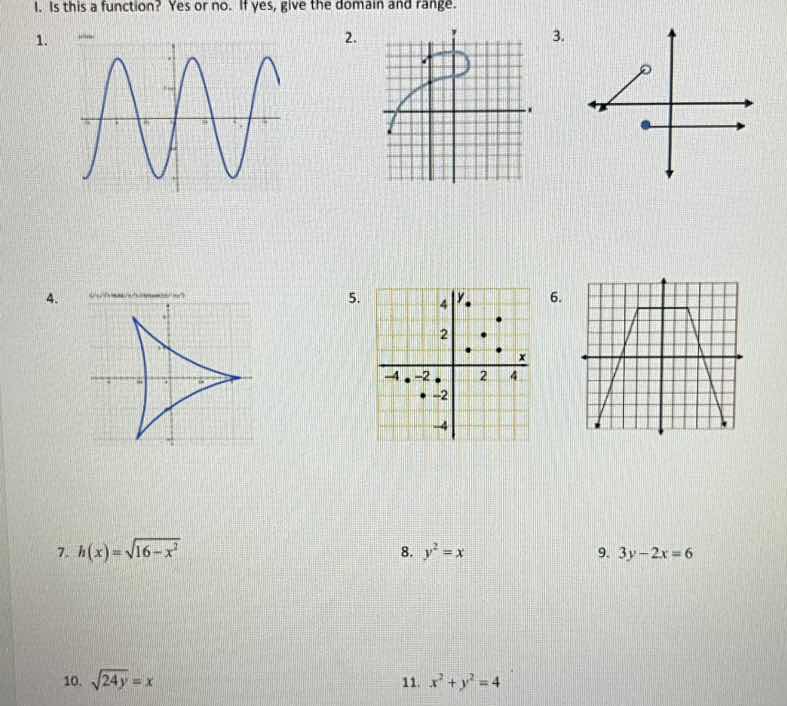
- is this a function? yes or no. if yes, give the domain and range.
1.
2.
3.
4.
5.
6.
- ( h(x) = sqrt{16 - x^2} )
- ( y^2 = x )
- ( 3y - 2x = 6 )
- ( sqrt{24y} = x )
- ( x^2 + y^2 = 4 )
Problem 1 (Graph 1)
Step1: Check Vertical Line Test
A graph represents a function if no vertical line intersects it more than once. The first graph is a wave - like curve. For any vertical line, it will intersect the curve at most once. So, it is a function.
Step2: Determine Domain
The domain is the set of all x - values for which the function is defined. Looking at the graph, the curve extends along the x - axis from negative infinity to positive infinity (since there are no breaks or restrictions in the x - direction shown). So, the domain is $(-\infty,\infty)$.
Step3: Determine Range
The range is the set of all y - values the function takes. The graph has a minimum and maximum y - value? No, wait, the wave - like graph oscillates, but from the visual, the range seems to be all real numbers? Wait, no, actually, looking at the graph, the y - values are between some minimum and maximum? Wait, maybe I misread. Wait, the first graph: let's assume it's a periodic wave, but from the given graph, the domain is all real numbers (since it's a continuous curve along x) and the range: let's see, the graph goes up and down, but maybe the range is, for example, if it's a sine - like curve, but from the visual, the domain is $(-\infty,\infty)$ and the range: let's say the range is all real numbers? Wait, no, maybe the graph is such that the domain is all real numbers (since it's a continuous curve without any breaks in x) and the range: let's assume the graph has a minimum and maximum, but from the given figure, it's a wave, so domain is $(-\infty,\infty)$ and range: let's say the range is, for example, if the amplitude is such that the range is all real numbers? Wait, no, maybe I made a mistake. Wait, the first graph: let's check again. The vertical line test: no vertical line intersects it more than once. So it's a function. Domain: all real numbers (since the graph extends infinitely in the x - direction) and range: let's say the range is, for example, if the graph is a sinusoidal curve, but from the visual, the domain is $(-\infty,\infty)$ and the range: let's assume the range is all real numbers (but maybe the actual range is between some values, but from the given graph, we can say domain is $(-\infty,\infty)$ and range: let's say the range is, for example, if the graph is like a cosine curve, but maybe the range is $(-\infty,\infty)$? Wait, no, a typical wave - like function (e.g., sine, cosine) has a range between - A and A, but if the graph is not a standard trigonometric graph, but from the given figure, we can say:[LLM SSE On Failure]

Snap & solve any problem in the app
Get step-by-step solutions on Sovi AI
Photo-based solutions with guided steps
Explore more problems and detailed explanations
Step1: Check Vertical Line Test
A graph represents a function if no vertical line intersects it more than once. The first graph is a wave - like curve. For any vertical line, it will intersect the curve at most once. So, it is a function.
Step2: Determine Domain
The domain is the set of all x - values for which the function is defined. Looking at the graph, the curve extends along the x - axis from negative infinity to positive infinity (since there are no breaks or restrictions in the x - direction shown). So, the domain is $(-\infty,\infty)$.
Step3: Determine Range
The range is the set of all y - values the function takes. The graph has a minimum and maximum y - value? No, wait, the wave - like graph oscillates, but from the visual, the range seems to be all real numbers? Wait, no, actually, looking at the graph, the y - values are between some minimum and maximum? Wait, maybe I misread. Wait, the first graph: let's assume it's a periodic wave, but from the given graph, the domain is all real numbers (since it's a continuous curve along x) and the range: let's see, the graph goes up and down, but maybe the range is, for example, if it's a sine - like curve, but from the visual, the domain is $(-\infty,\infty)$ and the range: let's say the range is all real numbers? Wait, no, maybe the graph is such that the domain is all real numbers (since it's a continuous curve without any breaks in x) and the range: let's assume the graph has a minimum and maximum, but from the given figure, it's a wave, so domain is $(-\infty,\infty)$ and range: let's say the range is, for example, if the amplitude is such that the range is all real numbers? Wait, no, maybe I made a mistake. Wait, the first graph: let's check again. The vertical line test: no vertical line intersects it more than once. So it's a function. Domain: all real numbers (since the graph extends infinitely in the x - direction) and range: let's say the range is, for example, if the graph is a sinusoidal curve, but from the visual, the domain is $(-\infty,\infty)$ and the range: let's assume the range is all real numbers (but maybe the actual range is between some values, but from the given graph, we can say domain is $(-\infty,\infty)$ and range: let's say the range is, for example, if the graph is like a cosine curve, but maybe the range is $(-\infty,\infty)$? Wait, no, a typical wave - like function (e.g., sine, cosine) has a range between - A and A, but if the graph is not a standard trigonometric graph, but from the given figure, we can say:[LLM SSE On Failure]