QUESTION IMAGE
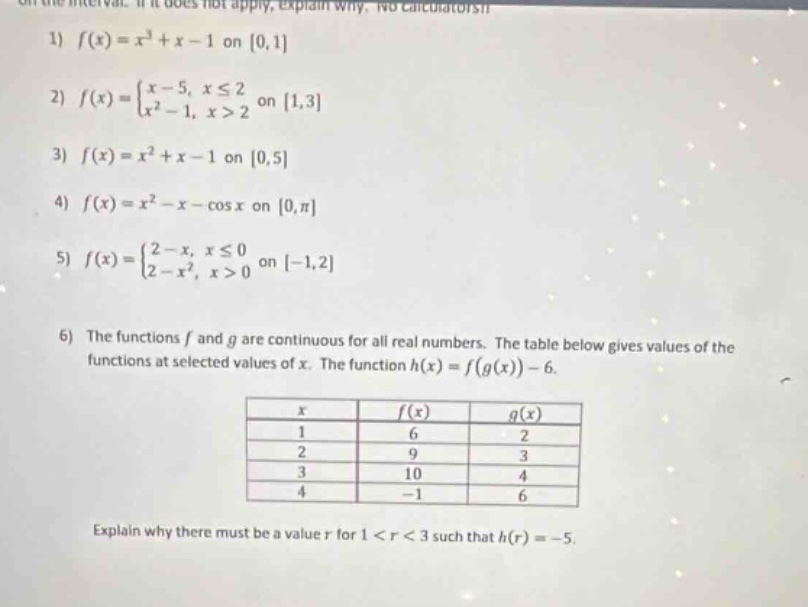
Question
- $f(x)=x^3 + x - 1$ on $0,1$
- $f(x)=\
$ on $1,3$
- $f(x)=x^2 + x - 1$ on $0,5$
- $f(x)=x^2 - x - \cos x$ on $0,\pi$
- $f(x)=\
$ on $-1,2$
- the functions $f$ and $g$ are continuous for all real numbers. the table below gives values of the functions at selected values of $x$. the function $h(x)=f(g(x)) - 6$.
| $x$ | $f(x)$ | $g(x)$ |
|---|---|---|
| 2 | 9 | 3 |
| 3 | 10 | 4 |
| 4 | -1 | 6 |
explain why there must be a value $r$ for $1 < r < 3$ such that $h(r) = -5$.
For problems 1-5 (Intermediate Value Theorem application check):
The Intermediate Value Theorem (IVT) states: If a function $f(x)$ is continuous on closed interval $[a,b]$, and $N$ is any number between $f(a)$ and $f(b)$, then there exists at least one $c \in (a,b)$ such that $f(c)=N$. We first check continuity, then evaluate endpoints.
---
Problem 1: $f(x)=x^3+x-1$ on $[0,1]$
Step1: Check continuity
Polynomials are continuous everywhere, so continuous on $[0,1]$.
Step2: Evaluate endpoints
$f(0)=0^3+0-1=-1$, $f(1)=1^3+1-1=1$
Step3: Apply IVT logic
For any $N$ between $-1$ and $1$, there is a $c \in (0,1)$ with $f(c)=N$. For example, since $0$ is between $-1$ and $1$, there is a root in $(0,1)$.
- First, rewrite the equation $h(r)=-5$ using $h(x)=f(g(x))-6$:
$f(g(r))-6=-5 \implies f(g(r))=1$.
- Check continuity of $h(x)$: Since $f$ and $g$ are continuous for all real numbers, the composition $f(g(x))$ is continuous, so $h(x)=f(g(x))-6$ is continuous everywhere, including on $[1,3]$.
- Evaluate $h(x)$ at $x=1$ and $x=3$:
- $h(1)=f(g(1))-6=f(2)-6=9-6=3$
- $h(3)=f(g(3))-6=f(4)-6=-1-6=-7$
- By the Intermediate Value Theorem, since $h(x)$ is continuous on $[1,3]$, and $-5$ is between $h(1)=3$ and $h(3)=-7$, there must exist some $r \in (1,3)$ such that $h(r)=-5$.

Snap & solve any problem in the app
Get step-by-step solutions on Sovi AI
Photo-based solutions with guided steps
Explore more problems and detailed explanations
The function is continuous on $[0,1]$. $f(0)=-1$, $f(1)=1$, so IVT applies: for any value between $-1$ and $1$, there exists a $c \in (0,1)$ where $f(c)$ equals that value.
---
Problem 2: $f(x)=
$ on $[1,3]$
Step1: Check continuity at $x=2$
Left-hand limit: $\lim_{x\to2^-} f(x)=2-5=-3$; Right-hand limit: $\lim_{x\to2^+} f(x)=2^2-1=3$. Limits are not equal, so $f(x)$ is discontinuous at $x=2 \in [1,3]$.