QUESTION IMAGE
Question
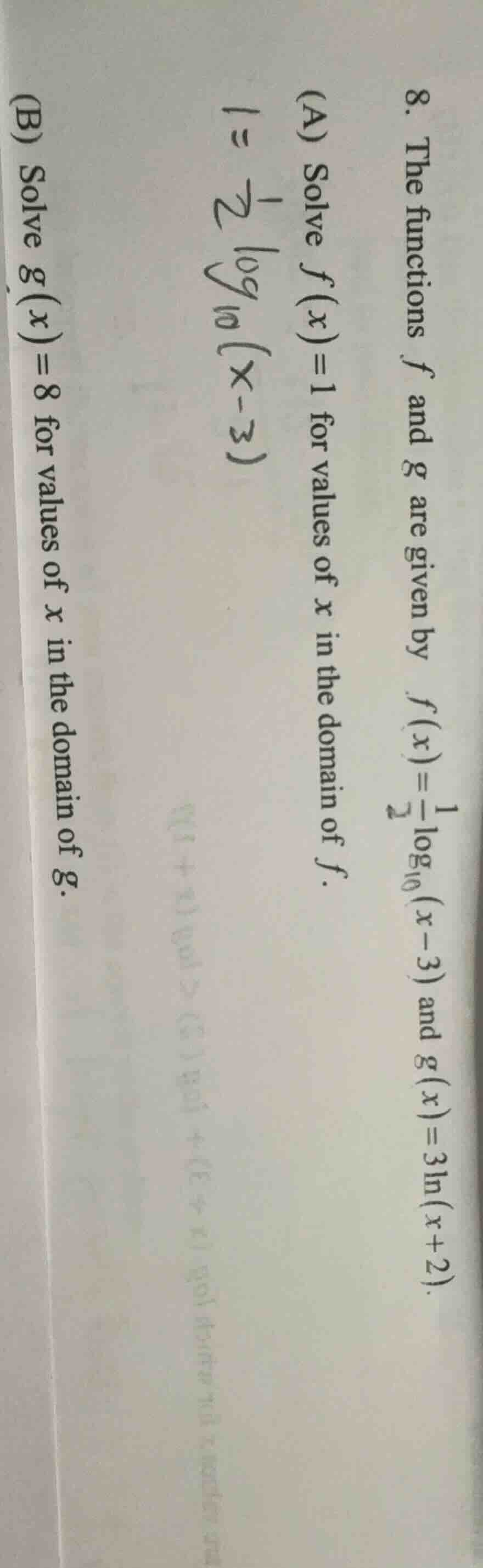
- the functions f and g are given by \\( f(x)=\frac{1}{2}\log_{10}(x - 3) \\) and \\( g(x)=3\ln(x + 2) \\).
(a) solve \\( f(x)=1 \\) for values of \\( x \\) in the domain of \\( f \\).
(b) solve \\( g(x)=8 \\) for values of \\( x \\) in the domain of \\( g \\).
Part (A)
Step 1: Start with the equation
We have the function \( f(x)=\frac{1}{2}\log_{10}(x - 3) \) and we want to solve \( f(x)=1 \). So we set up the equation:
\( \frac{1}{2}\log_{10}(x - 3)=1 \)
Step 2: Multiply both sides by 2
To isolate the logarithm, we multiply both sides of the equation by 2:
\( \log_{10}(x - 3)=1\times2 = 2 \)
Step 3: Convert from logarithmic to exponential form
Recall that if \( \log_{a}(b)=c \), then \( b = a^{c} \). Here, \( a = 10 \), \( c = 2 \), so we have:
\( x - 3=10^{2} \)
Step 4: Simplify the right - hand side and solve for x
\( 10^{2}=100 \), so the equation becomes \( x - 3 = 100 \). Then we add 3 to both sides:
\( x=100 + 3=103 \)
We also need to check the domain of \( f(x) \). For \( \log_{10}(x - 3) \) to be defined, \( x-3>0\), i.e., \( x > 3 \). Since \( 103>3 \), it is in the domain.
Step 1: Start with the equation
We have the function \( g(x)=3\ln(x + 2) \) and we want to solve \( g(x)=8 \). So we set up the equation:
\( 3\ln(x + 2)=8 \)
Step 2: Divide both sides by 3
To isolate the natural logarithm, we divide both sides of the equation by 3:
\( \ln(x + 2)=\frac{8}{3} \)
Step 3: Convert from logarithmic to exponential form
Recall that if \( \ln(b)=c \) (where \( \ln \) is the natural logarithm with base \( e \)), then \( b = e^{c} \). So we have:
\( x + 2=e^{\frac{8}{3}} \)
Step 4: Solve for x
Subtract 2 from both sides of the equation:
\( x=e^{\frac{8}{3}}-2 \)
We also need to check the domain of \( g(x) \). For \( \ln(x + 2) \) to be defined, \( x + 2>0\), i.e., \( x>-2 \). Since \( e^{\frac{8}{3}}\approx e^{2.6667}\approx14.39 \), then \( x=e^{\frac{8}{3}}-2\approx14.39 - 2 = 12.39>-2 \), so it is in the domain.

Snap & solve any problem in the app
Get step-by-step solutions on Sovi AI
Photo-based solutions with guided steps
Explore more problems and detailed explanations
\( x = 103 \)