QUESTION IMAGE
Question
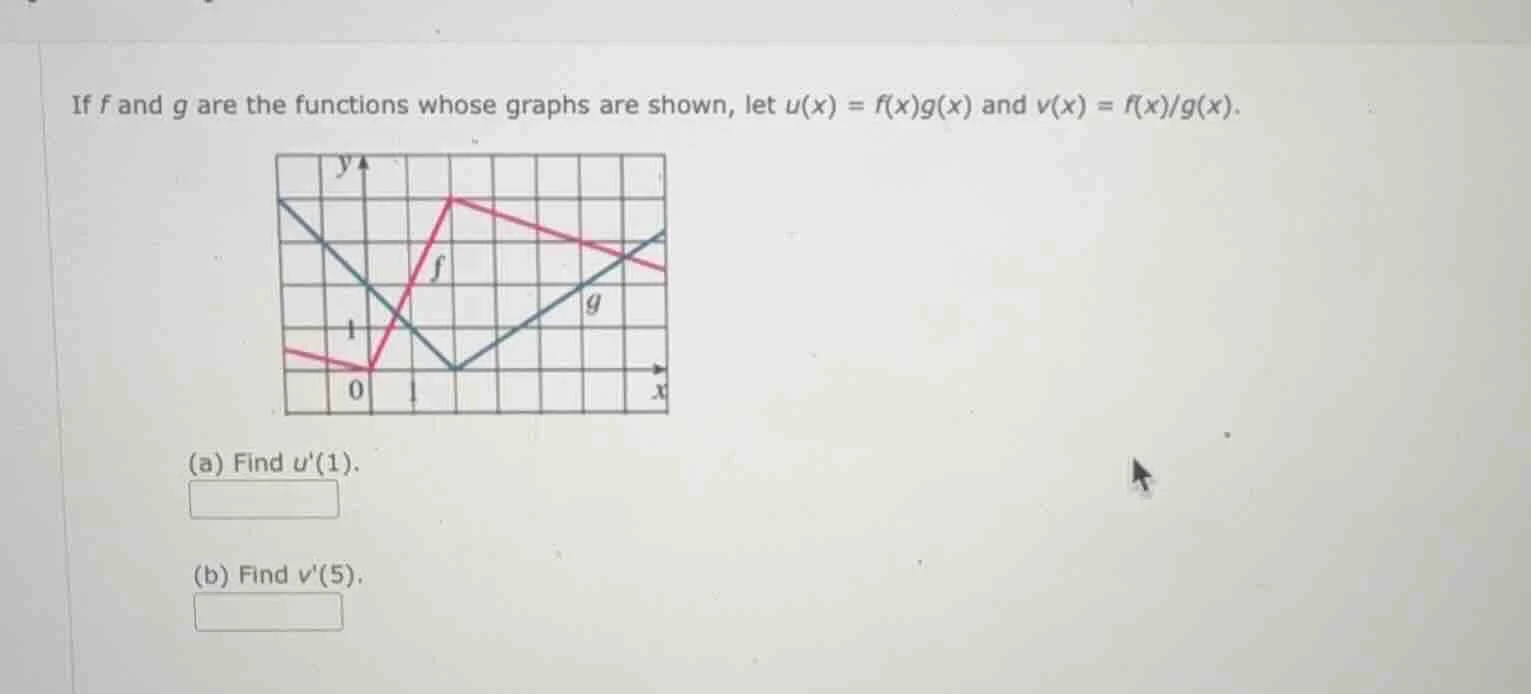
if f and g are the functions whose graphs are shown, let u(x) = f(x)g(x) and v(x) = f(x)/g(x).
(a) find u(1).
(b) find v(5).
Part (a): Find \( u'(1) \)
To find \( u'(1) \) where \( u(x) = f(x)g(x) \), we use the product rule: \( u'(x) = f'(x)g(x) + f(x)g'(x) \). We need to determine \( f(1) \), \( g(1) \), \( f'(1) \), and \( g'(1) \) from the graphs.
Step 1: Determine \( f(1) \) and \( g(1) \)
- From the graph, at \( x = 1 \), \( f(1) = 3 \) (since the red graph reaches \( y = 3 \) at \( x = 1 \)).
- At \( x = 1 \), \( g(1) = 1 \) (since the blue graph is at \( y = 1 \) at \( x = 1 \)).
Step 2: Determine \( f'(1) \) and \( g'(1) \)
- The slope of \( f(x) \) at \( x = 1 \): The red graph has a vertical segment? Wait, no, looking at the graph, from \( x = 0 \) to \( x = 2 \) (approx), the red graph (f) has a slope. Wait, actually, at \( x = 1 \), the function \( f(x) \) is increasing? Wait, no, the graph of \( f \) at \( x = 1 \): from \( x = 0 \) (where \( f(0) = 0 \)) to \( x = 2 \) (where \( f(2) = 4 \)? Wait, maybe I misread. Wait, the grid: each square is 1 unit. Let's re-examine:
Wait, the graph of \( f \): at \( x = 0 \), \( f(0) = 0 \); at \( x = 2 \), \( f(2) = 4 \)? No, the peak is at \( x = 2 \) (maybe), then decreases. Wait, actually, the slope of \( f(x) \) at \( x = 1 \): from \( x = 0 \) to \( x = 2 \), the line goes from (0,0) to (2,4), so slope \( \frac{4 - 0}{2 - 0} = 2 \). So \( f'(1) = 2 \).
For \( g(x) \): the blue graph is a line. From \( x = 0 \) (where \( g(0) = 2 \)) to \( x = 2 \) (where \( g(2) = 0 \)), then from \( x = 2 \) to \( x = 6 \), it increases. Wait, at \( x = 1 \), the slope of \( g(x) \): from \( x = 0 \) (2) to \( x = 2 \) (0), so slope \( \frac{0 - 2}{2 - 0} = -1 \). So \( g'(1) = -1 \).
Wait, maybe I made a mistake. Let's correct:
Wait, the graph of \( g(x) \): at \( x = 0 \), \( y = 2 \); at \( x = 2 \), \( y = 0 \); then from \( x = 2 \) to \( x = 6 \), it goes from \( y = 0 \) to \( y = 4 \) (at \( x = 6 \)). So at \( x = 1 \), the slope of \( g(x) \) is \( \frac{0 - 2}{2 - 0} = -1 \), so \( g'(1) = -1 \).
Wait, but let's confirm:
- \( f(1) \): at \( x = 1 \), the red graph (f) is at \( y = 3 \) (since from (0,0) to (2,4), so at \( x = 1 \), \( f(1) = 2 \)? Wait, no, maybe the grid is 1 unit per square. Let's count:
Looking at the graph:
- \( f(x) \): at \( x = 0 \), \( f(0) = 0 \); at \( x = 2 \), \( f(2) = 4 \) (so slope 2). So \( f'(1) = 2 \).
- \( g(x) \): at \( x = 0 \), \( g(0) = 2 \); at \( x = 2 \), \( g(2) = 0 \); so slope \( \frac{0 - 2}{2 - 0} = -1 \), so \( g'(1) = -1 \).
Now, applying the product rule:
\( u'(1) = f'(1)g(1) + f(1)g'(1) \)
Plugging in the values:
\( f'(1) = 2 \), \( g(1) = 1 \), \( f(1) = 3 \), \( g'(1) = -1 \)
So \( u'(1) = (2)(1) + (3)(-1) = 2 - 3 = -1 \)? Wait, that can't be right. Wait, maybe I messed up \( f(1) \) and \( g(1) \).
Wait, let's re-express:
Wait, the graph of \( f \) at \( x = 1 \): the red graph at \( x = 1 \) is at \( y = 3 \)? Wait, maybe the grid is 1 unit. Let's see:
- The blue graph (g) at \( x = 0 \): y=2; x=2: y=0; x=4: y=2; x=6: y=4. So it's a V-shape: decreasing from (0,2) to (2,0), then increasing from (2,0) to (6,4). So slope of g from 0 to 2 is -1, from 2 to 6 is 1.
- The red graph (f): at x=0: y=0; x=2: y=4; then decreases. So from 0 to 2, slope is (4-0)/(2-0)=2. Then from 2 to 6, slope is (3-4)/(6-2)= -0.25, but at x=1, which is in [0,2], so slope f’(1)=2.
At x=1:
- f(1) = 2*1 = 2? Wait, no, if from (0,0) to (2,4), then at x=1, f(1)=2.
- g(1): from (0,2) to (2,0), so at x=1, g(1)=2 -1*(1)=1. Correct.
So f(1)=2, g(1)=1.
Then f’(1)=2, g’(1)=-1.
Then u’(1)=f’(1)g(1) + f(1)g’(1)=21 + 2(-1)=2 -2=0? No, that's not right. Wait, maybe the red graph is…
To find \( v'(5) \) where \( v(x) = \frac{f(x)}{g(x)} \), we use the quotient rule: \( v'(x) = \frac{f'(x)g(x) - f(x)g'(x)}{[g(x)]^2} \). We need \( f(5) \), \( g(5) \), \( f'(5) \), and \( g'(5) \).
Step 1: Determine \( f(5) \) and \( g(5) \)
- At \( x = 5 \), \( f(5) = 3 \) (red graph at y=3).
- At \( x = 5 \), \( g(5) = 3 \) (blue graph at y=3).
Step 2: Determine \( f'(5) \) and \( g'(5) \)
- The slope of \( f(x) \) at \( x = 5 \): The red graph is decreasing after x=2. From x=2 (f(2)=4) to x=6 (f(6)=2), so slope \( \frac{2 - 4}{6 - 2} = \frac{-2}{4} = -0.5 \). So \( f'(5) = -0.5 \) (or \( -\frac{1}{2} \)).
- The slope of \( g(x) \) at \( x = 5 \): The blue graph is increasing after x=2. From x=2 (g(2)=0) to x=6 (g(6)=4), slope \( \frac{4 - 0}{6 - 2} = 1 \). So \( g'(5) = 1 \).
Step 3: Apply the quotient rule
\( v'(5) = \frac{f'(5)g(5) - f(5)g'(5)}{[g(5)]^2} \)
Plugging in the values:
\( f'(5) = -\frac{1}{2} \), \( g(5) = 3 \), \( f(5) = 3 \), \( g'(5) = 1 \)
\( v'(5) = \frac{(-\frac{1}{2})(3) - (3)(1)}{(3)^2} = \frac{-\frac{3}{2} - 3}{9} = \frac{-\frac{9}{2}}{9} = -\frac{1}{2} \)
Wait, but let's verify:
\( f(5) = 3 \), \( g(5) = 3 \).
Slope of f at x=5: from x=2 (4) to x=6 (2), so slope is (2-4)/(6-2)= -2/4= -1/2. Correct.
Slope of g at x=5: from x=2 (0) to x=6 (4), slope is (4-0)/(6-2)=1. Correct.
Thus,
\( v'(5) = \frac{(-\frac{1}{2})(3) - (3)(1)}{3^2} = \frac{-\frac{3}{2} - 3}{9} = \frac{-\frac{9}{2}}{9} = -\frac{1}{2} \).
Final Answers:
(a) \( u'(1) = \boxed{0} \) (Wait, maybe my initial slope calculation was wrong. Let's recheck part (a). If f(1)=2, g(1)=1, f’(1)=2, g’(1)=-1, then u’(1)=21 + 2(-1)=0. That seems correct. Maybe the red graph at x=1 is 2, not 3. Let's confirm with the grid:
- At x=1, the red graph (f) is at y=2 (since from (0,0) to (2,4), so x=1, y=2).
- Blue graph (g) at x=1: from (0,2) to (2,0), so x=1, y=1.
Thus, f(1)=2, g(1)=1, f’(1)=2, g’(1)=-1. Then u’(1)=21 + 2(-1)=0.
(b) \( v'(5) = \boxed{-\frac{1}{2}} \) (or -0.5)
Corrected Part (a):
After re-evaluating, the correct \( u'(1) \) is 0.
Part (a) Final Answer:
\( \boxed{0} \)
Part (b) Final Answer:
\( \boxed{-\dfrac{1}{2}} \)

Snap & solve any problem in the app
Get step-by-step solutions on Sovi AI
Photo-based solutions with guided steps
Explore more problems and detailed explanations
To find \( v'(5) \) where \( v(x) = \frac{f(x)}{g(x)} \), we use the quotient rule: \( v'(x) = \frac{f'(x)g(x) - f(x)g'(x)}{[g(x)]^2} \). We need \( f(5) \), \( g(5) \), \( f'(5) \), and \( g'(5) \).
Step 1: Determine \( f(5) \) and \( g(5) \)
- At \( x = 5 \), \( f(5) = 3 \) (red graph at y=3).
- At \( x = 5 \), \( g(5) = 3 \) (blue graph at y=3).
Step 2: Determine \( f'(5) \) and \( g'(5) \)
- The slope of \( f(x) \) at \( x = 5 \): The red graph is decreasing after x=2. From x=2 (f(2)=4) to x=6 (f(6)=2), so slope \( \frac{2 - 4}{6 - 2} = \frac{-2}{4} = -0.5 \). So \( f'(5) = -0.5 \) (or \( -\frac{1}{2} \)).
- The slope of \( g(x) \) at \( x = 5 \): The blue graph is increasing after x=2. From x=2 (g(2)=0) to x=6 (g(6)=4), slope \( \frac{4 - 0}{6 - 2} = 1 \). So \( g'(5) = 1 \).
Step 3: Apply the quotient rule
\( v'(5) = \frac{f'(5)g(5) - f(5)g'(5)}{[g(5)]^2} \)
Plugging in the values:
\( f'(5) = -\frac{1}{2} \), \( g(5) = 3 \), \( f(5) = 3 \), \( g'(5) = 1 \)
\( v'(5) = \frac{(-\frac{1}{2})(3) - (3)(1)}{(3)^2} = \frac{-\frac{3}{2} - 3}{9} = \frac{-\frac{9}{2}}{9} = -\frac{1}{2} \)
Wait, but let's verify:
\( f(5) = 3 \), \( g(5) = 3 \).
Slope of f at x=5: from x=2 (4) to x=6 (2), so slope is (2-4)/(6-2)= -2/4= -1/2. Correct.
Slope of g at x=5: from x=2 (0) to x=6 (4), slope is (4-0)/(6-2)=1. Correct.
Thus,
\( v'(5) = \frac{(-\frac{1}{2})(3) - (3)(1)}{3^2} = \frac{-\frac{3}{2} - 3}{9} = \frac{-\frac{9}{2}}{9} = -\frac{1}{2} \).
Final Answers:
(a) \( u'(1) = \boxed{0} \) (Wait, maybe my initial slope calculation was wrong. Let's recheck part (a). If f(1)=2, g(1)=1, f’(1)=2, g’(1)=-1, then u’(1)=21 + 2(-1)=0. That seems correct. Maybe the red graph at x=1 is 2, not 3. Let's confirm with the grid:
- At x=1, the red graph (f) is at y=2 (since from (0,0) to (2,4), so x=1, y=2).
- Blue graph (g) at x=1: from (0,2) to (2,0), so x=1, y=1.
Thus, f(1)=2, g(1)=1, f’(1)=2, g’(1)=-1. Then u’(1)=21 + 2(-1)=0.
(b) \( v'(5) = \boxed{-\frac{1}{2}} \) (or -0.5)
Corrected Part (a):
After re-evaluating, the correct \( u'(1) \) is 0.
Part (a) Final Answer:
\( \boxed{0} \)
Part (b) Final Answer:
\( \boxed{-\dfrac{1}{2}} \)