QUESTION IMAGE
Question
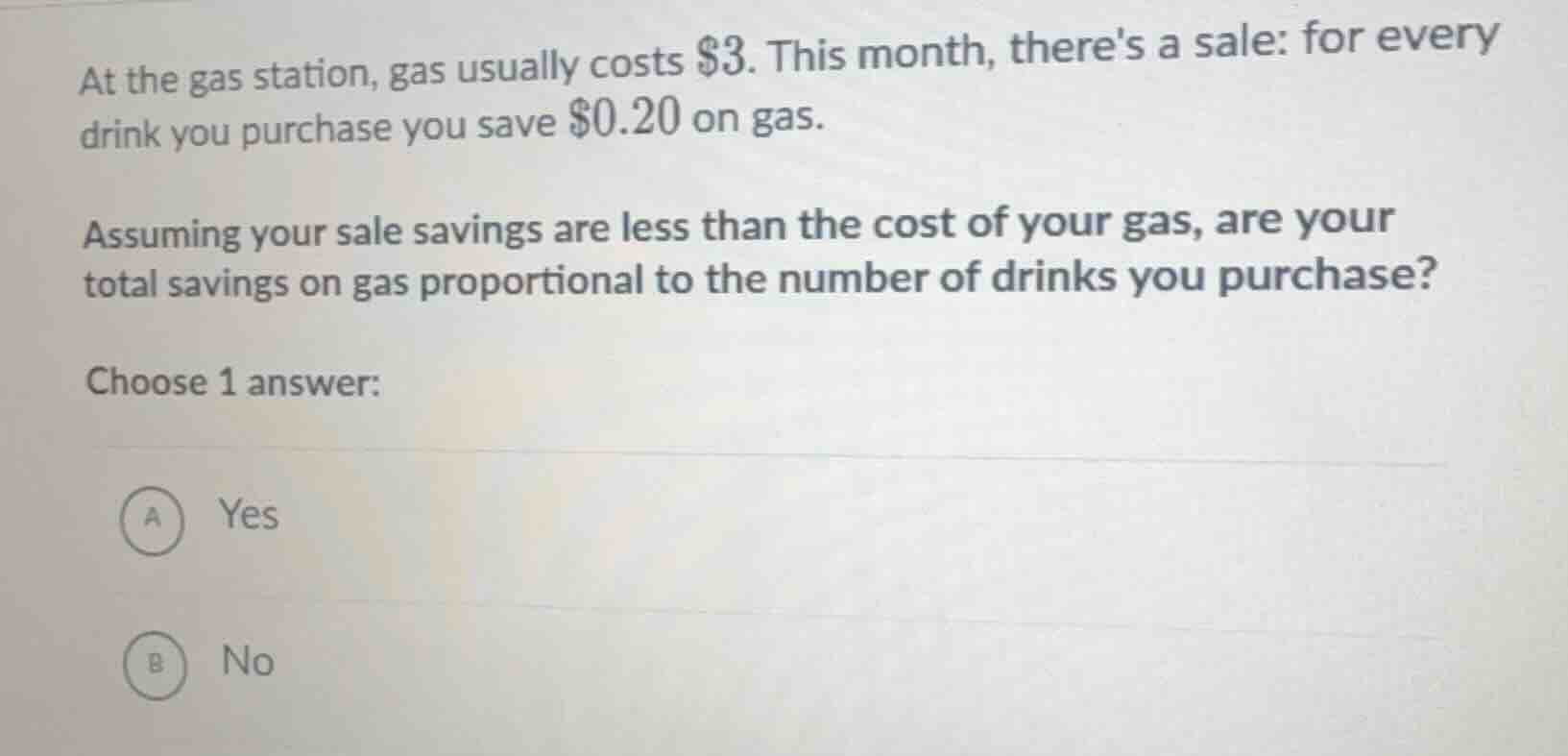
at the gas station, gas usually costs $3. this month, theres a sale: for every drink you purchase you save $0.20 on gas. assuming your sale savings are less than the cost of your gas, are your total savings on gas proportional to the number of drinks you purchase? choose 1 answer: a yes b no
To determine if total savings on gas are proportional to the number of drinks purchased, we analyze the relationship. Let \( n \) be the number of drinks and \( S \) be total savings. Each drink gives a savings of \$0.20, so LXI2. This is a linear equation in the form LXI3 (where LXI4, a constant), which represents a proportional relationship. The condition that savings are less than gas cost (here, gas cost is \$3, and \( 0.20n < 3 \) for reasonable \( n \)) doesn't change the proportionality of \( S \) and \( n \), as the ratio \( \frac{S}{n}=0.20 \) (constant).

Snap & solve any problem in the app
Get step-by-step solutions on Sovi AI
Photo-based solutions with guided steps
Explore more problems and detailed explanations
A. Yes