QUESTION IMAGE
Question
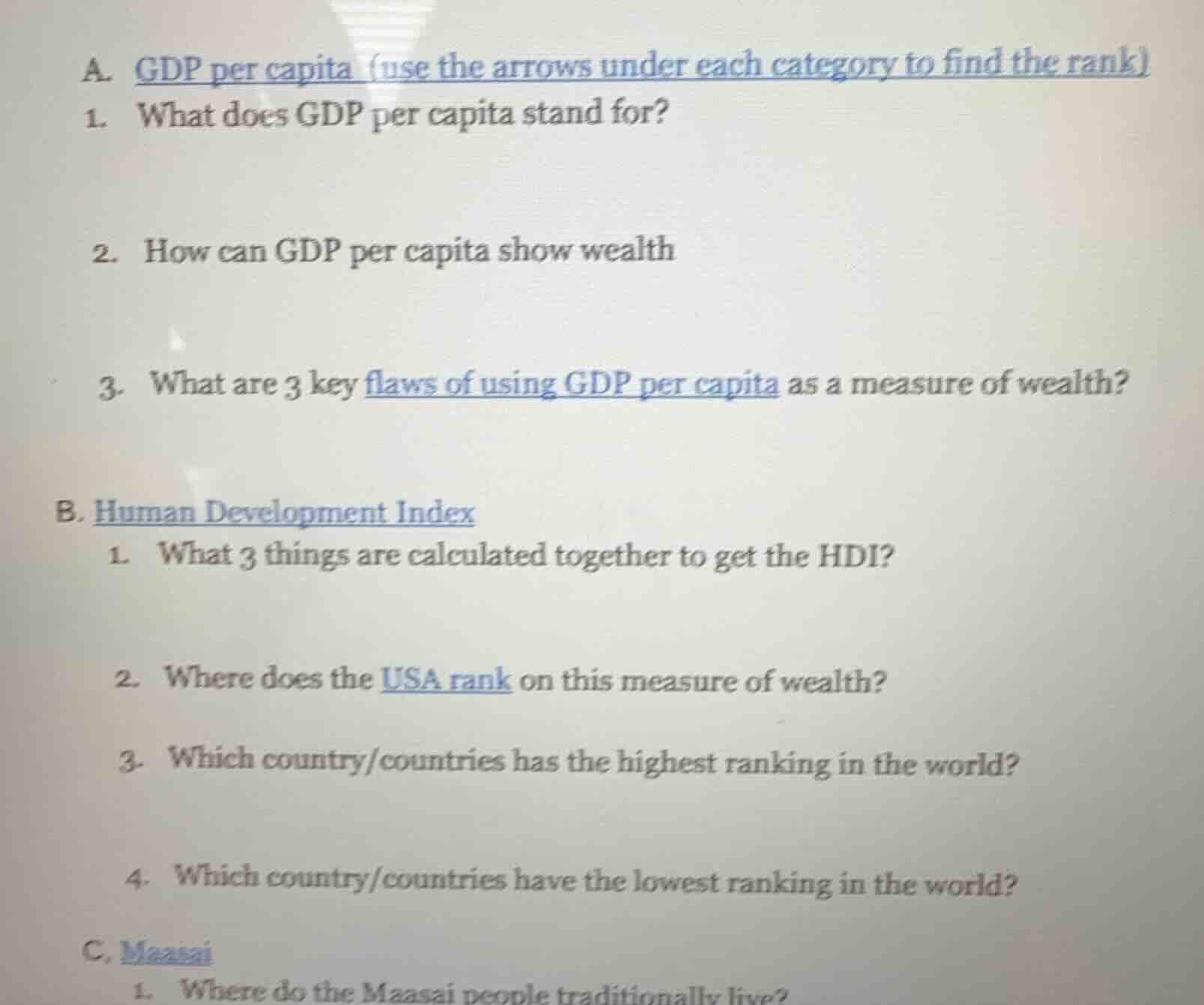
a. gdp per capita (use the arrows under each category to find the rank) 1. what does gdp per capita stand for? 2. how can gdp per capita show wealth 3. what are 3 key flaws of using gdp per capita as a measure of wealth? b. human development index 1. what 3 things are calculated together to get the hdi? 2. where does the usa rank on this measure of wealth? 3. which country/countries has the highest ranking in the world? 4. which country/countries have the lowest ranking in the world? c. maasai 1. where do the maasai people traditionally live?
Part A: GDP per capita
1. What does GDP per capita stand for?
GDP per capita stands for Gross Domestic Product per capita. It is calculated by dividing a country's total GDP (the market value of all final goods and services produced within a country in a given period) by its total population. This gives an average economic output per person in the country.
GDP per capita can show wealth by providing an average measure of the economic output generated per person in a country. A higher GDP per capita generally implies that, on average, individuals in that country have access to more goods and services (either produced domestically or imported with the economic resources generated). It can indicate the overall economic prosperity of a nation, as it reflects the total economic activity relative to the number of people, suggesting the potential for a higher standard of living (though it has limitations as a sole measure of wealth, as wealth also includes non - market factors like quality of life, assets, etc.).
- Inequality Ignorance: GDP per capita is an average. It does not account for the distribution of income and wealth within a country. A country with a high GDP per capita may have a large gap between the rich and the poor, so the average does not reflect the actual wealth or standard of living of the majority of the population. For example, in a country with a high GDP per capita, a small wealthy elite may hold most of the wealth while the majority live in poverty.
- Non - Market Activities Exclusion: It does not consider non - market activities such as household work (like cooking, cleaning, child - rearing done within the family), volunteer work, or the value of natural resources that are not monetized. These activities contribute to the well - being of a society but are not included in GDP calculations.
- Quality of Life and Well - being Omission: GDP per capita focuses on economic output but does not measure other aspects of wealth and well - being such as health, education quality, environmental quality, leisure time, or happiness. A country with a high GDP per capita may have high levels of pollution, long working hours, or poor health outcomes, which are not captured by this measure.

Snap & solve any problem in the app
Get step-by-step solutions on Sovi AI
Photo-based solutions with guided steps
Explore more problems and detailed explanations
Gross Domestic Product per capita (calculated as total GDP of a country divided by its total population)