QUESTION IMAGE
Question
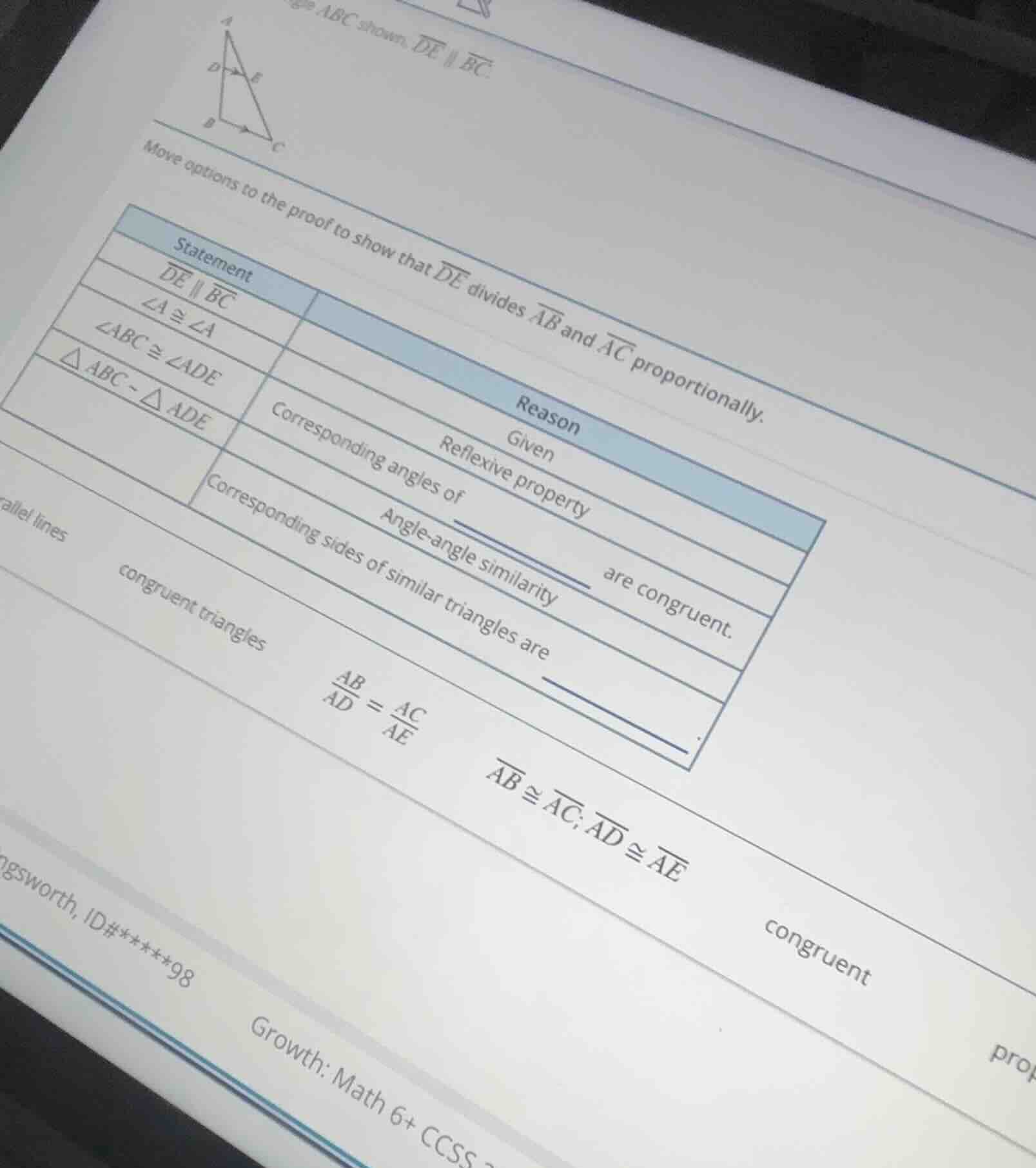
ge abc shown, \\(\overline{de} \parallel \overline{bc}\\).
move options to the proof to show that \\(\overline{de}\\) divides \\(\overline{ab}\\) and \\(\overline{ac}\\) proportionally.
| statement | reason |
|---|---|
| \\(\angle a \cong \angle a\\) | reflexive property |
| \\(\angle abc \cong \angle ade\\) | corresponding angles of \\(\underline{\quad}\\) are congruent. |
| \\(\triangle abc \sim \triangle ade\\) | angle - angle similarity |
| \\(\underline{\quad}\\) | corresponding sides of similar triangles are \\(\underline{\quad}\\). |
options: parallel lines, congruent triangles, \\(\frac{ab}{ad} = \frac{ac}{ae}\\), \\(\overline{ab} \cong \overline{ac}; \overline{ad} \cong \overline{ae}\\), congruent, proportional
Step1: Fill first blank (parallel lines)
Corresponding angles of parallel lines are congruent.
Step2: Fill second blank (proportional)
Corresponding sides of similar triangles are proportional, leading to $\frac{AB}{AD} = \frac{AC}{AE}$.

Snap & solve any problem in the app
Get step-by-step solutions on Sovi AI
Photo-based solutions with guided steps
Explore more problems and detailed explanations
- For the first blank: parallel lines
- For the second blank: proportional
- Final completed proportion: $\frac{AB}{AD} = \frac{AC}{AE}$