QUESTION IMAGE
Question
the geologic cross section diagram shows undisturbed rock layers with index fossils from two regions (a and b).
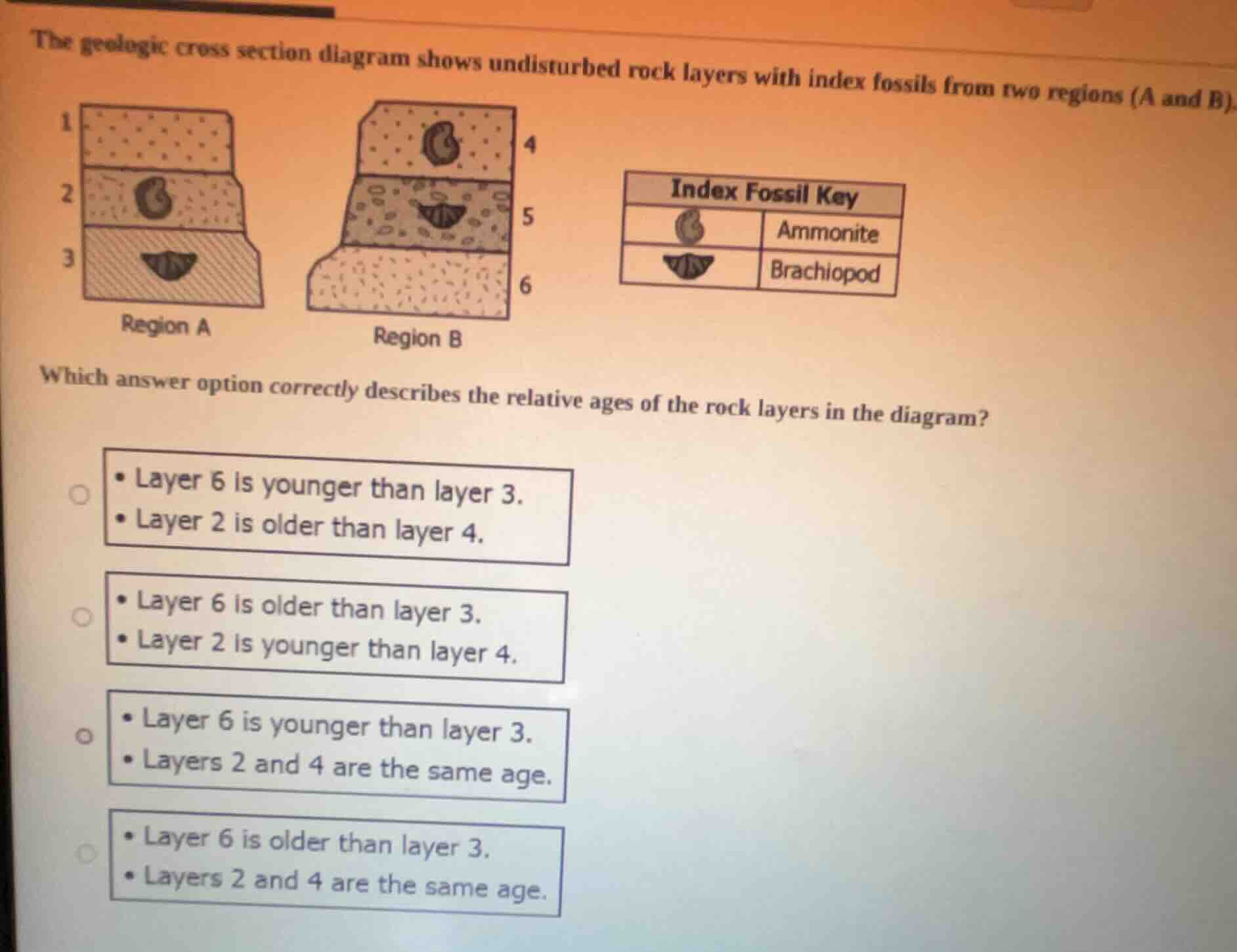
region a has layers 1, 2, 3. layer 1 (top) has no fossil, layer 2 has ammonite, layer 3 has brachiopod.
region b has layers 4, 5, 6. layer 4 (top) has ammonite, layer 5 has brachiopod, layer 6 (bottom) has no fossil.
index fossil key: ammonite (the spiral fossil), brachiopod (the shell - like fossil).
which answer option correctly describes the relative ages of the rock layers in the diagram?
- option 1: layer 6 is younger than layer 3. layer 2 is older than layer 4.
- option 2: layer 6 is older than layer 3. layer 2 is younger than layer 4.
- option 3: layer 6 is younger than layer 3. layers 2 and 4 are the same age.
- option 4: layer 6 is older than layer 3. layers 2 and 4 are the same age.
Brief Explanations
- Principle of Superposition: In undisturbed rock layers, the oldest layers are at the bottom, and younger layers are on top. Also, index fossils (like Ammonite and Brachiopod here) can be used to correlate ages between regions.
- Analyzing Layer 6 and Layer 3: Layer 6 is at the bottom of Region B, and Layer 3 is at the bottom - middle of Region A. Using superposition and fossil correlation: Brachiopod is in Layer 3 (Region A) and Layer 5 (Region B). Ammonite is in Layer 2 (Region A) and Layer 4 (Region B). Layer 6 is below Layer 5 (which has Brachiopod, same as Layer 3), so Layer 6 is older than Layer 3 (since lower layers are older).
- Analyzing Layer 2 and Layer 4: Layer 2 (Region A) and Layer 4 (Region B) both have Ammonite (index fossil). Since they have the same index fossil, they are the same age (fossil correlation shows same time period).
- Eliminating other options:
- First option: Layer 6 is younger than Layer 3? No, Layer 6 is older. Layer 2 older than Layer 4? No, same age.
- Second option: Layer 2 younger than Layer 4? No, same age.
- Third option: Layer 6 younger than Layer 3? No.
- Fourth option: Layer 6 is older than Layer 3 (correct from superposition) and Layers 2 and 4 are same age (correct from index fossil correlation).

Snap & solve any problem in the app
Get step-by-step solutions on Sovi AI
Photo-based solutions with guided steps
Explore more problems and detailed explanations
- Layer 6 is older than layer 3.
- Layers 2 and 4 are the same age.