QUESTION IMAGE
Question
geometry -1, term3, term4
6-5: savvy adaptive practice
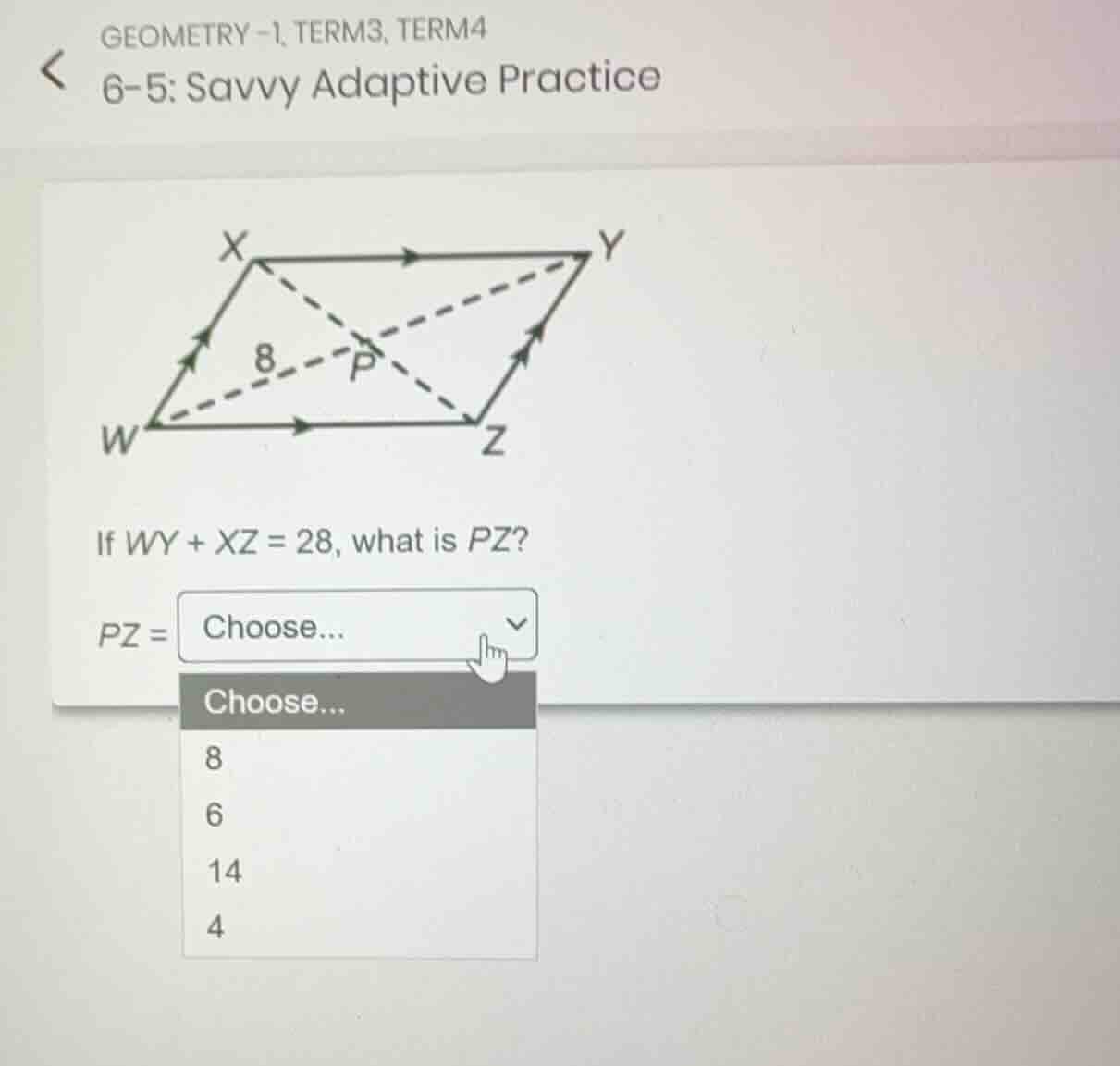
if ( wy + xz = 28 ), what is ( pz )?
( pz = ) choose...
choose...
8
6
14
4
Step1: Recall parallelogram diagonals property
In a parallelogram, diagonals bisect each other. So \( XZ = 2 \times PZ \) and \( WY \) and \( XZ \) are diagonals. Given \( XZ \) has a segment \( WP = 8 \)? Wait, no, the diagram shows \( WP \) (part of \( WY \))? Wait, no, the diagram: \( WXYZ \) is a parallelogram, diagonals \( WY \) and \( XZ \) intersect at \( P \). Wait, the length of \( WP \) is 8? Wait, no, the dashed line \( WX \)? Wait, no, the diagram: \( WZ \) is a side, \( XZ \) is a diagonal? Wait, no, the problem: \( WY + XZ = 28 \), and we know that in a parallelogram, diagonals bisect each other, so \( XZ = 2 \times PZ \), and also, wait, the length of \( WP \) is 8? Wait, no, the diagram has \( WP = 8 \)? Wait, no, the dashed line from \( W \) to \( X \)? No, the diagonals are \( WY \) and \( XZ \), intersecting at \( P \). So \( WY = 2 \times WP \), and \( WP = 8 \)? Wait, the diagram shows \( WP = 8 \)? Wait, the problem: the dashed line from \( W \) to \( P \) is 8? Wait, no, the label is 8 on the diagonal \( WY \)? Wait, no, the diagram: \( WXYZ \) is a parallelogram, diagonals \( WY \) and \( XZ \) intersect at \( P \). The length of \( WP \) is 8, so \( WY = 2 \times 8 = 16 \)? Wait, no, if \( WP = 8 \), then \( WY = 2 \times WP = 16 \) (since diagonals bisect each other). Then \( XZ = 28 - WY = 28 - 16 = 12 \)? No, wait, \( WY + XZ = 28 \). Wait, maybe I misread. Wait, the diagram: the diagonal \( WY \) has a segment \( WP = 8 \), so \( WY = 2 \times 8 = 16 \)? Then \( XZ = 28 - 16 = 12 \)? No, that can't be. Wait, no, maybe the diagonal \( XZ \) is split into \( XP \) and \( PZ \), each equal. Wait, let's start over.
In a parallelogram, diagonals bisect each other. So \( WP = PY \) and \( XP = PZ \). So \( WY = 2 \times WP \), \( XZ = 2 \times PZ \). Wait, the diagram shows \( WP = 8 \), so \( WY = 2 \times 8 = 16 \). Then \( WY + XZ = 28 \), so \( 16 + XZ = 28 \), so \( XZ = 12 \). Then \( XZ = 2 \times PZ \), so \( PZ = XZ / 2 = 12 / 2 = 6 \)? Wait, no, that doesn't match. Wait, maybe the 8 is on \( XZ \)? Wait, the diagram: the dashed line from \( W \) to \( P \) is 8? No, the label 8 is on the diagonal \( XZ \)? Wait, no, the problem: the diagonal \( XZ \) has a segment \( WP \)? No, I'm confused. Wait, let's re-express:
Given \( WXYZ \) is a parallelogram, diagonals \( WY \) and \( XZ \) intersect at \( P \). So \( WP = PY \) and \( XP = PZ \) (diagonals bisect each other). Let \( WP = 8 \), so \( WY = 2 \times WP = 16 \). Then \( WY + XZ = 28 \) => \( 16 + XZ = 28 \) => \( XZ = 12 \). Then \( XZ = 2 \times PZ \) => \( PZ = XZ / 2 = 12 / 2 = 6 \). Wait, but the options are 8,6,14,4. So 6 is an option. So that makes sense.
Wait, let's check again:
- In parallelogram, diagonals bisect each other: \( WP = PY \), \( XP = PZ \).
- From diagram, \( WP = 8 \), so \( WY = 2 \times WP = 16 \).
- Given \( WY + XZ = 28 \), so \( XZ = 28 - WY = 28 - 16 = 12 \).
- Since \( XZ = 2 \times PZ \) (diagonals bisect each other), \( PZ = XZ / 2 = 12 / 2 = 6 \).
Yes, that works. So \( PZ = 6 \).
Step1: Identify parallelogram diagonal property
In a parallelogram, diagonals bisect each other. So \( WP = PY \) and \( XP = PZ \), and \( WY = 2 \times WP \), \( XZ = 2 \times PZ \).
Step2: Find \( WY \) length
From the diagram, \( WP = 8 \), so \( WY = 2 \times 8 = 16 \).
Step3: Find \( XZ \) length
Given \( WY + XZ = 28 \), substitute \( WY = 16 \):
\( 16 + XZ = 28 \)
\( XZ = 28 - 16 = 12 \).
Step4: Find \( PZ \) length
Since \( XZ = 2 \times PZ \) (diagonals bisect each other):
\( PZ = \frac{XZ}{2} = \f…

Snap & solve any problem in the app
Get step-by-step solutions on Sovi AI
Photo-based solutions with guided steps
Explore more problems and detailed explanations
6