QUESTION IMAGE
Question
geometry - honors - 9(ac)10(a) - 2025-2028
7-4: mathxl for school: practice & problem-solving copy 1
due jan 21 - 11:45 pm late
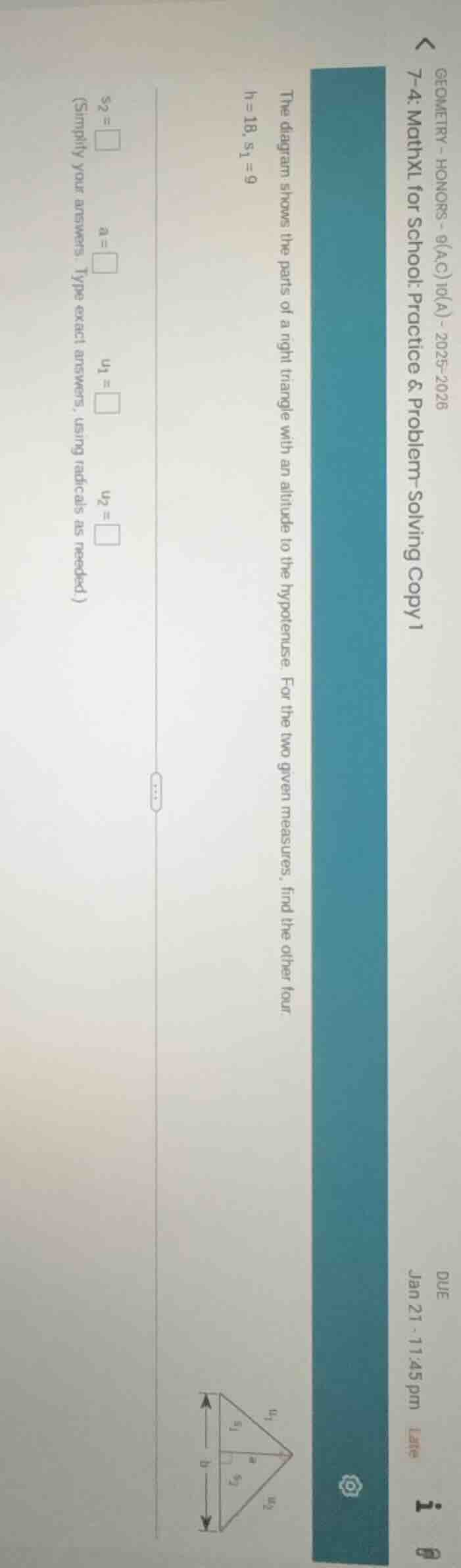
the diagram shows the parts of a right triangle with an altitude to the hypotenuse. for the two given measures, find the other four.
h = 18, s₁ = 9
( s_2 = square )
( a = square )
( u_1 = square )
( u_2 = square )
(simplify your answers. type exact answers, using radicals as needed.)
Step1: Recall geometric mean theorem (altitude-on-hypotenuse theorem)
In a right triangle, the altitude to the hypotenuse is the geometric mean of the segments into which it divides the hypotenuse. Also, each leg is the geometric mean of the hypotenuse and the adjacent segment.
Given \( h = 18 \) (altitude), \( s_1 = 9 \) (one segment of hypotenuse). Let \( s_2 \) be the other segment. By geometric mean theorem: \( h^2 = s_1 \times s_2 \)
So, \( 18^2 = 9 \times s_2 \)
\( 324 = 9s_2 \)
Step2: Solve for \( s_2 \)
Divide both sides by 9: \( s_2=\frac{324}{9}= 36 \)
Step3: Find \( a \) (leg, geometric mean of \( s_1 \) and hypotenuse part? Wait, no: \( a^2 = s_1 \times (s_1 + s_2) \)? No, wait: \( a^2 = s_1 \times (s_1 + s_2) \)? Wait, no, the leg \( a \) (the one adjacent to \( s_1 \)): \( a^2 = s_1 \times (s_1 + s_2) \)? Wait, no, correct formula: \( a^2 = s_1 \times (s_1 + s_2) \)? Wait, no, actually, \( a^2 = s_1 \times (s_1 + s_2) \) is wrong. Wait, the two segments of hypotenuse are \( s_1 = 9 \), \( s_2 = 36 \), so hypotenuse \( u = s_1 + s_2 = 9 + 36 = 45 \). Then, \( a^2 = s_1 \times u \)? Wait, no: \( a^2 = s_1 \times (s_1 + s_2) \)? Wait, no, the correct formula is that in right triangle with altitude \( h \), segments \( s_1, s_2 \), legs \( u_1, u_2 \), then:
\( h^2 = s_1 s_2 \)
\( u_1^2 = s_1 (s_1 + s_2) \)? No, wait, \( u_1^2 = s_1 (s_1 + s_2) \) is incorrect. Wait, actually, \( u_1^2 = s_1 (s_1 + s_2) \) is wrong. Let's rederive:
Let the right triangle be \( \triangle ABC \), right-angled at \( C \), altitude \( CD \) to hypotenuse \( AB \), with \( AD = s_1 = 9 \), \( DB = s_2 \), \( CD = h = 18 \), \( AC = u_1 \), \( BC = u_2 \), \( AB = s_1 + s_2 \).
Then, \( \triangle ACD \sim \triangle ABC \), so \( \frac{AC}{AB} = \frac{AD}{AC} \implies AC^2 = AD \times AB \)
Similarly, \( BC^2 = BD \times AB \)
And \( CD^2 = AD \times BD \) (which we used for \( s_2 \))
So, \( AB = s_1 + s_2 = 9 + 36 = 45 \)
Then, \( a^2 = s_1 \times AB = 9 \times 45 = 405 \)? Wait, no, wait, \( a \) is \( AC \), so \( AC^2 = AD \times AB = 9 \times 45 = 405 \), so \( a = \sqrt{405} = \sqrt{81 \times 5} = 9\sqrt{5} \)? Wait, no, wait, I think I messed up. Wait, no, the leg \( a \) (the one from the right angle to the vertex, the altitude's top) – wait, no, the leg \( a \) is the one that is the geometric mean of \( s_1 \) and \( s_2 \)? No, wait, \( a^2 = s_1 \times (s_1 + s_2) \) is wrong. Wait, let's use \( a^2 = s_1 \times (s_1 + s_2) \)? Wait, no, let's use the first formula: \( a^2 = s_1 \times (s_1 + s_2) \) is incorrect. Wait, let's use \( a^2 = s_1 \times (s_1 + s_2) \) – no, let's compute \( a \) as \( \sqrt{s_1^2 + h^2} \), since \( \triangle ACD \) is right-angled at \( D \), so \( AC^2 = AD^2 + CD^2 = 9^2 + 18^2 = 81 + 324 = 405 \), so \( a = \sqrt{405} = 9\sqrt{5} \)? Wait, no, 9² is 81, 18² is 324, sum is 405, square root of 405 is 9√5? Wait, 405 = 81×5, so √405 = 9√5. Wait, but let's check with the other formula: \( AC^2 = AD \times AB \), \( AB = 9 + 36 = 45 \), so \( 9×45 = 405 \), which matches. So \( a = \sqrt{405} = 9\sqrt{5} \)? Wait, no, wait, 9×45 is 405, √405 is 9√5? Wait, 9√5 is approximately 20.12, but 18² + 9² = 324 + 81 = 405, yes.
Wait, but let's find \( u_1 \) and \( u_2 \). Wait, \( u_1 \) is \( AC \), which we just found as \( 9\sqrt{5} \)? Wait, no, wait, \( u_1 \) is \( AC \), \( u_2 \) is \( BC \). Let's find \( u_2 \): \( BC^2 = BD \times AB = 36 \times 45 = 1620 \), so \( u_2 = \sqrt{1620} = \sqrt{324×5} = 18\sqrt{5} \). Wait, but let's check with \( BC^2 = CD^2 + BD^2 = 18² + 36² = 324 + 1296…

Snap & solve any problem in the app
Get step-by-step solutions on Sovi AI
Photo-based solutions with guided steps
Explore more problems and detailed explanations
\( s_2 = \boldsymbol{36} \)
\( a = \boldsymbol{9\sqrt{5}} \)
\( u_1 = \boldsymbol{9\sqrt{5}} \)
\( u_2 = \boldsymbol{18\sqrt{5}} \)