QUESTION IMAGE
Question
geometry, unit 5 - congruent triangles proof activity - part i name
for each problem, do the following:
a. show the given information in the diagram (using tick marks to show congruent sides and arcs to show congruent angles)
b. show any other congruent parts you notice (from vertical angles, sides shared in common, or alternate interior angles with parallel lines)
c. give the postulate or theorem that proves the triangles congruent (sss, sas, asa, aas, hl)
d. finally, fill in the blanks to complete the proof.
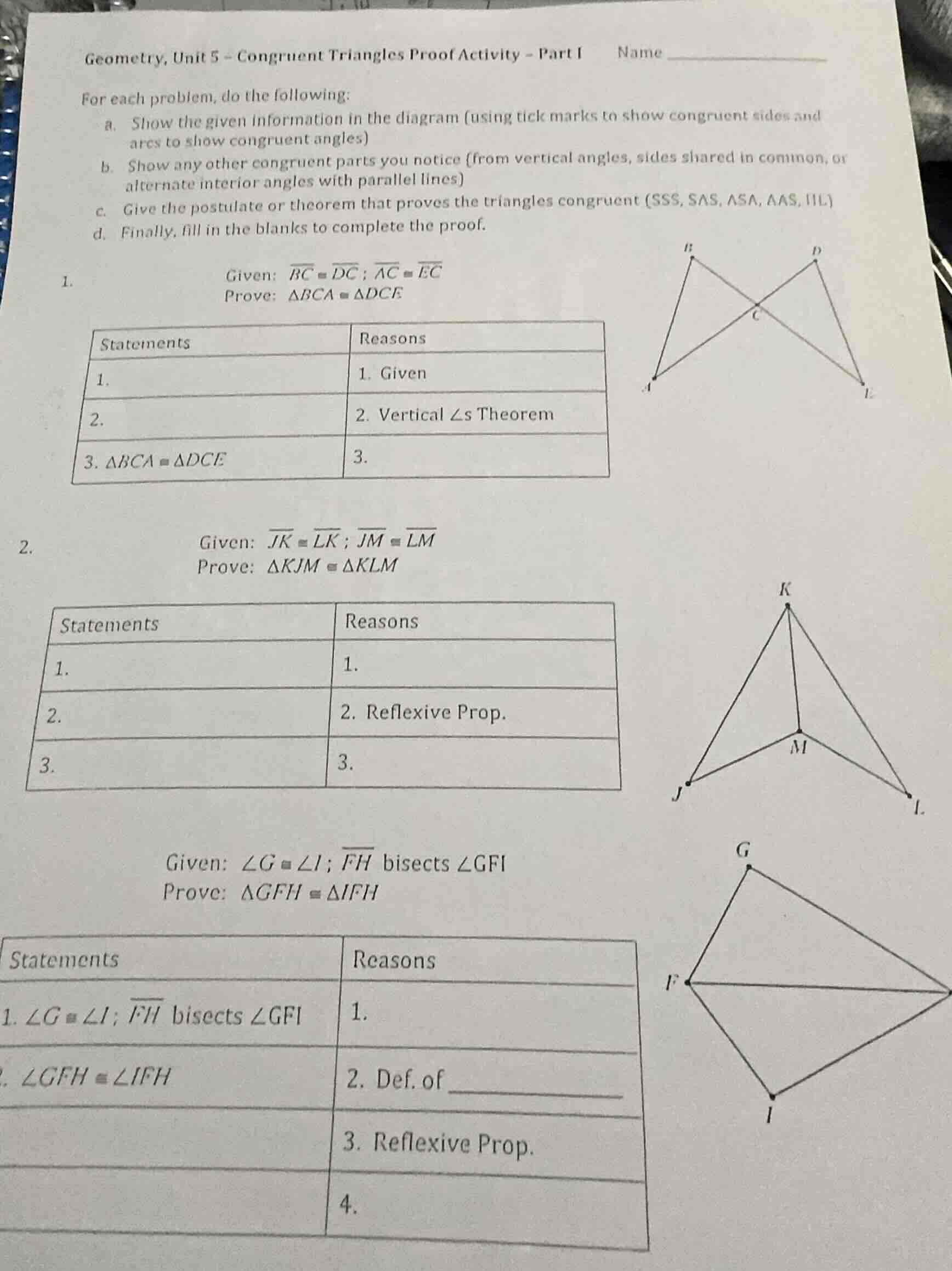
- \tgiven: $overline{bc} cong overline{dc}$; $overline{ac} cong overline{ec}$
\tprove: $\triangle bca cong \triangle dce$
| statements | reasons |
|---|---|
| 2. | 2. vertical $angle$s theorem |
| 3. $\triangle bca cong \triangle dce$ | 3. |
(diagram of two triangles with a common vertex c, labeled a, b, c and d, e, c)
- \tgiven: $overline{jk} cong overline{lk}$; $overline{jm} cong overline{lm}$
\tprove: $\triangle kjm cong \triangle klm$
| statements | reasons |
|---|---|
| 2. | 2. reflexive prop. |
| 3. | 3. |
(diagram of two triangles sharing a common side km, labeled j, k, m and l, k, m)
given: $angle g cong angle i$; $overline{fh}$ bisects $angle gfi$
prove: $\triangle gfh cong \triangle ifh$
| statements | reasons |
|---|---|
| 2. $angle gfh cong angle ifh$ | 2. def. of __________ |
| 3. reflexive prop. | |
| 4. |
(diagram of a quadrilateral with a diagonal fh, labeled g, f, h, i)
Problem 1:
Step 1: Fill in Statement 1
We know the given information is \(\overline{BC} \cong \overline{DC}\) and \(\overline{AC} \cong \overline{EC}\), so we put that in the first statement.
Statement 1: \(\overline{BC} \cong \overline{DC}\), \(\overline{AC} \cong \overline{EC}\)
Step 2: Fill in Statement 2
By the Vertical Angles Theorem, \(\angle BCA \cong \angle DCE\) (vertical angles are congruent).
Statement 2: \(\angle BCA \cong \angle DCE\)
Step 3: Determine the Congruence Postulate
We have two sides and the included angle congruent (SAS: Side - Angle - Side). So the reason for \(\triangle BCA \cong \triangle DCE\) is SAS.
Reason 3: SAS (Side - Angle - Side) Postulate
Step 1: Fill in Statement 1 and Reason 1
The given information is \(\overline{JK} \cong \overline{LK}\) and \(\overline{JM} \cong \overline{LM}\), so we put that in statement 1 with reason "Given".
Statement 1: \(\overline{JK} \cong \overline{LK}\), \(\overline{JM} \cong \overline{LM}\); Reason 1: Given
Step 2: Fill in Statement 2
By the Reflexive Property, a side is congruent to itself. Here, \(\overline{KM} \cong \overline{KM}\) (common side).
Statement 2: \(\overline{KM} \cong \overline{KM}\); Reason 2: Reflexive Prop.
Step 3: Determine the Congruence Postulate
We have three sides congruent (SSS: Side - Side - Side). So the triangles \(\triangle KJM \cong \triangle KLM\) by SSS.
Statement 3: \(\triangle KJM \cong \triangle KLM\); Reason 3: SSS (Side - Side - Side) Postulate
Step 1: Fill in Reason 1
The first statement is given, so Reason 1: Given
Step 2: Fill in the Blank in Reason 2
Since \(\overline{FH}\) bisects \(\angle GFI\), by the definition of an angle bisector, \(\angle GFH \cong \angle IFH\). So the blank is "angle bisector".
Reason 2: Def. of angle bisector
Step 3: Fill in Statement 3 and Reason 3
By the Reflexive Property, \(\overline{FH} \cong \overline{FH}\) (common side).
Statement 3: \(\overline{FH} \cong \overline{FH}\); Reason 3: Reflexive Prop.
Step 4: Determine the Congruence Postulate
We have \(\angle G \cong \angle I\), \(\angle GFH \cong \angle IFH\) and \(\overline{FH} \cong \overline{FH}\), so by AAS (Angle - Angle - Side) the triangles \(\triangle GFH \cong \triangle IFH\).
Statement 4: \(\triangle GFH \cong \triangle IFH\); Reason 4: AAS (Angle - Angle - Side) Theorem

Snap & solve any problem in the app
Get step-by-step solutions on Sovi AI
Photo-based solutions with guided steps
Explore more problems and detailed explanations
- Statements: \(\overline{BC} \cong \overline{DC}\), \(\overline{AC} \cong \overline{EC}\); Reasons: Given
- Statements: \(\angle BCA \cong \angle DCE\); Reasons: Vertical \(\angle\)s Theorem
- Reasons: SAS (Side - Angle - Side) Postulate