QUESTION IMAGE
Question
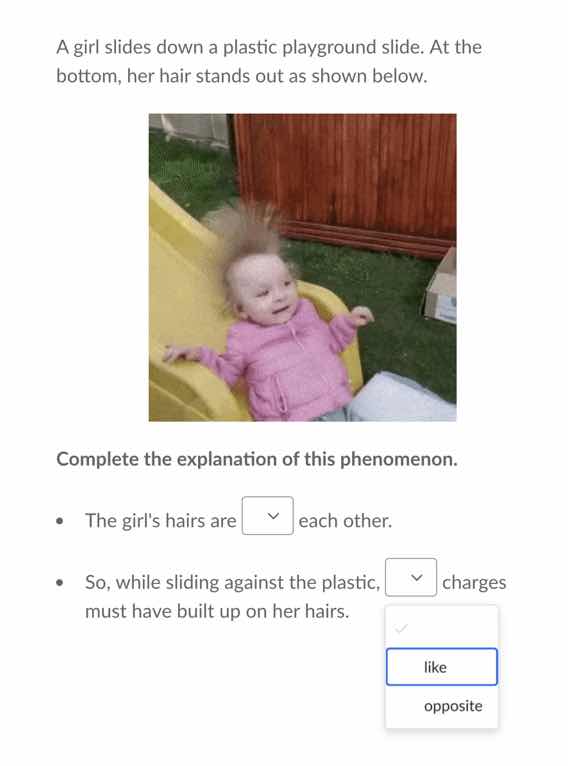
a girl slides down a plastic playground slide. at the bottom, her hair stands out as shown below. complete the explanation of this phenomenon. - the girls hairs are each other. - so, while sliding against the plastic, charges must have built up on her hairs. like opposite
- When the girl slides down the plastic slide, friction causes charging by contact (triboelectric effect). Her hairs acquire the same type of charge (either all positive or all negative).
- Charges of the same type (like charges) repel each other. So, the hairs stand out because they repel one another.
- For the first blank, since like charges repel, the hairs are "repelling" each other (the dropdown should have an option like "repelling", but from the given options for the second part, we analyze the charge nature: to have repulsion, the charges on hairs must be like (same) charges. So the first blank's logic is about repulsion due to like charges, and the second blank is "like" because like charges repel. Wait, the first dropdown's options? Wait, the user's image shows for the first blank a dropdown, and the second has "like" and "opposite". Wait, let's re-express:
- The girl’s hairs are repelling each other (because like charges repel). But the first blank's dropdown—wait, maybe the first blank's options? Wait, the user's problem: the first bullet: "The girl's hairs are [dropdown] each other." The second: "So, while sliding against the plastic, [dropdown (like/opposite)] charges must have built up on her hairs."
So, when sliding, friction transfers charge, making all hairs have the same (like) charge. Like charges repel, so hairs repel each other (stand out). So:
First blank: repelling (but if the dropdown has options, but the user's image shows for the second blank "like" and "opposite". Wait, maybe the first blank's intended answer is related to repulsion, and the second is "like" because like charges repel. Let's confirm:
- When two objects have like charges (same sign), they repel. So if hairs have like charges, they repel each other (stand out). So the second blank is "like" (because like charges repel, so to have repulsion, charges on hairs are like). The first blank: the hairs are "repelling" each other (but if the dropdown options for the first blank include "repelling", or maybe the first blank's options? Wait, the user's problem might have the first blank's dropdown with "repelling" (or similar), and the second with "like" and "opposite". So:
For the first bullet: The girl's hairs are repelling each other (due to like charges repelling). For the second bullet: So, while sliding against the plastic, like charges must have built up on her hairs (because like charges repel, causing the hairs to stand out).
So the second blank: "like" (since like charges repel, leading to hair repulsion). The first blank: the action between hairs is repulsion (so the first blank's answer is related to repelling, but if the dropdown for the first blank has "repelling" as an option, or maybe the first blank's options? Wait, the user's image shows the second blank's options as "like" and "opposite". Let's focus on the second blank first: to have repulsion, charges must be like (same), so "like" is correct. The first blank: the hairs are "repelling" each other (because like charges repel).
So:
- First blank: repelling (assuming the dropdown has that option, but since the user's image shows the second blank's options, we proceed with the second blank as "like" and first blank as repelling (but the user's first blank's dropdown—maybe the first blank's intended answer is "repelling" and second is "like".

Snap & solve any problem in the app
Get step-by-step solutions on Sovi AI
Photo-based solutions with guided steps
Explore more problems and detailed explanations
- The girl's hairs are repelling each other. (Assuming the first dropdown has "repelling" as an option; if not, the logic is repulsion due to like charges.)
- So, while sliding against the plastic, like charges must have built up on her hairs.
(For the second blank, the correct option is: like)