QUESTION IMAGE
Question
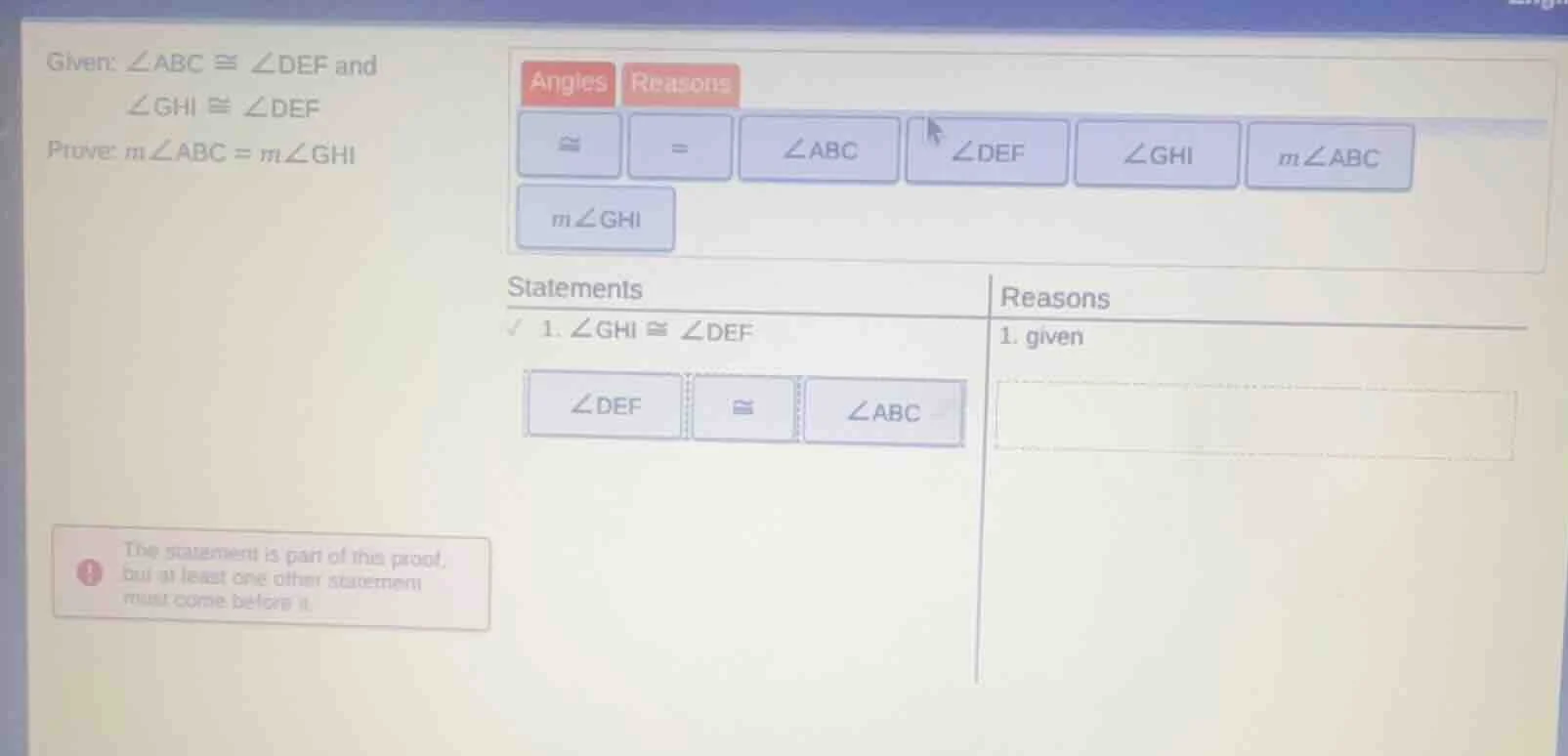
given: ∠abc ≅ ∠def and ∠ghi ≅ ∠def
prove: m∠abc = m∠ghi
(there is a box with angles and reasons options, and a two - column proof table with the first statement ∠ghi ≅ ∠def and reason given, and a statement ∠def ≅ ∠abc to be filled in the proof table, along with a note that the statement is part of the proof but at least one other statement must come before it)
Step1: Identify the given congruence
We know from the problem that $\angle ABC \cong \angle DEF$ (given). Also, $\angle GHI \cong \angle DEF$ (given).
Step2: Use the transitive property of congruence
The transitive property of congruence states that if $\angle A \cong \angle B$ and $\angle B \cong \angle C$, then $\angle A \cong \angle C$. Here, since $\angle ABC \cong \angle DEF$ and $\angle GHI \cong \angle DEF$, we can say $\angle ABC \cong \angle GHI$ by the transitive property. But first, we need to state $\angle ABC \cong \angle DEF$ as a given. So the next statement after $\angle GHI \cong \angle DEF$ (given) should be $\angle ABC \cong \angle DEF$ with the reason "given".
Step3: Relate angle measures
If two angles are congruent, their measures are equal. So if $\angle ABC \cong \angle DEF$ and $\angle GHI \cong \angle DEF$, then by transitivity of equality (since congruent angles have equal measures), $m\angle ABC = m\angle GHI$. But for the table, the second statement (after $\angle GHI \cong \angle DEF$) is $\angle ABC \cong \angle DEF$ with reason "given".

Snap & solve any problem in the app
Get step-by-step solutions on Sovi AI
Photo-based solutions with guided steps
Explore more problems and detailed explanations
The statement $\boldsymbol{\angle ABC \cong \angle DEF}$ should be added with the reason "given". Then, using the transitive property of congruence (and the fact that congruent angles have equal measures), we can conclude $m\angle ABC = m\angle GHI$. But for the specific blank in the table (the second statement's reason for $\angle ABC \cong \angle DEF$), the reason is "given".