QUESTION IMAGE
Question
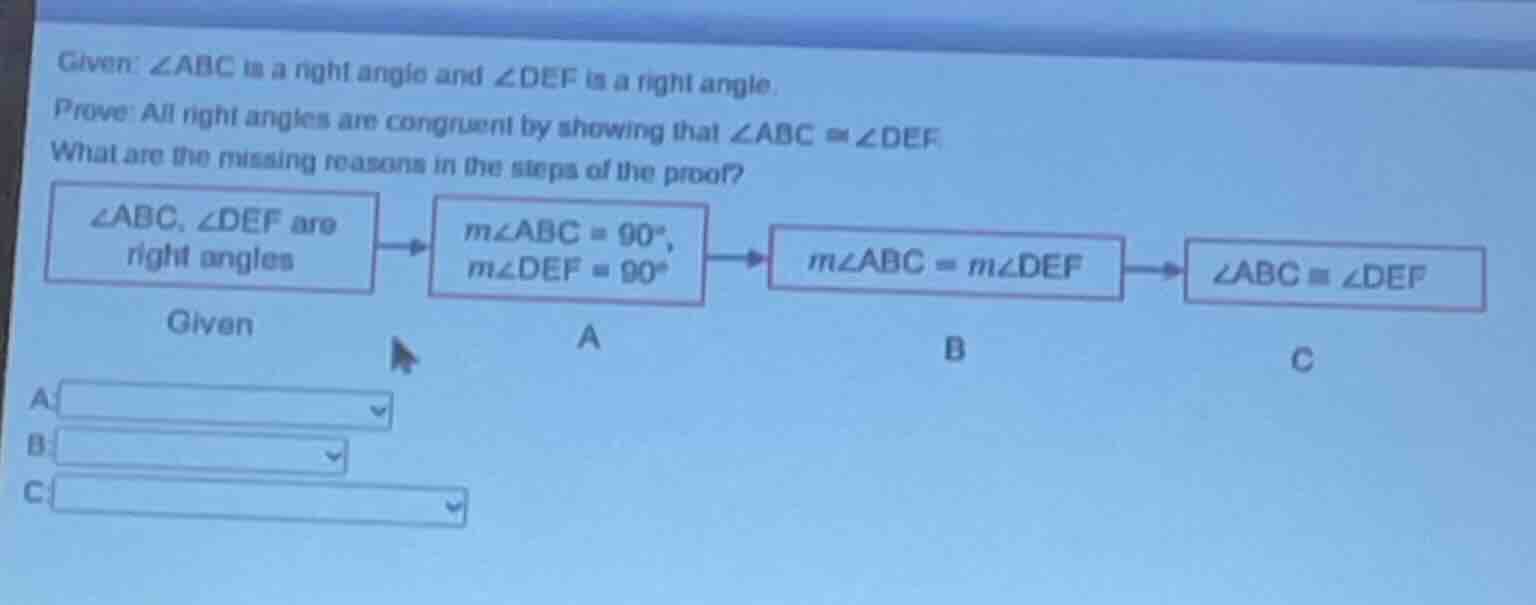
given: ∠abc is a right angle and ∠def is a right angle. prove: all right angles are congruent by showing that ∠abc ≅ ∠def. what are the missing reasons in the steps of the proof? ∠abc, ∠def are right angles (given) → m∠abc = 90°, m∠def = 90° (a) → m∠abc = m∠def (b) → ∠abc ≅ ∠def (c)
Step 1: Reason for A
A right angle is defined as an angle with a measure of \( 90^\circ \). So the reason for \( m\angle ABC = 90^\circ \) and \( m\angle DEF = 90^\circ \) (given that \( \angle ABC \) and \( \angle DEF \) are right angles) is the Definition of a Right Angle.
Step 2: Reason for B
We know that \( m\angle ABC = 90^\circ \) and \( m\angle DEF = 90^\circ \). By the Transitive Property of Equality (or simply recognizing that if two quantities are equal to the same quantity, they are equal to each other), we can say \( m\angle ABC = m\angle DEF \).
Step 3: Reason for C
If the measures of two angles are equal, then the angles themselves are congruent. This is the Definition of Congruent Angles (angles with equal measures are congruent).

Snap & solve any problem in the app
Get step-by-step solutions on Sovi AI
Photo-based solutions with guided steps
Explore more problems and detailed explanations
- A: Definition of a Right Angle
- B: Transitive Property of Equality (or Substitution, since both equal \( 90^\circ \))
- C: Definition of Congruent Angles