QUESTION IMAGE
Question
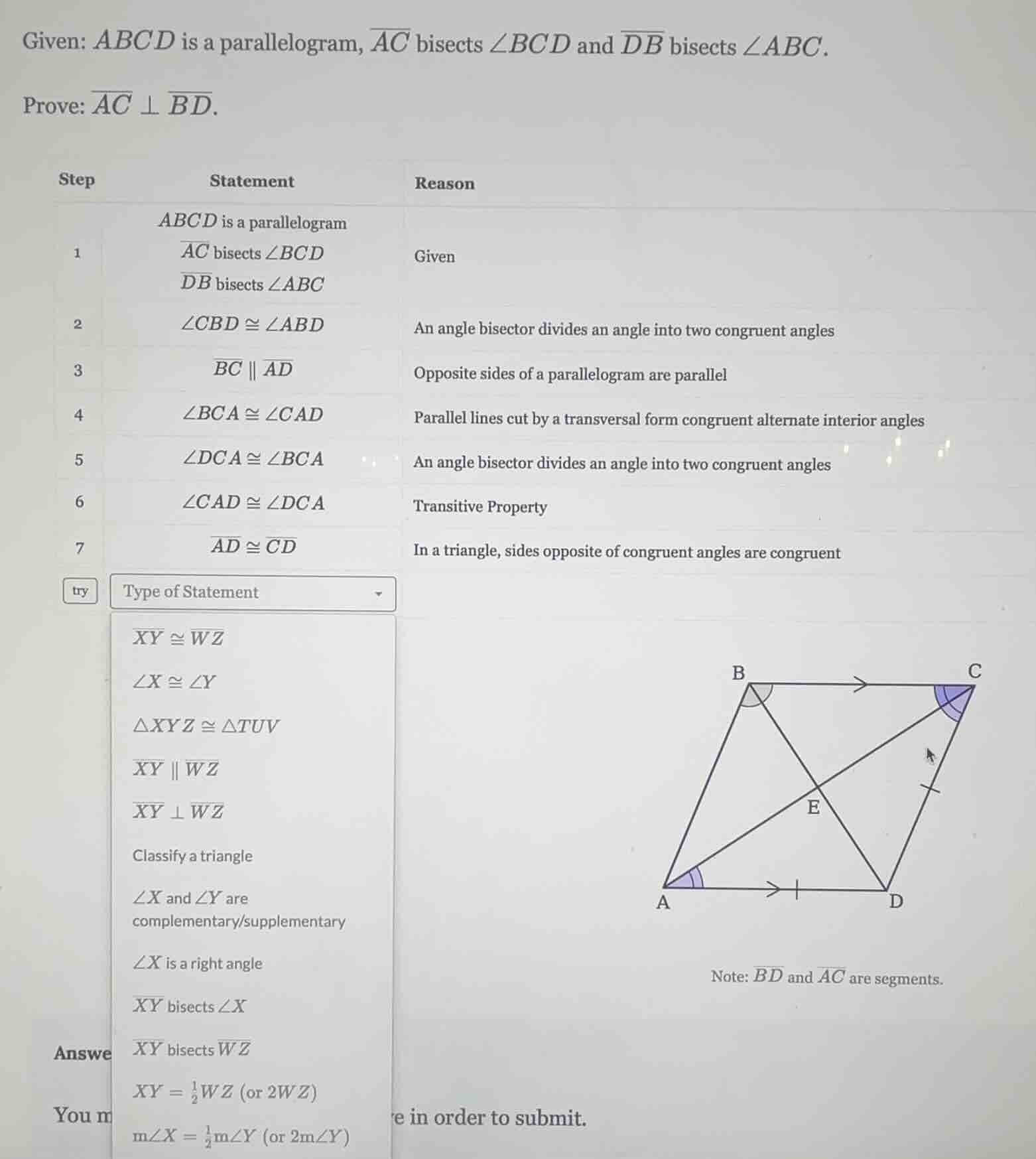
given: abcd is a parallelogram, \\(\overline{ac}\\) bisects \\(\angle bcd\\) and \\(\overline{db}\\) bisects \\(\angle abc\\). prove: \\(\overline{ac} \perp \overline{bd}\\). step statement reason 1 abcd is a parallelogram \\(\overline{ac}\\) bisects \\(\angle bcd\\) \\(\overline{db}\\) bisects \\(\angle abc\\) given 2 \\(\angle cbd \cong \angle abd\\) an angle bisector divides an angle into two congruent angles 3 \\(\overline{bc} \parallel \overline{ad}\\) opposite sides of a parallelogram are parallel 4 \\(\angle bca \cong \angle cad\\) parallel lines cut by a transversal form congruent alternate interior angles 5 \\(\angle dca \cong \angle bca\\) an angle bisector divides an angle into two congruent angles 6 \\(\angle cad \cong \angle dca\\) transitive property 7 \\(\overline{ad} \cong \overline{cd}\\) in a triangle, sides opposite of congruent angles are congruent type of statement dropdown and image of parallelogram abcd with diagonals ac, bd intersecting at e, angle markings at a, b, c note: \\(\overline{bd}\\) and \\(\overline{ac}\\) are segments.
Step1: Establish ABCD is a rhombus
Since $AD \cong CD$ (from step7) and $ABCD$ is a parallelogram, a parallelogram with adjacent congruent sides is a rhombus.
Step2: Use rhombus diagonal property
In a rhombus, the diagonals are perpendicular to each other.

Snap & solve any problem in the app
Get step-by-step solutions on Sovi AI
Photo-based solutions with guided steps
Explore more problems and detailed explanations
$\overline{AC} \perp \overline{BD}$
---
To complete the proof table, the next critical statements/reasons (after step7) would be:
Step8:
Statement: $ABCD$ is a rhombus
Reason: A parallelogram with congruent adjacent sides is a rhombus
Step9:
Statement: $\overline{AC} \perp \overline{BD}$
Reason: Diagonals of a rhombus are perpendicular