QUESTION IMAGE
Question
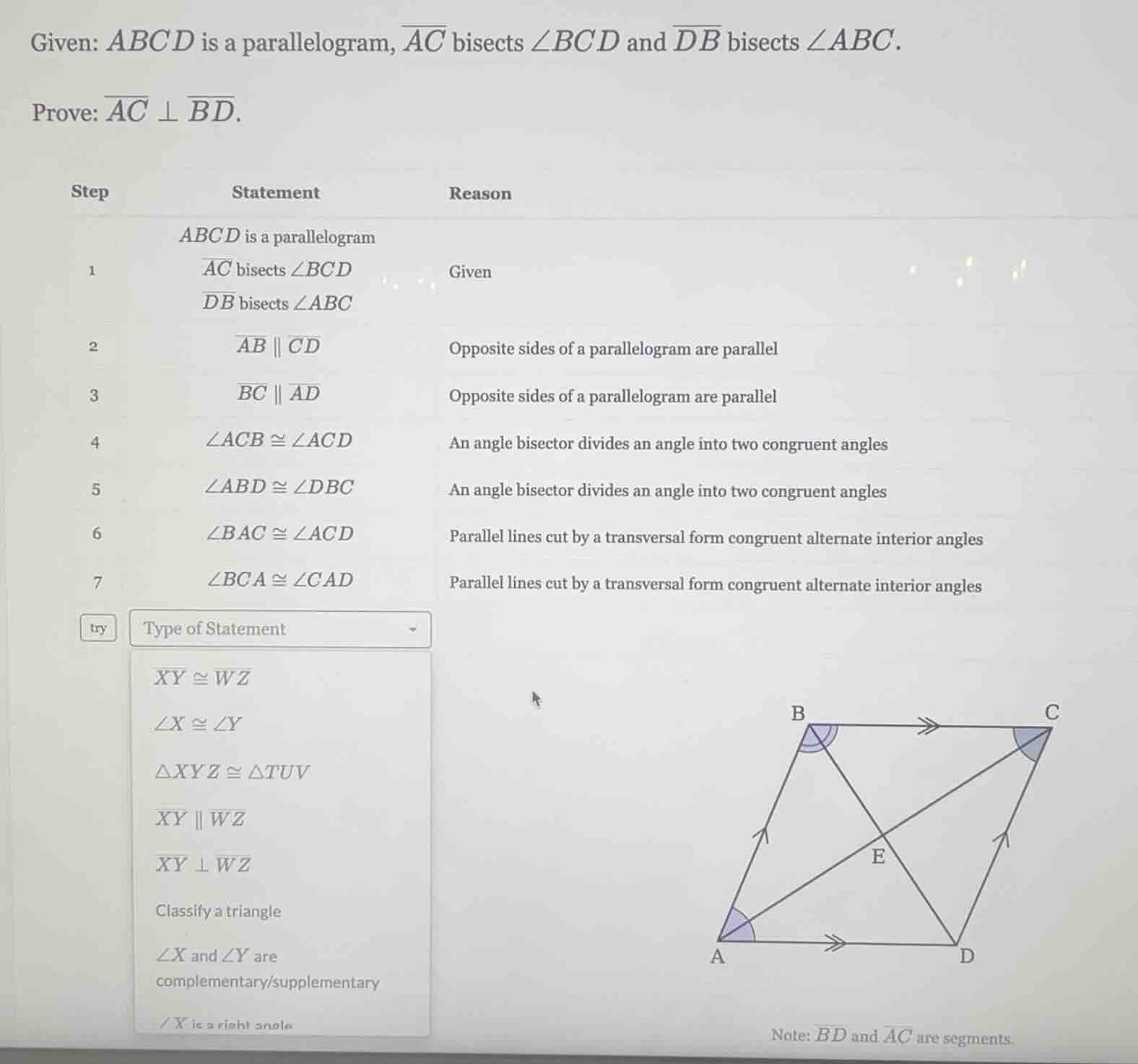
given: abcd is a parallelogram, \\(\overline{ac}\\) bisects \\(\angle bcd\\) and \\(\overline{db}\\) bisects \\(\angle abc\\). prove: \\(\overline{ac} \perp \overline{bd}\\). step statement reason 1 abcd is a parallelogram \\(\overline{ac}\\) bisects \\(\angle bcd\\) \\(\overline{db}\\) bisects \\(\angle abc\\) given 2 \\(\overline{ab} \parallel \overline{cd}\\) opposite sides of a parallelogram are parallel 3 \\(\overline{bc} \parallel \overline{ad}\\) opposite sides of a parallelogram are parallel 4 \\(\angle acb \cong \angle acd\\) an angle bisector divides an angle into two congruent angles 5 \\(\angle abd \cong \angle dbc\\) an angle bisector divides an angle into two congruent angles 6 \\(\angle bac \cong \angle acd\\) parallel lines cut by a transversal form congruent alternate interior angles 7 \\(\angle bca \cong \angle cad\\) parallel lines cut by a transversal form congruent alternate interior angles note: \\(bd\\) and \\(\overline{ac}\\) are segments.
Step1: Congruent angles imply congruent sides
From Step4 ($\angle ACB \cong \angle ACD$) and Step6 ($\angle BAC \cong \angle ACD$), we get $\angle ACB \cong \angle BAC$. By the converse of isosceles triangle theorem, $\overline{AB} \cong \overline{BC}$.
Step2: Identify parallelogram as rhombus
Since $ABCD$ is a parallelogram with adjacent sides $\overline{AB} \cong \overline{BC}$, $ABCD$ is a rhombus.
Step3: Diagonals of rhombus are perpendicular
By the property of a rhombus, its diagonals are perpendicular. Thus, $\overline{AC} \perp \overline{BD}$.

Snap & solve any problem in the app
Get step-by-step solutions on Sovi AI
Photo-based solutions with guided steps
Explore more problems and detailed explanations
$\overline{AC} \perp \overline{BD}$ is proven, as shown in the steps above.